




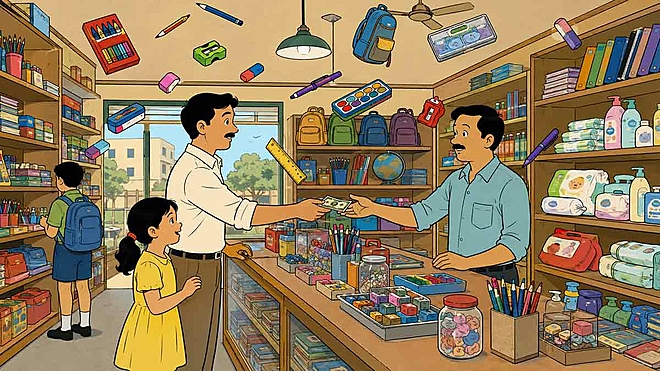
 Anand Kumar/AI-Generated Image

Summary: DOMS Industries sells your everyday stationery supplies. But why is its stock trading at nearly 60 times earnings? We look at the factors that drove the stock’s premium valuation and why the market is willing to pay more for it.
Most IPO (initial public offering) stories begin with excitement. Subscription, listing-day gains, you name it. But once the buzz dies down, the reality is often grim.
In our research on mainboard IPOs between FY22 and FY25, nearly 48 per cent of them delivered negative returns within six months post-listing, while 52 per cent remained in the red after a year. And this is where disappointment usually creeps in.
However, one company has been an exception: DOMS Industries. It sells stationery items such as pencils, erasers, sharpeners, geometry boxes, school bags, notebooks and baby hygiene products. This makes its premium valuation of 60 times trailing earnings even more surprising, as its peers, such as Flair and Linc, trade at far lower valuations of 20 times and 18 times earnings, respectively.
Let’s find out what makes this stationery seller stand out in the competition and why the market is willing to pay a premium for its stock.
From supplier to challenger
India's pencil market was not empty when DOMS arrived. Hindustan Pencils, founded in 1958, turned Nataraj and Apsara into household names. For years, stationery was a parent-led purchase. Parents bought what they trusted.
DOMS entered from manufacturing. Its roots go back several decades, but the brand became visible later. The trademark was registered in the mid-2000s, and Italy's FILA became a partner in 2012, helping with global access and R&D.
DOMS did not win by saying, "We also make pencils." It just made ordinary products more attractive: triangular and groove pencils, neon pencils, polymer pencils, bundled kits. In a low-ticket category, small improvements matter. A pencil only needs to be smoother, brighter or more desirable to a child.
This mattered because buyer behaviour was shifting. Earlier, parents had the final say. Over time, children became more involved in buying decisions, and a child asking for a specific brand can change what a retailer stocks.
How DOMS won over the Indian market
By FY23, DOMS had become the second-largest player in India's branded stationery and art-products market, with about a 12 per cent share by value. In its core categories, the position was stronger: roughly 29 per cent in pencils and 30 per cent in mathematical instrument boxes.
The trajectory is easier to see in the pencil business, where longer numbers exist. Though FY15 category-wise data is not public, DOMS' pencil sales rose from about Rs 204 crore in FY16 to Rs 439 crore in FY23, roughly 12 per cent annually. On estimated market size, DOMS likely held about a fifth of the pencil market around FY16. By FY23, its official share was 29 per cent.
The runway may not stop there. On its Q3 FY26 call, management said it does not track market reports closely, but it would be fair to assume DOMS is now above 35 per cent in pencils, and that with new capacity it could move closer to 45 per cent. This is the company's own estimate, not an independent measure, so read it as a statement of confidence rather than fact. But the direction is clear.
The pattern was never only about pencils. Between FY21 and FY23, sales rose sharply across mathematical instrument boxes, crayons, sketch and marker pens, erasers and exercise books. By FY25, scholastic stationery contributed about 37 per cent of gross product sales and scholastic art material about 22 per cent. Office supplies, paper stationery, kits, combos, and hygiene products formed the next layer of growth. The school business remained the anchor, but it was no longer just a pencil story.
The flywheel
DOMS' model is to win a larger share of the retailer's shelf space. If its pencils sell well, the retailer is more willing to stock its erasers. If those move, colours, geometry boxes, kits and paper products follow. That is a flywheel: more SKUs (stock-keeping units) per outlet, more shelf space, stronger recall among children and higher confidence among retailers.
This is why outlet count alone can mislead. DOMS had more than 5,600 distributors and over 1.45 lakh retailers by FY25, yet Flair and Linc disclose larger networks. DOMS' edge is not the size of the network. It is that its brand, product basket, manufacturing and distribution are all built around one consumer: the school-going child.
Its advantage, in short, is not uniqueness. It is alignment. It moved from a pencil supplier to a pencil challenger to a broader school-consumption brand.
The valuation test
Here is where the story meets its price. DOMS reported FY26 revenue growth of 21.6 per cent to Rs 2,326 crore, but PAT (profit after tax) grew only 12.2 per cent to Rs 240 crore. Earnings growth in the low teens does not, on its own, justify a 60x earnings multiple. The market is assuming PAT growth will reaccelerate as new capacity comes online and newer categories scale.
The capacity is real. DOMS spent about Rs 292 crore on capex in FY26, and its large expansion project could need Rs 850-1,000 crore. At an asset turnover of about 2 times, in line with its current business, that could support Rs 1,700-2,000 crore of additional revenue at maturity. But ‘at maturity’ is the operative phrase. This is not next year's revenue. It is a multi-year execution possibility.
The takeaway
DOMS has made ordinary products look valuable. But a trusted brand that can sell many such products through the same retailer to the same child year after year is not ordinary.
The bigger lesson is this: premium valuations are not paid for past growth. They are paid for the market's belief that the past was only the beginning.
That belief is reflected in the price today. And at around 60 times earnings, it asks DOMS to keep doing all of it at once: grow faster than the industry, defend margins, scale newer categories and hold off larger rivals. DOMS may well deserve a premium. But at this price, the story has very little room to go wrong.
Should you invest in DOMS Industries?
DOMS Industries looks great on paper and partly justifies its high valuation. However, investing in a stock goes beyond valuations and requires an in-depth understanding of the company’s financials, management and track record. And that’s where Value Research Stock Advisor comes in. It provides deeper insights into businesses, giving you expert-led advice on whether a stock is a good next buy.
Subscribe to Stock Advisor today
Ask Value Research 


 New episodes every Friday












 New Process Alert
  Seems like you've uploaded a wrong QR code. Please upload the QR code downloaded from MF Central platform.


