




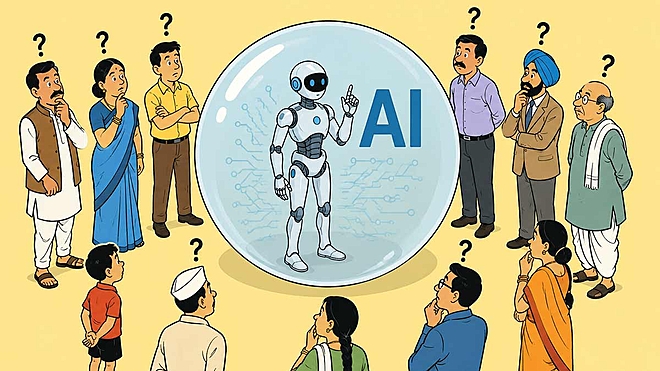
 Anand Kumar/AI-Generated Image


Summary: Everyone wants to know whether AI is a bubble, but that's the wrong question. We explain why bubbles are created by investor behaviour rather than technology, and why building a resilient portfolio matters far more than trying to predict when enthusiasm will end.
Everyone I meet these days wants to know the same thing: Is AI a bubble? My answer tends to disappoint people because the question is not worth answering. Let me explain why.
In the late 1990s, by which time I had already spent some years writing about money, almost everyone I knew was sure that the internet would change the world. What almost nobody saw was that being right about this was close to worthless as a guide to where one should put one's savings, because the companies associated with the internet were priced as though the entire future had already arrived and been paid for. When those stocks collapsed in 2000, the internet did not collapse with them; people used it in ever greater numbers, and the businesses that mattered kept growing. The belief had been right, but the prices were wrong, and the gap between the two was far too wide to be bridged.
Suggested read: AI's trillion-dollar gamble: Growth or bubble?
I was reminded of that gap by an X post from François Chollet, who is about as far from a sceptic as one can find. Chollet created ‘Keras’, a widely used framework for building the kind of AI systems now in the news, devised the benchmark by which the industry measures its own progress towards true machine intelligence, wrote a standard book on the subject and now runs his own research lab in pursuit of it. This is a man who believes in technology as deeply as anyone, which is what makes his argument worth repeating. A thing can be a bubble, he points out, even if the technology works perfectly, even if it has eager customers, even if it is already making money, and even if its future demand is without limit. All a bubble requires is that a lot of people bet on something with too much enthusiasm and then, at some later moment, grow frightened and panic together.
The point that should stay with you is the one Chollet makes almost in passing: a bubble is not a property of the technology at all. It is a property of the people who are buying. In the 19th century, railways were real but also a bubble, and when we say that a bubble has burst, all we are ever saying is that prices fell and money became frightened. We have had our own rehearsals: when the technology stocks of 2000 fell to earth, the better Indian software firms among them were sound businesses that grew for two more decades, yet their shares still lost most of their value and took years to recover. A few years later, before the 2008 crash, it was the turn of infrastructure, power and property. In this case, the bubble lay not in that need but in the prices, and in the fact that many of the companies sold as a way to own the sector were promotions dressed as businesses.
Suggested read: The AI revolution worth having
That means the question everyone is now asking, whether artificial intelligence is a bubble, cannot be answered in advance, because it depends on the future behaviour of millions of nervous strangers. Even the people building it, who understand it better than any commentator, cannot tell you, and the verdict, when it comes, will be visible only in the rear-view mirror.
Suggested read: AI bubble ready to pop?
This is why I would suggest that the question is not yours or mine to solve. An investor who is sensibly diversified, not staking the family's future on a single story, and not trading on each day's headlines, should not bother about how such a drama ends. If a boom continues, such an investor takes part in it; if it ends in disaster, the damage is contained and survivable.
If there is a bubble anywhere in this story, it is not in the technology, and it is not even in the valuations. It is in you: in the temptation to bet more than you should because everyone around you is doing well, and in the panic that will follow when the mood turns. That is the only part of the entire affair you control, and happily, it is also the only part that matters.
Also read: The many worlds of AI
Ask Value Research 

 New episodes every Friday









 New Process Alert
  Seems like you've uploaded a wrong QR code. Please upload the QR code downloaded from MF Central platform.


