




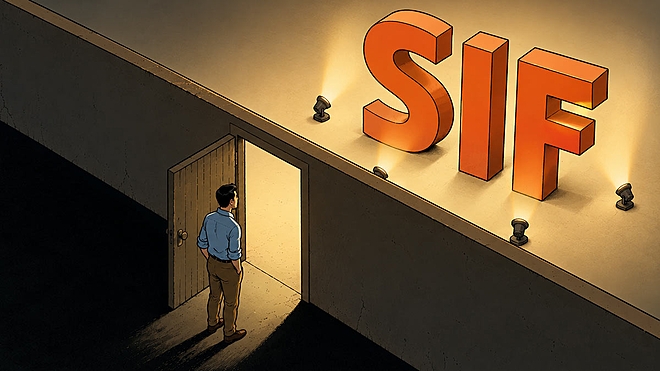
 Anand Kumar/AI-Generated Image


Summary: For years, the products on the other side of the wealth wall asked for Rs 50 lakh before they'd take your call. SEBI has just cut a door in that wall at Rs 10 lakh. Once you can see inside, it's worth asking what was ever so special about what lay behind it.
For as long as this magazine has been published, there has been a class of investment products that most of our readers were never allowed to buy. Portfolio management services (PMS) asked for Rs 50 lakh before they would take your call, and the Category III alternative investment fund (AIF) set its floor at a full crore. These were the products for the wealthy, and part of their appeal was precisely that not everyone could reach them. A gate that keeps most people out creates a certain impression in our minds, suggesting that something worth having lies on the other side and that those who have crossed know something the rest of us do not.
This month’s cover story looks at the Specialised Investment Fund, or SIF, which SEBI has placed at a Rs 10 lakh entry point, a tenth of what the products above it demand. Most coverage of the new category weighs it on its own terms, as our cover story does. But I find the more useful way to read SIFs is as a door that SEBI has cut into a wall that used to have none, because once you can see into the room, it is worth asking what was ever so special about it.
The real answer is that it’s much less than the implied price of admission. Products for the wealthy tend to charge fees with no regulatory limits, and to charge them again as a share of any good year. They carry the harshest tax treatment of anything an ordinary investor can buy, since you pay each time the manager does something, rather than deferring until you sell, as in a normal mutual fund. And the leverage is good for their brochures in a rising market but bad for your portfolio account in a falling one. Most importantly for me, their records, unlike the thousands of mutual fund NAVs anyone can verify, rest on their own statements, with no independent audit behind them.
The product is sold on personalisation, on a portfolio customised for, but that is just the story. SEBI’s own training institute states as much: a manager cannot run a separate portfolio for every client, so a PMS builds a single model portfolio and replicates it across all clients, with individual accounts differing only slightly. There is another thing worth knowing, and it comes not from any manual but from how these products are regulated: an AMC’s better fund managers usually end up on its mutual funds rather than its PMS, because the funds carry the strictest disclosure and the heaviest scrutiny.
However, I don’t see all this as a scandal, because it is not one. This is what happens when scarcity can be priced. SEBI’s stated reasoning for the SIF was that demand for hedged and concentrated strategies had been pushing money toward riskier, less transparent corners, and that a regulated system under fund discipline would serve it better. That is the exception worth granting to the general rule. The genuinely valuable thing behind the wall was never the exclusivity or the leverage, but the ability to hedge and short under proper oversight, and SIFs do deliver that.
Which leaves the reader with a cleaner question than the marketing people would prefer. If you were drawn to these strategies because they seemed to belong to a more sophisticated tier of investor, that instinct was about the tier, not the returns. If you were drawn to them because you have a specific job for a hedged, disciplined strategy that your existing funds cannot do, the SIF now offers a way in at a fraction of the old cost, and that is a real improvement. The difference between those two motives is the whole of the decision. The door in the wall is open now, and what lies on the other side of it, once you stop admiring the wall itself, is simply a tool that only some portfolios need, but most do not. The conclusion is obvious.
Also read: SIFs: SEBI’s new middle child that everyone suddenly likes
Ask Value Research 

 New episodes every Friday










 New Process Alert
  Seems like you've uploaded a wrong QR code. Please upload the QR code downloaded from MF Central platform.


