




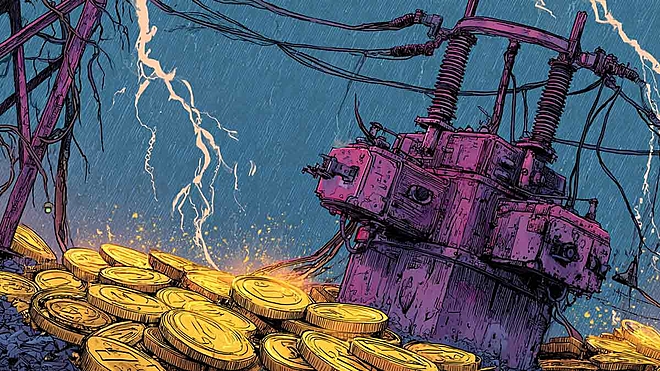
 Vinayak Pathak/AI-Generated Image

Summary: IEX hasn't collapsed. The profits are still there. But one regulatory decision removed the thing that made this business difficult to compete with. What remains is a reasonable company at a reasonable price, and a question the market hasn't answered yet.
IEX has fallen over 30 per cent in the last year. From its 2021 peak, it is down more than 65 per cent. At that peak, investors were paying over 100 times earnings for the stock. Today, they are paying around 24 times.
The business has not collapsed. The profits are still there. What changed is one regulatory decision. And that one decision has rewritten the entire investment case.
What IEX actually does
Think of IEX the way you think of BSE or NSE, except instead of stocks, what gets traded is electricity.
IEX, the Indian Energy Exchange, launched in 2008 alongside a competitor, PXIL, or Power Exchange India. But IEX pulled ahead quickly. It built the deepest pool of buyers and sellers in the market, and depth attracts depth. If you were a serious buyer or seller of power and needed a liquid market, one where large orders could be placed without moving the price, IEX was the only real option. That liquidity advantage was its moat. The thing that kept competitors out.
Market coupling has attacked that moat directly.
What market coupling means, and why it matters
Previously, price discovery happened within a single exchange. IEX's order book, the combined record of all buy and sell bids, was where the electricity price was set. Whoever had the most buyers and sellers set the price. IEX had the most. IEX set the price.
CERC—the Central Electricity Regulatory Commission, India's power sector regulator—changed this. Under market coupling, bids from all exchanges are pooled simultaneously, so price discovery happens across platforms at once. The result: it no longer matters which exchange you trade on. You get the same price and the same depth everywhere.
IEX's liquidity advantage disappears. The moat fills in.
The market understood this immediately. The stock fell sharply, not because the business had broken, but because the structural edge that justified the premium valuation was gone.
The regulatory overhang has not lifted either. In February 2026, the appellate tribunal APTEL, the Appellate Tribunal for Electricity, disposed of a legal challenge, but made clear that the specific regulations under Regulation 39 had not yet been framed. IEX remains free to challenge those regulations once they arrive. The risk has not gone away. It has shifted from an immediate threat to a slower, regulation-led overhang hanging over every quarter.
The case for IEX, with conditions
It is tempting to write IEX off entirely. But the numbers tell a more complicated story.
In FY25, India generated 1,830 billion units of electricity. Of that, only 144 billion units, roughly 8 per cent, were traded through exchanges. IEX held over 75 per cent of that volume.
Now consider what happens if exchange penetration rises to 15 per cent, not an unreasonable assumption given the government's push toward market-based electricity pricing. That takes exchange-traded volume to 274 billion units. Even if IEX's market share falls to 50 per cent—a drop of over 25 percentage points—it would still show volume growth of 27 per cent.
That is the bull case. Penetration growth large enough to absorb significant market share loss and still leave IEX bigger than it is today.
Why the bull case is uncomfortable
The problem is that it rests entirely on assumptions IEX does not control.
Market coupling has levelled the playing field. New exchanges can now enter without the disadvantage of thin liquidity. That barrier no longer exists. Any competitor offering lower transaction fees can compete from day one. IEX built its dominance on depth. Depth is no longer a structural advantage.
The penetration growth the bull case needs is real but uncertain. Renewable energy additions and the gradual shift from long-term power purchase agreements, fixed contracts between generators and buyers, toward short-term trading could both drive penetration higher. But these are policy levers, not business decisions. They sit entirely outside IEX's control.
What to watch
Two variables determine how this story plays out.
First, exchange penetration — is the share of electricity traded on exchanges rising meaningfully? Second, market share — how much is IEX ceding to competitors, and how fast?
These do not move independently. If penetration accelerates while market share holds, the volume math works in IEX's favour. If share loss runs ahead of penetration growth, it does not. At around 24 times earnings, the current valuation reflects neither outcome with certainty.
Stocks like IEX sit in an uncomfortable middle ground. The business is intact, the moat is damaged and the valuation is no longer obviously wrong. Knowing what to do with that kind of ambiguity is harder than it looks. Value Research Stock Advisor tracks exactly these situations, helping you decide whether to hold, exit or wait before the market makes the decision for you.
What the market is waiting for is evidence. Penetration data and competitive dynamics need to show a clear direction before the overhang lifts. Until then, the regulatory risk has not disappeared. It has simply moved further down the road.
Also read: Indian IT's new currency: Cash, not just dividends
Ask Value Research 
 New episodes every Friday









 New Process Alert
  Seems like you've uploaded a wrong QR code. Please upload the QR code downloaded from MF Central platform.


