




 Adobe Stock

Summary: India’s battery storage boom looks obvious. The investment opportunity is not. Understanding the value chain and which players are making crucial bets will tell you where to look.
In our previous story, we argued that energy storage is the missing organ in India’s renewable energy transition. Without it, wind and solar energy that does not always get absorbed by the grid goes wasted. That raises an obvious question for investors: who is actually building this missing piece—and where, within the battery-storage ecosystem, does the real value sit?
A useful way to think about a battery energy storage system (BESS), which stores power and releases it on demand, is as a layered stack. At the bottom sit specialised chemicals and materials. Above that come battery cells, then assembled packs. On top of this sit power electronics and software that allow batteries to interact with the grid. Finally, there are EPC players who stitch everything together on the ground.
We walk up this stack layer by layer, focusing on what Indian listed companies are actually building:
1) Battery chemicals: the quiet foundation
Before a battery cell is assembled, someone must supply the underlying chemistry—electrolytes, lithium salts, cathode powders and binders. This is the least visible part of the value chain, but also one of the hardest to replicate.
Globally, this layer is dominated by Chinese, Korean and Japanese firms. In India, however, several speciality chemicals players are now committing serious capital.
Neogen Chemicals has placed battery materials at the centre of its long-term strategy, planning roughly Rs 1,500 crore of capex for electrolytes and lithium salts. Its LiPF₆ (a lithium salt) joint venture aims to scale from pilot volumes to multi-thousand-tonne capacity.
Gujarat Fluorochemicals, through GFCL EV Products, is building what’s believed to be India’s first fully integrated battery-materials plant in Gujarat, covering LiPF₆, LFP cathodes (positive electrodes in lithium-ion batteries), electrolyte formulations and polymer binders, backed by a $50-million investment from World Bank arm International Finance Corporation.
Acutaas Chemicals (formerly Ami Organics) is adding an annual electrolyte additives capacity of 4,000 tonnes by FY26 at Jhagadia as part of a Rs 250-crore battery-focused expansion.
Himadri Speciality Chemicals is setting up India’s first commercial LFP cathode plant, starting with 40,000 tonnes and scalable to 2 lakh tonnes over five to six years—enough to support roughly 100 GWh (gigawatt per hour) of cell production.
Tata Chemicals has chosen a different route, focusing on lithium-ion recycling to recover cathode materials and metals from spent batteries.
This layer matters because battery-grade chemicals are not basic commodities. The chemistry is complex, approvals are sticky, and once a supplier is qualified, contracts tend to endure.
2) Cells and gigafactories: where the risks pile up
Battery cells are the heart of any storage system—and the part of the stack that most closely mirrors the solar-module race. It is capital-intensive, technologically unforgiving and already dominated by Chinese overcapacity.
Indian players are small in global terms, but several listed companies are committing sizable investments:
Exide Industries is building a 12 GWh lithium-ion cell plant near Bengaluru in two phases, with about Rs 3,600–3,700 crore already invested and trial production targeted by end-FY25.
Amara Raja Energy & Mobility plans up to 16 GWh of cell capacity and 5 GWh of pack assembly in Telangana over the next decade for about Rs 9,500 crore of planned investment. Another Rs 1,200 crore is planned for the initial 1 GWh phase by FY27.
Reliance Industries is constructing a Jamnagar gigafactory targeting 40 GWh initially, scalable to 100 GWh, spanning cells, packs and recycling.
Waaree Energies has earmarked Rs 300 crore for a lithium-ion cell plant alongside its solar operations.
Ola Electric is currently the only advanced chemistry cell-PLI scheme beneficiary with commissioned cell capacity of 1 GWh. It expects its home-battery line alone to consume around 5 GWh per year once scaled.
From an investor’s perspective, this is the most treacherous layer. Chinese cell capacity alone exceeds global demand, prices are falling fast, and technological cycles are short. The upside is large but so is the risk that domestic players end up competing in a brutally oversupplied market.
3) Packs and containers: assembling the hardware
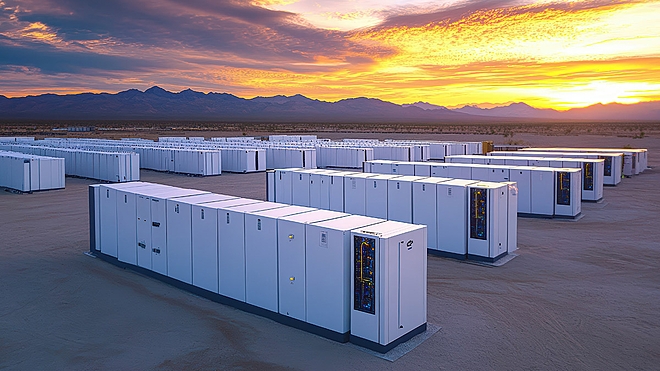
Most grid-scale BESS projects look like rows of shipping containers. These metal boxes house racks of cells, cooling systems, safety hardware and battery-management systems.
This layer does not require beating Chinese battery leader CATL on cell costs. Instead, value comes from integration, safety engineering and project-specific customisation.
Godawari Power & Ispat, through Godawari New Energy, is setting up a 10 GWh BESS integration facility in Maharashtra with about Rs 300 crore of equity raise and a total outlay of roughly Rs 700 crore as it scales up. It intends to buy cells from global or domestic suppliers and integrate them into container systems.
Servotech Renewable Power Systems has partnered with China’s Zhuhai Piwin to locally manufacture modular BESS units with hardware and software technology transfer.
Waaree Energies is moving beyond solar modules into full storage systems, backed by a fundraise of Rs 125 crore and early utility-scale orders.
Oriana Power, traditionally a solar EPC, is building a dedicated BESS vertical with a 2 GWh of pipeline through FY26 and a 20 GWh target by 2030 to offer end-to-end container-plus-controls solutions.
Commercially, this layer will live or die on how quickly system prices track Chinese hardware—and whether Indian integrators can capture value through design, reliability and service rather than just selling metal boxes.
4) Power electronics and software: the brains of storage
A battery without controls is no more than an expensive pile of lithium. Power-conversion systems (PCS), inverters and software determine how a BESS behaves as a grid asset—responding to frequency changes, managing charge cycles and providing ancillary services.
India has no pure-play listed software companies here; intelligence is bundled with hardware:
Hitachi Energy India supplies PCS and digital platforms that combine power electronics with grid-management software.
HBL Engineering provides integrated battery-management systems and control electronics.
Siemens India, GE T&D India and Schneider Electric Infrastructure strong supply automation, protection relays (used to trigger circuit breakers) and SCADA systems (automation platforms for supervision of machines and processes) increasingly paired with BESS.
Much of the high-end software IP still sits with multinationals. But as India’s grid demands more sophisticated services, this layer could quietly emerge as a durable moat.
5) EPC and integrators: putting steel in the ground
Finally, EPC contractors deliver the final storage project to clients after managing the entire lifecycle from initial design, sourcing of necessary components including batteries to physical installation and commissioning.
Larsen & Toubro has emerged as one of the most credible BESS EPC players, with multiple large solar-plus-storage wins. It also has an active presence in standalone BESS tenders.
Waaree Renewable Technologies, not to be confused with Waaree Energies, plays the EPC role for solar-plus-storage projects using hardware from its own storage arm or third-party suppliers.
This is a familiar business: scale, execution and balance-sheet strength matter most. As tenders standardise, margins here are likely to drift towards solar-EPC levels.
So where does value creation lie for investors?
Two powerful forces are colliding in battery storage. First, prices are collapsing. Lithium-ion pack prices have fallen sharply due to Chinese overcapacity and cheaper raw materials. Chinese planned capacity now runs into multiple terawatt-hours—far more than global demand.
Second, India’s deployment remains uneven. While over 80 GWh of BESS has been tendered since 2021, actual commissioned capacity is a fraction of that at 500 MWh, with cancellations rising. Recent bids as low as Rs 1.5 per kWh of storage suggest intense overcrowding, ultra-thin margins and the risk of compromised safety.
The takeaway is not that storage is unattractive but that the industry is still in its churn phase. Across the value chain, capacity has arrived faster than discipline. History suggests that this phase does not last forever. As prices stabilise, weaker balance sheets strain and execution begins to matter more than ambition, consolidation will follow. And it is only after that shake-out—across cells, systems and services—that the true long-term winners in India’s battery-storage ecosystem are likely to emerge.
At Value Research Stock Advisor, we have been tracking this space closely. Within the noise, two companies stand out for their balance-sheet strength, capital discipline and ability to withstand a prolonged shake-out. They are best positioned to survive consolidation and potentially gain from it.
Also read: This may be the moment to look at beaten-down renewables
This article was originally published on December 16, 2025.
Ask Value Research 

 New episodes every Friday









 New Process Alert
  Seems like you've uploaded a wrong QR code. Please upload the QR code downloaded from MF Central platform.


