




 Aprajita Anushree/AI-Generated Image


Summary: “Which fund should I buy?” is often the wrong first question. This piece looks at why investing without fixing basics can sabotage long-term wealth.
“Is it okay to invest if my finances aren’t perfect yet, or should I fix everything first?”
Most people don’t come to me saying, “My financial life is a mess, please help.”
They say, “Sir, bataaiye, kaunsa mutual fund theek rahega?”
Two minutes later, it turns out they have a chunky credit card balance, no proper emergency fund, hardly any health insurance, and sometimes a personal loan on top of a home loan. But the main worry is still, “Large cap ya flexi cap?”
That’s like arguing about wall colour when the house doesn’t have a roof.
There is a sequence to getting your money life in order. Think of it as building a foundation before you add fancy floors. First, you protect yourself from shocks; then you fix the most expensive leaks; and only then do you worry about chasing higher returns. At Value Research, whenever we look at a real person’s finances, we follow that order.
Let’s start with the least glamorous part: debt. If you are carrying credit card balances or personal loans at 24–36 per cent interest, and at the same time starting an equity SIP hoping to earn 11–12 per cent, the arithmetic is against you. You are paying 30 per cent to earn 12 per cent, maybe. That’s not smart investing; that’s wishful thinking dressed up as discipline.
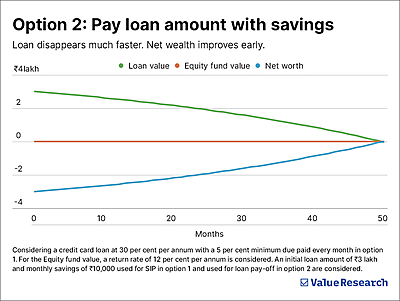
Imagine you have Rs 3 lakh of credit card or personal loan debt at around 30 per cent a year. You also have Rs 10,000 per month to spare. One option is to pay only the minimum due and invest the Rs 10,000 in an equity fund SIP. The other path is to throw Rs 10,000 at the loan every month until it dies, and only then start investing.
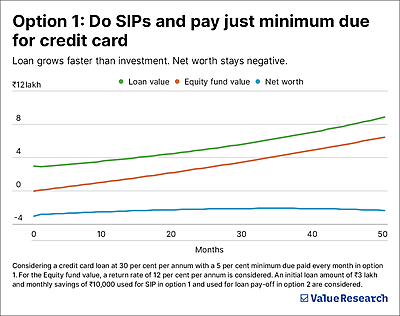
In most realistic scenarios we run at Value Research, the second path wins clearly. Every rupee of high-interest debt you repay is a guaranteed, tax-free return. You will not find a mutual fund that offers that combination.
The second quiet problem is the lack of a safety net. A lot of people start SIPs enthusiastically with no emergency fund and barely any health insurance. They are “long-term investors” right up to the point when life happens: a job loss, a medical issue, a family emergency. With no buffer, they are forced to redeem their “long-term” equity at exactly the wrong time. They walk away saying “mutual funds are risky”, when the real risk was that there was no cushion between life and the market.
When we talk to investors at Value Research, we ask unglamorous questions like “for how many months can you run your household if your income stops tomorrow?”
So what does the “right order” look like in plain language?
First, you slowly build an emergency fund of three to six months of essential expenses in a safe, liquid place—savings plus a liquid or ultra-short-term fund is fine. This money is not there to impress anyone with returns; it is there so you don’t have to blow up your investments every time life throws a surprise.
In parallel, make sure you have basic health insurance and a plain-vanilla term life insurance policy if your family depends on your income. Only after that do you attack and reduce expensive debt as aggressively as possible. Once those three pieces are in decent shape, your SIPs into equity or hybrid funds suddenly start making sense—because they’re no longer fighting emergencies and 30 per cent interest. So the order is pretty simple:
- Start with an emergency fund of 3-6 months of expenses
- Ensure you have adequate health and life (term) insurance
- Clear all high-cost loans, such as credit card debt
- When these three are done, you can shift your focus towards SIPs and long-term investing
Of course, there is a practical objection here: “If I wait to fix everything, I’ll never start.” That’s fair. Your finances may never be picture-perfect. You can start a small SIP while you’re still building your emergency fund, as long as you’re not drowning in high-cost debt. You can invest while paying a home loan, because a home loan at a reasonable rate is a different animal from a credit card. The key is not to fool yourself: don’t proudly say “I’m investing for my future” while brutal interest rates are eating a large chunk of your present.
There is another very real constraint: some people simply cannot afford a full retail term plan and a decent family floater health policy yet. If that is your situation, don’t give up and wait for some perfect day. At the very least, use the basic safety nets the government has already put in place.
For life cover, there is the Pradhan Mantri Jeevan Jyoti Bima Yojana (PMJJBY). It’s a very simple, government-backed term insurance policy that provides Rs 2 lakh of life insurance for a small annual premium, auto-debited from your bank or post office account.
For hospitalisation, if your family falls within the eligible category, Ayushman Bharat (AB-PMJAY) provides up to Rs 5 lakh per family per year of cashless treatment at empanelled hospitals. You don’t pay premiums; the government does. It is not fancy, but for crores of Indians, it is the difference between treatment and debt.
At Value Research, we like talking about funds, categories and returns, but underneath that, our real job is more basic: making sure you don’t build a glass palace on a cracked foundation.
First, put on the roof. Then we can argue, in great detail, about which colour to paint the walls.
This column was originally published in The Times of India.
Also read: Don’t let FOMO hijack your money
Ask Value Research 

 New episodes every Friday










 New Process Alert
  Seems like you've uploaded a wrong QR code. Please upload the QR code downloaded from MF Central platform.


