




 Aditya Roy/AI-Generated Image


Summary: When everyone around you is suddenly a stock-market genius, FOMO hits hard. This piece breaks down why chasing “hot” ideas hurts real returns and how to stay sane when the noise gets loud.
You don't need CNBC to know when markets are doing well. You just need to attend a wedding.
Suddenly, the cousin who never replied to your messages is giving stock tips. The uncle who used to discuss blood pressure is now discussing small caps. Your office WhatsApp group is half jokes, half profit screenshots. And there you are, sitting with your boring SIP or even more boring FD, wondering, "Am I the only idiot not making easy money?"
That sinking feeling has a modern name: FOMO – fear of missing out. In real life, it usually means "other people are sounding smart, and I am quietly doubting myself."
The first thing to understand is this: people talk loudly about gains and very softly about losses. You will always see the screenshot where they bought it at Rs 100, and it went to Rs 150. You will rarely see the one where they bought it for Rs 150, and it went down to Rs 80. Social media is not a portfolio statement; it's a highlight reel.
When we dig into the numbers at Value Research, a clear pattern emerges: categories become popular only after a strong rally. Money doesn't anticipate performance; it chases it. This behaviour shows up across the market, and infrastructure funds offer one of the clearest recent examples.

Now, let me introduce two imaginary investors whom you have definitely met in real life: Rohan and Meera.
Rohan is the classic FOMO investor. He hears from colleagues and relatives about a "star" small-cap or sector fund. He opens his app, sees a fantastic one-year return, feels a mix of jealousy and excitement, and immediately shifts a big chunk from his simple diversified fund into this hot new idea.
Meera is the boring one. She started an SIP in a sensible, diversified fund three years ago. She has heard about the same hot fund. She's tempted for five minutes, shrugs, and carries on with her existing plan.
Now freeze the frame there and fast-forward four years.
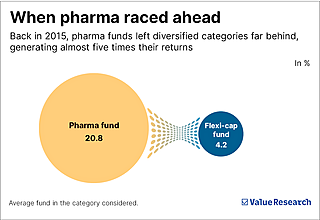
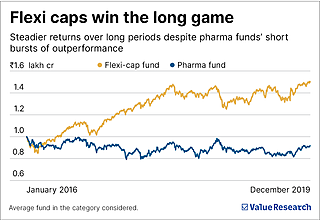
The punchline is boring but important: Rohan felt up to date and clever; Meera felt outdated and dull. But Meera's money quietly did better. This is not just a story; it's what we repeatedly see in data. When we calculate "investor returns" – what the average investor actually earns – versus "fund returns" – what the fund delivered over time – there is often a gap. A big reason is FOMO-driven timing: people enter late, after a good run and lose patience in the next rough patch.
Why is FOMO so powerful? First, we hate feeling like the odd one out. When everyone is in some small cap, IPO or crypto, and you're not, it feels like a mistake, even if your own plan is perfectly fine. Second, our brains are hard-wired to chase recent performance. That shiny one-year return number in fund tables is like a plate of jalebis: you know too much is bad, but your hand still goes there. Third, we confuse repetition with truth. The more you hear about a fund or theme on TV, YouTube and WhatsApp, the more "obvious" and "safe" it starts to sound.
At Value Research, our job is to be slightly boring in the middle of this drama. We look at rolling returns over long periods, not just last year. We look at how a fund behaves in crashes, not just in bull markets. We compare it against its index and peers, and we look at the risk it took to get those numbers. When you do that, many hot ideas look less impressive.
So, how do you live in a FOMO-heavy world without becoming a hermit?
The first step is to ask a very simple question: Am I building a portfolio for my goals, or for other people's conversations? Your child's college fees don't care what your colleagues bought last month. Your retirement doesn't care about your brother-in-law's multibagger story from 2017. FOMO is about their story; personal finance is about yours.
The second step is to accept that you are human. If you really can't resist the urge to experiment, don't pretend you're above it. Instead, put it in a box. Decide that a small portion of your money – say, 5 per cent to 10 per cent of your equity allocation – is your "mad money" corner. That is where you are allowed to do all the exciting things: themes, sectors, IPO punts, the fund your cousin won't stop talking about. The remaining 90 per cent to 95 per cent should stay in a boring, well-constructed plan aligned to your goals and risk capacity. That way, your experiments can go wrong – and many will – without setting fire to your future.
The third step is to zoom out. Instead of obsessing over the latest one-year return, look at full cycles of seven to 10 years.
Sectoral funds shine briefly, flexi caps endure
Flexi-cap funds have delivered steadier returns in longer run with milder dips
| Category | Average 1Y return | Average 5Y return | Average 7Y return | Minimum 1Y return |
|---|---|---|---|---|
| Sectoral-Banking | 13.1 | 10.5 | 11.2 | -46 |
| Sectoral-Infrastructure | 16.9 | 12 | 10.1 | -38.2 |
| Thematic-Energy | 17.4 | 13.7 | 12.2 | -35.8 |
| Flexi Cap | 14.4 | 13.4 | 12.9 | -30.3 |
| Average fund in the category considered. Data based on a 1,5 and 7-year rolling basis from 2015 to 2025. | ||||
When we analyse funds this way at Value Research, the quiet, steady ones look a lot more attractive. Not because they top every table, but because they let you stay invested.
Here's a simple rule you can keep in mind the next time a fund or stock comes up at a party: if I hear about it from five different people at once, I am probably late. That doesn't mean it's automatically bad. It just means your decision should come from your plan, not your FOMO.
You don't have to attend every party the market throws. One or two small parties are fine. But the real wealth is built by showing up for the long, slightly boring, reliable relationship – not the latest exciting fling.
This column was originally published in The Times of India.
Also read: Take a leap of faith
Ask Value Research 

 New episodes every Friday




 New Process Alert
  Seems like you've uploaded a wrong QR code. Please upload the QR code downloaded from MF Central platform.


