
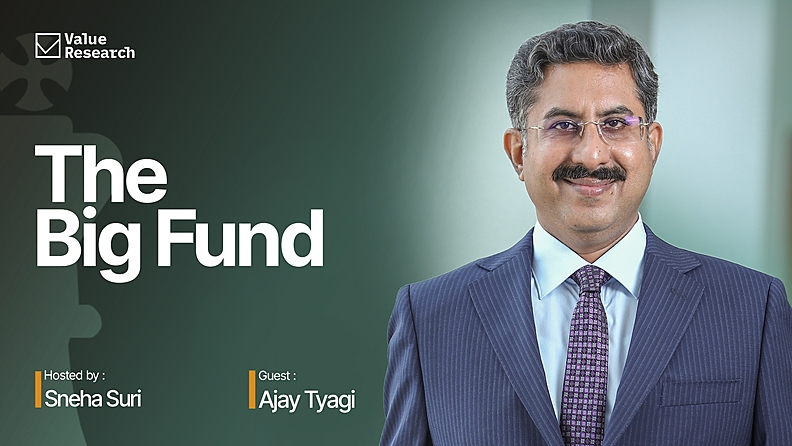
30-Sep-2026 | Sneha Suri

Ajay Tyagi trusted quality. The cycle has started to agree.
After four lean years, the manager of UTI Flexi Cap explains why he never changed course, and what investors should expect next.
Four calendar years. Four years behind the BSE 500. The worst came in 2022, when UTI Flexi Cap fell about 13 per cent while the index rose about 5 per cent. Most managers would have tinkered. Ajay Tyagi held firm.
Tyagi, Head of Equities at UTI AMC, has run the fund since January 2016. When we sat down with him, he started where he always does: with the process.
UTI Flexi Cap is a quality fund, and it stays one. Tyagi buys businesses with high returns on capital, strong cash generation, stable margins and long runways of growth. That filter draws him to consumption, healthcare and technology. It keeps him out of metals, energy, construction and public-sector companies. For four years, those cheaper, cyclical corners led the market. The fund sat them out.
"The style factor has been against us," he says. He has no plans to switch. Styles move in cycles, and this dry spell for quality has run longer than any in the 20 years of data his team tracks. He expects the pendulum to swing hard the other way.
Signs of a turn
The fund is ahead of the BSE 500 this year for the first time since 2021. Tyagi refuses to celebrate yet. Six months of outperformance means little on its own, he says. It must feed into one-year numbers, and then into three-year numbers.
The portfolio's lean is clear. Consumer services and consumer durables together form his biggest bet. Income-tax cuts and GST rationalisation have put money back in household pockets, and he sees spending picking up. Healthcare is another large overweight. He points to a diagnostics holding whose margins today sit above their pre-competition levels. For Tyagi, that's quality under pressure.
Since 2021, he has moved steadily from the largest IT companies to mid-tier ones. Sheer size, he says, makes mid-teen growth hard for the giants. He sees AI as a net positive over time, because enterprises will need system integrators to fit new models into old systems.
New-age holdings, old rules
Why does a quality fund own internet companies that were loss-making until recently? Tyagi's answer lies in the accounting. New-age firms expense their spending at once, while older firms spread capex over years. So he checks whether a business is profitable in its established markets. If it is, the rest can follow. He applied that test to a food-delivery and quick-commerce holding in 2021, and says the script has played out.
His exit rule is equally simple. A stock leaves when either reason for owning it fails: quality or growth faster than the market's earnings. Slowing growth ended a long-held position in a large IT company.
The lesson
Kamal Gada joined him as co-manager in April 2025, and Akash Shah joined in January 2026. Tyagi still pulls the final trigger. A central team of 16 analysts covering about 475 stocks serves all eight UTI fund managers.
His biggest lesson from a decade in the seat is about investors. Fund houses, he says, should warn of dry spells while performance is strong. For those who have already waited four years, his message is plain. This is the wrong moment to leave.
Other Videos


Indian funds down. Go abroad?
· 1,064 Views


Rebalancing too often? Watch this.
· 4,125 Views

One simple plan for every age
26-Sep-2026 · 63,712 Views

What Small Caps Actually Pay You For
25-Sep-2026 · 1.3 Lakh Views

Direct funds. Who watches your mix?
· 1,916 Views

The fund that missed 2025 and came back stronger
· 5,792 Views

When is your fund an exit?
· 12,578 Views

The first SIP at 40: what 20 years can still build
18-Sep-2026 · 2.3 Lakh Views

₹1.8 crore, retiring in 2 years. Exit equity?
· 5,331 Views

When the buyer is also the seller
· 8,768 Views

Aggressive Hybrid VS Balanced Advantage Funds
11-Sep-2026 · 61,005 Views

Are debt funds taxed as FDs now?
· 3,784 Views



 New Process Alert
  Seems like you've uploaded a wrong QR code. Please upload the QR code downloaded from MF Central platform.


