




 AI-generated image
Summary: For years, passive investing in India effectively stopped at large caps. Investors who wanted a fully indexed portfolio still had to rely on active funds for mid- and small-cap exposure. That gap has finally closed. With a new wave of ETFs now covering every major segment, it’s possible to build an entire equity allocation passively — provided the mix matches your risk profile. This article breaks down how aggressive, balanced and conservative investors can construct complete ETF portfolios, the role of global exposure and how allocations should evolve with age.
For the longest time, exchange-traded funds (ETFs) were little more than a convenient way to own large caps. With most active large-cap funds struggling to beat the benchmark, investors naturally warmed to indexing. But beyond large caps, those who wanted to stay fully passive had little to choose from. Mid- and small-cap exposure still had to be hunted through active funds because index ETFs in those segments simply didn’t exist.
That has changed meaningfully in recent years. With new ETFs launched across market segments, investors can now build a complete, diversified and risk-aligned portfolio using ETFs alone, without relying on active fund selection.
Of course, the mix still matters. A poorly aligned equity allocation can undermine outcomes even in a passive strategy. Thus, our framework below lays out how investors can construct ETF portfolios across three risk profiles: aggressive, balanced and conservative.
For the aggressive investor
An aggressive investor is essentially someone prepared to take on volatility in pursuit of higher returns. For them, mid-and small-cap index ETFs can unlock a fully passive path to higher-growth segments.
In the last 15 years, small caps have delivered as much as 38 per cent annually over five-year rolling periods, while mid caps have given around 35 per cent. But these segments can also fall sharply. While large caps haven’t declined in any rolling five-year periods, small caps have given negative returns around 8 per cent of the time.
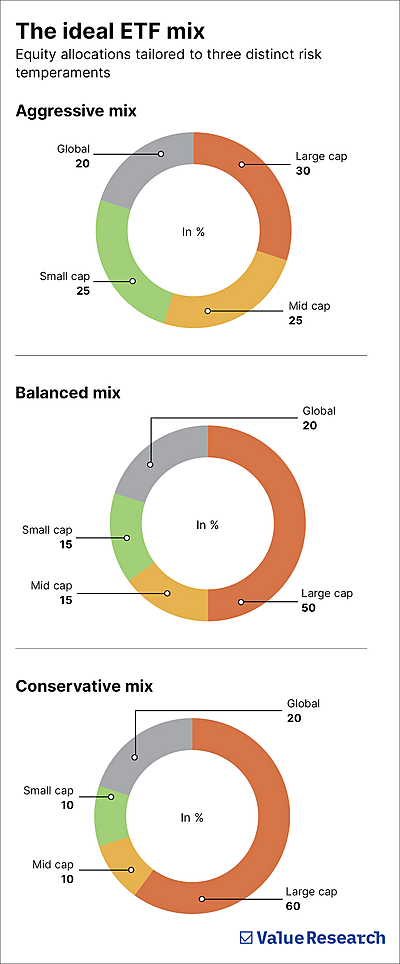
An aggressive portfolio can be anchored around 30 per cent in large caps while placing nearly half of its weight – 25 per cent each – into mid- and small-cap ETFs. A final 20 per cent in global ETFs can add a useful layer of diversification beyond domestic markets.
For the balanced investor
A balanced investor is someone who wants growth but also prefers a stable portfolio. They are willing to compromise on returns for that stability. Here, the portfolio should have a higher weightage towards large caps – about 50 per cent – while mid- and small-cap ETFs should be present in lower proportions, at roughly 15 per cent each. This preserves return potential without letting volatility dominate.
A consistent 20 per cent global allocation can strengthen the portfolio’s resilience here as well. Since global markets often move differently from Indian equities, this slice helps smooth the return profile, an advantage particularly meaningful for balanced investors who value steadier compounding.
For the conservative investor
A conservative investor typically aims for returns above inflation or a corporate bond, without taking on much equity risk. Stability is the priority. This requires high large-cap exposure, as it is the least volatile segment.
A conservative ETF mix should lean heavily on large caps – 50-60 per cent – to provide a sturdy anchor. Mid- and small-cap exposure should be up to 10 per cent each – enough for participation, not enough to destabilise the portfolio.
A 20 per cent global allocation can complement this setup, adding diversification. Some investors can even allocate a small portion to gold ETFs, which have historically cushioned portfolios during market stress. Together, these elements can create a steady portfolio that stays true to a conservative temperament.
The need for rejigging the mix with age
Risk appetite isn’t the only determinant of allocation; age often decides both the capacity and need for risk. Investors in their 20s and early 30s have decades ahead of them. They can comfortably weather sharp corrections in mid- and small-cap segments because time smoothens volatility. For them, aggressive or aggressive-leaning allocations are not just tolerable, they’re often beneficial.
But as investors enter their 40s and 50s, the runway shortens. Goals draw nearer, income stability takes precedence, and the ability to recover from prolonged drawdowns shrinks. At this stage, an overly aggressive mix, particularly one with more than 60 per cent in mid and small caps, can jeopardise their long-term plans instead of accelerating them.
A practical approach is to adjust the allocation by about 10 per cent depending on age, proximity to financial milestones and the stability of cash flows. Portfolios must evolve with life, not remain frozen in a younger self’s risk appetite.
A few realities to keep in mind
Going completely passive with an ETF-based portfolio makes investing simpler, but not flawless. A few caveats matter:
- Going fully passive means giving up potential extra returns that skilled active managers can still generate, especially in small caps, where market inefficiencies remain high.
- Liquidity thins out beyond large caps. In mid- and small-cap ETFs, investors may face difficulty in both entering and exiting.
- Tracking errors also rise outside large caps, meaning ETF returns may deviate noticeably from the index they are designed to mirror.
- Global ETFs are subject to overseas investment caps, which have pushed many of them to trade at premiums to their net asset value (NAV) due to a demand-supply gap.
The case for an all-ETF portfolio
Despite the caveats, the appeal of an ETF-only approach is undeniable. It eliminates the need to track fund managers, decipher investment styles or react to strategy shifts. Investors instead focus on asset allocation – the true driver of long-term outcomes.
India’s ETF market is maturing rapidly, with improving liquidity, tighter spreads and a growing list of products across market caps and asset classes. As scale builds, tracking errors should fall further.
For those seeking a clean, disciplined, low-maintenance investment journey, ETFs offer a simple yet powerful blueprint – one that keeps the focus on what actually builds wealth over time: allocation, patience and consistency.
This article was originally published on December 01, 2025.
Ask Value Research 










 New Process Alert
  Seems like you've uploaded a wrong QR code. Please upload the QR code downloaded from MF Central platform.


