




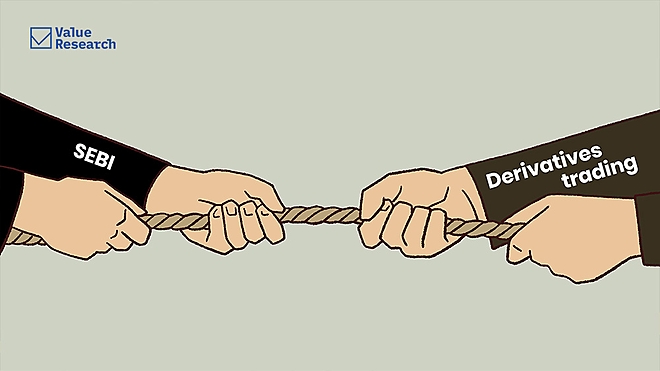
 Illustration: Anand Kumar


As everyone interested in the equities market would know by now, regulator SEBI has developed a spate of measures in how derivatives trading is done. These measures are designed to... to what? Well, the circular released by the regulator says, "to strengthen the equity index derivatives framework." By itself, that's a say-nothing legalistic kind of statement.
However, the context in which these measures have been announced makes the goal quite clear. Let's put it quite bluntly: Individual traders in index options are making massive losses. They are being robbed blindly by the cabal of exchanges, brokers, and large institutional entities conducting automated algorithmic trading.
This context is clear from the release of its second report on derivatives trading just a few days ago. The original report famously told us that "89 per cent of the individual traders (i.e., 9 out of 10 individual traders) in the equity F&O segment incurred losses, with an average loss of Rs 1.1 lakh during FY22...". The follow-up report, based on data from three financial years, FY22, FY23, and FY24, shows that the headline conclusion is the same. Some 91 per cent of traders lost money in FY24, too.
However, the details are truly damning and highlight the regulatory challenge. Consider this: Individuals made losses in F&O, and the FPIs and Proprietary traders earned profits. Proprietary traders earned about Rs 33,000 crore of gross profits in the F&O segment in FY24, followed by FPIs, who earned about Rs 28,000 crore in gross profits. Individuals and others incurred a loss of over Rs 61,000 crore in FY24. Algorithmic trading outfits made the most profits for FPIs and Proprietary traders. Ninety-seven per cent of profits of FPIs and 96 per cent of profits of Proprietary traders came from such entities in FY24.
What does this prove? Simply put, the market is completely biassed against the individual. If the losses were better spread among small and large, manual and algo traders, then the regulatory challenge would have been different or even non-existent. Given that derivatives trading is a zero-sum game, the above simply means that one class of traders are taking away money from the other.
Suggested read: India's gambling industry
Given the context of the report and the data, the goal of the changes can be understood quite clearly. These changes include increased contract sizes, where the minimum trading amount for derivatives will rise to Rs 15 lakh. To address high volatility on expiry days, SEBI will implement an additional 2 per cent extreme loss margin (ELM) for all open short options on the day of expiry. Brokers must collect option premiums upfront, discouraging excessive intraday leverage among investors. To reduce speculative trading, calendar spreads for contracts expiring on the same day will be eliminated. Stock exchanges will begin intraday monitoring position limits for equity index derivatives, checking limits multiple times throughout the trading day. Finally, SEBI will reduce the weekly expiries for index derivative contracts to just one benchmark index per exchange.
Broadly, these changes aim to do three things: First, they discourage very small investors who do not have adequate funds from trading derivatives at all. Second, they sharply reduce leverage, which is a fancy way of saying that traders should be prevented from punting with borrowed money. Third, they reduce volatility and trading of certain kinds at excessively volatile periods like expiry days.
What has yet to be said is that trading during excessively volatile times is especially advantageous to algo traders. Machines and software can react to price and volume changes on a sub-second basis, but humans cannot. During such phases, the wealth transfer from the small to the large flows the strongest.
Will these changes work? Will the implicit goal of reducing the skew against the small trader be achieved because that's the gauntlet that SEBI has thrown down to itself? Honestly, I'm less than hopeful. Given the zero-sum nature of this market, all profits have to come from someone else's losses, and it's hard to see small traders not losing.
The ideal outcome would be a sharp reduction in the number of retail traders who enter this casino. Let the algos fight it while the real savers do the real investing.
Also read: Retail investors and the derivatives trap
Ask Value Research 

 New episodes every Friday









 New Process Alert
  Seems like you've uploaded a wrong QR code. Please upload the QR code downloaded from MF Central platform.


