





We recently stumbled upon a fascinating observation while experimenting with our all-new Stock Ratings tool. Looking at the companies rated five or higher across quality, growth and valuation in FY14, we realised they were all banks!
But what was even more surprising is that Yes Bank and PNB (Punjab National Bank) had received a stock rating of five back then.
Why is it surprising? Over the last few years, Yes Bank and PNB have eroded shareholders' wealth, causing their stock ratings to diminish to just one.
What happened to these banks? Let's have a look.
Yes Bank: The one with the shenanigans
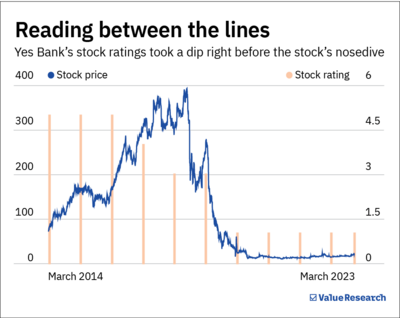
Touted as the next HDFC, Yes Bank was on a high till FY18, delivering the best-in-class results. Yet, its glory days did not last long, as the RBI (Reserve Bank of India) found that the bank was underreporting its NPAs (non-performing assets). Once Yes Bank was brought under scrutiny, its ballooning NPA numbers came out, causing its financials to tumble with the bottomline turning red.
The beleaguered bank further found itself in trouble when Rana Kapoor, the MD and CEO, was found guilty of money laundering and taking bribes. Moreover, Kapoor's once successful formula of lending to risky companies at high interest rates affected the bank's share price, which fell by 72 per cent in the last 10 years, dwindling to its 2005 IPO stock price. What's more, our Stock Ratings tool had started to show the signals with its stock rating dwindling since FY17.
Punjab National Bank: The one conned by a diamond merchant
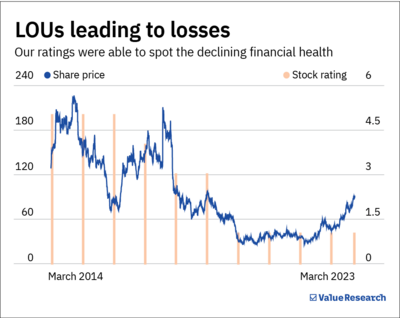
PNB was already struggling when it realised that several LOUs (Letter of Undertakings) were issued to Nirav Modi through the international payment system SWIFT (Society for Worldwide Interbank Financial Telecommunication) without any record in its internal systems.
Initially, the total value of the LOUs was assumed to be around Rs 280 crore. However, the actual figure was reported to be Rs 14,000 crore. It turned out to be India's biggest banking fraud to date, and PNB recorded the highest loss ever by an Indian bank till Yes Bank took over in FY20.
Owing to its poor performance, PNB's stock has delivered a negative return of 28 per cent in the last 10 years. Even after a jump in the share price since 2022, there hasn't been a significant improvement in its returns.
Worsened woes
Net profit declined while NPAs balloned
| Yes Bank (FY14) | Yes Bank (FY23) | PNB (FY14) | PNB (FY23) | |
|---|---|---|---|---|
| Net profit (Rs cr) | 1611 | 736 | 3535 | 3069 |
| GNPA (Rs cr) | 175 | 4395 | 18880 | 77328 |
| GNPA is gross non-performing assets | ||||
Present-day scenario
PNB has provided for most of its bad loans like many other public sector banks and shows signs of improvement. However, its GNPA (gross non-performing assets) remains high.
On the other hand, Yes Bank has yet to see the light of the day. The bank is yet to recover the payment for the bad loans it sold to an ARC (asset reconstruction company) owing to various factors.
It is suggested that you exercise caution and do your due diligence before investing in these banks' stocks.
Investors' corner
The above exercise highlights how our stock ratings can help investors avoid market euphoria and make better investment decisions. Our ratings successfully revealed the declining financial health of these banks, as shown in the graph above (see graph "Reading between the lines" and "LOUs leading to losses").
In short, regardless of the sector or company, an unbiased analysis is paramount. Our stock ratings aim to stray investors away from such ailing business and avoid hype and market noise.
Also read: What matters more for banks?
Ask Value Research 

 New episodes every Friday











 New Process Alert
  Seems like you've uploaded a wrong QR code. Please upload the QR code downloaded from MF Central platform.


