
Powered by
Investors' Hangout | 22-May-2026 | Value Research

You feel safe when prices are already high.
Every crisis since 1991 looked unsurvivable at the time. The Sensex recovered from the 2008 crash in about 18 months. This one may take longer. Your SIP does not need to know when.
Should you continue your SIP when this crisis feels genuinely different?
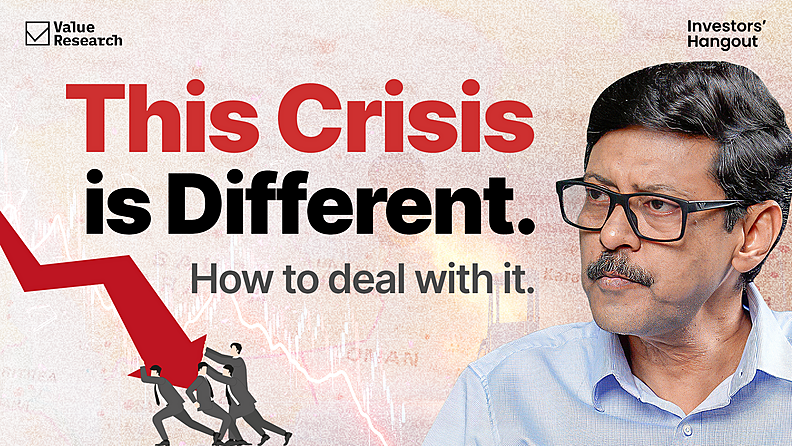
Why This Crisis Is Different and What to Do with Your SIP
For the first time in 30 years, Dhirendra Kumar said he is alarmed. That one sentence triggered hundreds of reader responses and a question that would not go away: if even he is worried, should I keep my SIP running? This page gives you the full answer, including why this disruption carries a different economic weight than any crisis since 1991 and exactly what each type of investor should do right now.
Dhirendra Kumar has told investors to stay put through every major market crisis of the past three decades. The 2008 global financial crisis, the dot-com bust, the licence-raj disruptions of the 1990s: every time, the message was the same. This time, he broke that pattern. He wrote that "this too shall pass" may not hold in the same way, and hundreds of readers wrote in asking what that actually means.
This video answers that question across four types of investors. Hemant is 35, salaried, and has his emergency fund in place, with 90 per cent of his SIP going to equity. Sridhara is retired, has no pension, and is spending Rs 40,000 every month from a corpus of roughly Rs 15.5 lakh. Prashant has Rs 3 crore and is a few years from retirement. And a CFP named Kaveri wrote in saying that DK's words were making her rethink everything she believed about equity.
Each of them gets a different answer. Not because the market is different for each of them, but because the right action depends entirely on your timeline and your withdrawal rate. Think of it like a pressure cooker: the same heat means something very different depending on whether the lid is sealed tight or already cracked open.
The one thing that connects all four answers is this: the crisis may differ, but the response does not. Equity is still the right long-term bet for India, and matching your allocation to your actual timeline is the only plan that survives in an unpredictable market.
Why This Crisis Does Not Behave Like 2008 or 2020
Most market crises fix themselves when the mood changes. This one will not, and the reason matters for how long you need to be patient.
Every major crisis of the past 30 to 35 years was driven by money and mood. The dot-com crash happened because too much capital chased too few viable companies. The 2008 global financial crisis happened because investors speculated beyond all reason, and the system cracked. Both times, central banks stepped in, confidence returned, and markets recovered. The damage was financial, so the fix was financial too.
This crisis is different because physical capacity has been destroyed. India imports approximately 85 per cent of its crude oil requirements. That supply infrastructure has been disrupted, and it cannot be restored by cutting interest rates or announcing a stimulus package. Pipelines and refineries take time to repair regardless of how optimistic the market feels. That is why the recovery here may be U-shaped or gradual rather than the sharp V-shape Indian investors came to expect between 2020 and 2024.
This does not mean doom. Human ingenuity will find alternatives. Corrective steps will be taken. But the pendulum cannot simply swing back on its own when the disruption is physical rather than psychological. Some industries will be hurt. Others will benefit. The impact will be uneven across sectors and geographies. Knowing this changes your expectation of recovery speed, not the action you take.
What Each Investor Should Do Right Now
The right response to this crisis depends entirely on where you stand. Here is what the transcript recommends for each of the four investor situations raised by readers.
1. Continue your SIP without timing it
Hemant is 35, salaried, with an emergency fund in place and 90 per cent of his SIP in equity. The answer for him is to keep going and do nothing else. He has 25 to 30 years ahead of him. Over any five to seven-year period, markets have rewarded patient investors. The market may fall further from here. No one knows. What Hemant must protect is not his portfolio value today but his income: losing his job is the only thing that could derail this plan.
Do not try to time a lump sum alongside the SIP. Do not borrow to invest extra. If the market falls and the instinct kicks in to buy more, resist it. Make a plan, stay the course, and stick to it. If you want to see how a long-term SIP actually behaves through market cycles, this piece on building a monthly SIP portfolio for a long horizon is a useful reference.
2. Fix your withdrawal rate before the market fixes itself
Sridhara is retired, has no pension, and needs Rs 40,000 every month from roughly Rs 15.5 lakh invested across stocks and mutual funds. His annual withdrawal of nearly Rs 5 lakh represents over 30 per cent of his capital. The safe rule is that annual income from a portfolio should not exceed 6 per cent of invested capital. At 30 per cent, the capital depletes in under four years even without any market fall. A falling market accelerates that depletion significantly.
For someone in Sridhara's position, the answer is less equity and more fixed income. The goal is not growth. It is capital preservation and a withdrawal rate that the portfolio can actually sustain. This requires a proper financial plan, not a market view. Get in touch with someone who can look at your full income requirement, all your assets, and your expenses together.
3. Rebalance now if retirement is five to seven years away
Prashant has Rs 3 crore and is a few years from retirement. He still has time to calibrate. The work is to determine the appropriate asset allocation, rebalance at least annually, and remove underperforming funds. If fund selection feels uncertain, an index fund offers broad market participation with predictability. The single most expensive mistake this group makes is panicking at the wrong time. Years of disciplined saving can be undone in one fear-driven decision made too close to the finish line.
4. Hold gold as insurance, not as an investment
Gold should be 5 to 10 per cent of your portfolio, held the way you hold a fire insurance policy. You do not hope to use it. You hold it because when everything else falls at once, this tends to hold value. Dhirendra Kumar resisted recommending gold for years. He has changed his position. Central banks globally are buying it. Do not buy more right now, and do not sell what you already hold. Treat it as insurance and leave it alone.
Is Equity Still the Right Long-Term Bet for India?
Yes, and the reason has nothing to do with market cycles. It has to do with people.
India is not Japan. Japan's economy stalled because its population aged and stopped aspiring. India's population is still young, still growing, and still moving upward. More people are becoming middle-class. More middle-class families are becoming upper-middle-class. Every segment is upgrading its quality of life. That aspiration creates demand for goods and services, and the companies that supply them are what equity represents.
The caveat is time. Equity rewards patience over five to seven years or more. It punishes those who need the money back next year. After the 2008 global financial crisis, after eight months of steep decline, the Sensex made a full recovery in roughly another year and a half. This recovery may take longer. But the direction of a billion aspiring people does not reverse because of a geopolitical disruption. Match your equity to your timeline. Act on the plan, not the headlines.
If this raised more questions about your own SIP plan, here is where to go next. Use the SIP Calculator to see what your current monthly investment produces at different time frames. If you are retired and need a regular income without high equity risk, the Steady Income fund selector shows funds designed for that purpose. Free guides on building an inflation-proof retirement income plan are available at the free investment reports page.
Questions Investors Are Asking Right Now
Should I stop my SIP because the market may fall further?
No. Stopping a SIP in a falling market is the single most expensive move most investors make. A falling market means each instalment buys more units at a lower price. That benefit only materialises if you are still invested when the market recovers. The only valid reason to pause is a genuine personal emergency: job loss or a medical crisis that directly threatens your income. A news headline, however alarming, does not qualify.
Is this crisis really different from 2008?
Yes, in one specific way: the damage is physical, not just financial. The 2008 crisis was a collapse of credit and confidence. Central banks restored both by injecting liquidity. This crisis involves disrupted physical infrastructure tied to energy supply, which takes time to repair regardless of liquidity. Recovery will likely be slower and more uneven across sectors. The correct investor response remains the same: stay invested, rebalance, and match your allocation to your timeline.
What is the 6 per cent rule for retirement withdrawals?
The 6 per cent rule says your annual income from a portfolio should not exceed 6 per cent of your total invested capital. If you withdraw more than that, you risk depleting your capital during a prolonged market decline. A retiree with Rs 15.5 lakh who spends Rs 40,000 a month is withdrawing over 30 per cent annually, which means the corpus runs out in under four years even before accounting for any market fall. If your withdrawal rate is above 6 per cent, fixing that is more urgent than any market decision.
How much of my portfolio should be in gold?
Between 5 and 10 per cent, held as insurance rather than a growth asset. Gold does not produce earnings. It does not compound. It disappoints in calm markets. But when currencies weaken and equity markets fall together, it tends to hold value or rise. Use a gold fund or gold ETF rather than physical jewellery, which carries making charges and storage costs. Do not move more than 10 per cent into gold regardless of how uncertain the outlook feels.
What should I do if I am three to five years from retirement?
Rebalance your portfolio now, while you still have time. Clarify your income requirement in retirement. Check whether your current corpus can support that requirement at a 6 per cent annual withdrawal. Reduce exposure to small and mid-cap funds and increase allocation to large-cap funds, index funds, or short-duration debt. The mistake that undoes years of savings is selling equity at the bottom in the months just before retirement. Plan your allocation now so that the decision never needs to be made under fear.
Will equity ever stop being the right long-term bet for India?
Equity stops being the right long-term bet when people stop working, aspiring, and upgrading their lives. That is not happening in India. Millions of people get up every morning, produce something, earn an income, and aspire to improve their standard of living. Every step up in living standards creates demand, and demand creates returns for the businesses that serve it. The crisis changes the speed of recovery. It does not change the direction of a billion people.
What does Dhirendra Kumar mean by "this too shall pass may not hold the same way"?
He means the recovery will likely be slower and less symmetrical than past crises, not that equity is no longer worth holding. Every previous crisis he advised investors through was driven by mood or money. Both can reverse quickly. This one involves physical damage to energy infrastructure, which takes real time to fix. That changes the shape of the recovery curve, not the destination. His advice for long-term investors with secure income remains: continue your SIP, stay your course, and act on the plan rather than the headlines.
Disclaimer: This page is based on a video by Dhirendra Kumar, founder of Value Research, who has tracked Indian markets since 1992. Value Research is an independent, SEBI-registered investment research platform. This content reflects the video's analysis and is not a personalised investment recommendation.
Other Videos


You chose 60:40. The market made it 75:25
16-Oct-2026 · 38,189 Views

The next scam will not look like a scam
09-Oct-2026 · 20,319 Views

Multi-asset funds share a name, not a portfolio
02-Oct-2026 · 31,593 Views

What Small Caps Actually Pay You For
25-Sep-2026 · 1.4 Lakh Views

The first SIP at 40: what 20 years can still build
18-Sep-2026 · 2.7 Lakh Views

Aggressive Hybrid VS Balanced Advantage Funds
11-Sep-2026 · 65,450 Views

How Much Is Too Much in One Fund?
04-Sep-2026 · 29,617 Views

Thirty Funds to Six. A Two-Year Exit Plan.
28-Aug-2026 · 43,328 Views

Your SGB Is Maturing. The Money Needs a Plan.
21-Aug-2026 · 44,203 Views

Building Financial Freedom, Decade by Decade
14-Aug-2026 · 17,080 Views

Why Your Best Fund Suddenly Looks Average
07-Aug-2026 · 24,933 Views

REITs Pay Regularly. Is It All Income?
31-Jul-2026 · 43,290 Views

What 20 years of investor trust looks like
· 72,058 Views

New Fund Offer - Not a cheaper fund.
24-Jul-2026 · 21,719 Views

How Much Equity in Retirement?
17-Jul-2026 · 17,953 Views

STP, SWP, or Sell in One Go?
10-Jul-2026 · 30,990 Views
 New Process Alert
  Seems like you've uploaded a wrong QR code. Please upload the QR code downloaded from MF Central platform.


