




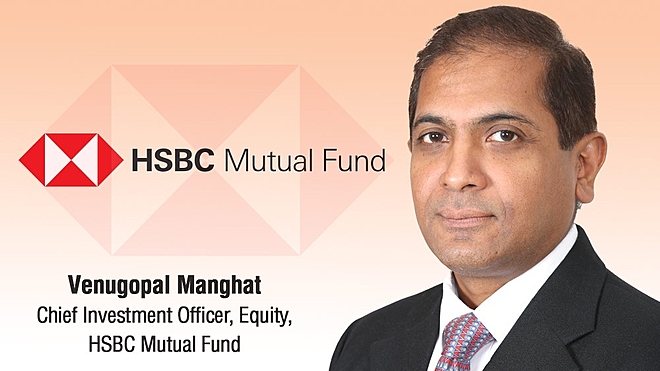


With over 28 years of experience in the financial market, Venugopal Manghat, HSBC Mutual Fund's chief investment officer, takes us through his professional journey. In the interview, he talks about the early days of his career, navigating the dynamic landscape of the financial industry, to the current role of overseeing the equity investing division at the fund house.
Here is the edited transcript of the interview.
How did you start your professional journey?
While doing my management course, I was quite fascinated with what was happening in the country then. This was after the bull run that we saw in 1992. The beginning of foreign multinational research companies getting established in India with cutting-edge work was fascinating, and I wanted to be part of that industry. At that time, it was unclear exactly what it was or what it entailed, but that attraction led me to the research world. I looked for a job and got into a research team with a small private broking entity that was advising a large number of retail investors and, later, a couple of large institutions on the public side.
Later, in 1995, I got an opportunity to join Tata Asset Management as a management trainee. I got into the dealing division and was part of a two-member team. We set up a team and got the brokers to empanelled on equity and fixed income sides. Later, when schemes started to roll out, we started deploying money in money markets and equities. So, that was the beginning; my fascination with research got me into the capital market and the stock market in general.
How did you rise from being a dealer to a research analyst?
In equities, that transformation happens rarely. But, in my case, given that I had spent almost a couple of years on the research side working with a small team across sectors, that experience really helped.
In that short stint at Tata Asset Management, in my spare time, say after 3:30 pm (the closing of equity markets in India) and finishing the dealing work, I used to help the research team and different managers identify companies, run screeners, and set up meetings. So, I was always interested and was a part of that process. It was a natural progression for me. I was always interested in research, so I took it with both hands when that opportunity came.
The equity markets have undergone significant changes. Looking back, what difference do you see in the market?
Even though markets have changed, the basics of investing have remained the same, like buying good companies and remaining invested in the markets. But I think the process has undergone a change. I mean, each of the three parts of the chain—the research part, the fund management part (portfolio construction), and then the dealing part—all have evolved along with the market.
Now, there's more technological advancement, and everything is electronic. Of course, the biggest change is paperless trading. That's a structural change that happened in the industry. Otherwise, every single aspect has been refined over time, and we are closer to the rest of the world or the most advanced markets now.
Even the regulations have changed significantly; there's been so much advancement in terms of different categories and different types of funds in the industry. Several new categories have emerged. And I think the regulations have ensured a far more professional approach to each part of this chain. I remember that in 1995-96, things were not even 10-20 per cent of what they are today. In terms of the approach, especially the operational part of it, everything has changed quite significantly.
How do you co-manage seven funds? How is the division of work among other fund managers?
The co-fund manager is actually in a support role. The first name (in the fund) is the lead manager, who runs the fund and is responsible for the performance. Whenever the lead manager is not there, that is when the support role or the co-fund manager comes into play.
At HSBC Mutual Fund, I am the CIO of equity, so I'm supervising the equity investing part of the organisation overall. While doing that, I'm also managing some of the funds - the value fund, small-cap fund, infrastructure fund, and multi-cap fund. I have also taken on more funds in the last few months because somebody has moved on. So till the time we get replacements, I've taken those schemes. We are five fund managers, including myself. So, the schemes and work are distributed quite well among the five fund managers.
How do you manage such diverse funds?
The experience I've had over the last so many years has definitely helped, as I've covered or tracked many sectors and stocks in the past. I've seen two or three cycles and met most of the companies that are relevant today. So, that has helped me make decisions faster. Obviously, one needs to apply the mind. Different strategies require different mindsets and approaches, and one needs to give quality time to these different strategies.
I prefer to have my universe created for each of these strategies. To give an example, for the value fund, I have a universe that I have in mind, which is plugged into the Bloomberg system. For small caps, I have a different universe. I work with a universe of stocks, which helps me make quicker decisions. In any case, I don't churn the portfolio too much. It's a very low-churn portfolio, and my approach has always been to stay invested for longer periods and let the companies and businesses perform. Therefore, the effort that goes in at the beginning is to identify the company, look into that business, and then keep tracking it.
How will you define yourself as an investor? What kind of stock or situation excites you?
I like companies that are growing faster. I think India is a growing market and will remain a growing economy for a long time. This will lead to exciting opportunities for investors; therefore, what excites me as an investor is that growth.
I also like companies where there could be tailwinds for the sector. It could be a management change or a new product introduction. It can even be a change of baton or handover from the father to the child or a change of manager or promoter. So, any of such things can change the company's fortunes. And if you are in the right business, run by the right people, then that's all you need to really focus on, and that's what excites me.
Good-quality businesses where there can be change and improvement excite me as an investor. I really like to stay invested in good-quality companies and let them perform and grow to bigger sizes over time. And I enjoy seeing companies grow to bigger scales over time; if I get it early in the cycle, that becomes a compelling buy for me.
We are largely bottom-up investors, so we don't prefer to invest based on the economy. It's more about the company's performance and what businesses are turning around or likely to do better. The growth expectation and what is captured in the price matters more than the sectoral view.
What's your take on the section of stocks that investors have fancied and are buying at any price?
You will find such instances in any market. But you will also have to carefully understand the factors behind those valuations. Some great-quality companies can really grow at a higher pace for longer periods and, therefore, can compound for a long time and, to that extent, may get a higher valuation for longer periods. In very liquidity-driven markets with strong fundamentals, you might see valuations increase even more. I think you have to be careful, and one has to be very wary of such situations where valuations have run up too much and can't be justified with the fundamental prospects.
The HSBC Midcap Fund continues to underperform. How do you plan to improve its performance?
The mid-cap fund has outperformed this calendar year, and the performance has been fairly good. As always, it's a high-quality portfolio that has been created with a lot of thought behind it. It's not a flavour-of-the-season kind of portfolio. It's a portfolio with companies at reasonably good valuations as an entry point. It's just taken a little longer for those to really start outperforming and delivering numbers. But now we are seeing the benefits of that. So, I don't see any need to really materially change the portfolio or do anything to it. The fund is running fairly well now.
Also read: Interview with Resham Jain of DSP Mutual Fund
Ask Value Research 

 New episodes every Friday









 New Process Alert
  Seems like you've uploaded a wrong QR code. Please upload the QR code downloaded from MF Central platform.


