




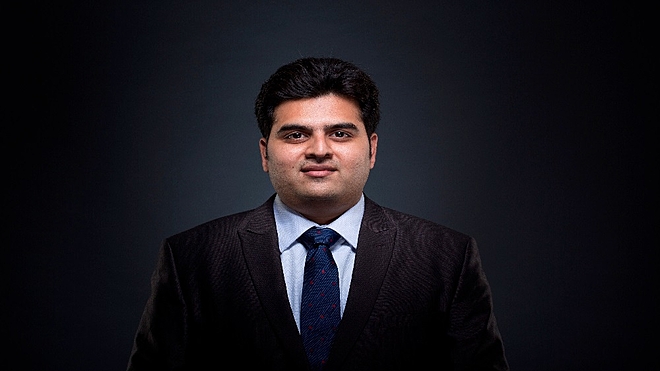


The mid and small-cap stocks have been in the limelight this year. We spoke with Resham Jain, fund manager at DSP Mutual Fund, who co-manages DSP Midcap Fund and DSP Small Cap Fund. In this interview, he shares his stock-picking strategy and more. Here is the edited transcript.
1) What got you interested in equity investing?
I have donned many caps in my career in the last 15 years. I started in academics; I used to teach. After that, I moved to corporate finance. I worked for a manufacturing company and looked at various aspects of finance there. From there, I moved to sales (B&K Securities), tracking several sectors. Since the last eight years, I have been on the fund management side, tracking several sectors along with the fund responsibilities as well.
2) What is your role in co-managing both funds with other managers? How do you divide the work?
The DSP Small Cap Fund was established in 2007-08 and has been in operation for nearly 17 years, with the fund's size increasing over the period. The AUM was near Rs 3,000 crore a decade ago; now, it's close to Rs 13,000 crore. As the fund grows in size, our stock universe increases, prompting us to bring in more personnel to share the responsibility. At the portfolio level, we all sit down and discuss what has to be done in the fund. But then, we may delve deeper into specific areas of mutual interest. I look at specific industries in greater depth in the small-cap fund, such as chemicals, agro, and some retailing companies.
Abhisek (Ghosh) delves deeper into other areas, such as construction materials, logistics, and more. Vinit (Sambre) is a seasoned fund manager with much more experience. He is, therefore, involved in all our overall decisions. Having said that, it's a collaborative decision; we reach a consensus, and then we make our decision. So, in essence, Vinit makes the final decision on whether a certain stock should remain in the portfolio or be removed from it.
3) What are the key constraints while managing mid and small-cap funds?
I believe there are a few significant alterations or limits, which are significant. Let us first assume that new sectors are developing with no history. For example, there were once just a few companies with a very limited history in the chemical sector. However, an increasing number of chemical businesses have formed. Each chemical firm sells different types of products and has a global history. So, we must return to multinational corporations and examine what they have done and how they have done it.
Second, in the last five years or so, the global environment has changed in some ways. We can observe that many quantitative and qualitative barriers have been established in the industries, contributing to a global trade imbalance. As a result, you must comprehend global variables as well as local industries. It may simply have domestic sales, but it may be influenced by what is happening in terms of worldwide prices. At the same time, if it is a multinational corporation, it will undoubtedly have far-reaching consequences. I believe a new group of businesses has formed. It's not a constraint, but what occurs is that you need to view that sector from a different lens where you don't have any history and how it would play out in an inverted way, in an Indian sort of scenario, and how might some of these global shifts affect Indian promoters. So, in the previous five years, I would categorise this as a kind of challenge for analysts to grasp such areas.
4) You mentioned that AUM has increased significantly in the last few years. Is size a deterrent, especially in mid and small-cap stocks?
We don't really see size as a constraint at this moment; we see enough opportunities arising. And, as previously stated, the definition of small caps has altered. Five years ago, a company valued less than Rs 6,000 crore was considered a small cap; today, it is a company that's worth less than Rs 18,000 crore. In a Rs 6,000 crore company, a 1 per cent ownership works out to Rs 60 crore. A 1 per cent stake in a Rs 18,000 crore company now costs Rs 180 crore. So, I believe we must consider how the market has changed over time; this, in turn, helps, and thus, I do not believe it is a restraint. Having additional hands to dig deeper and a higher weight also helps in some ways. So, from the bandwidth standpoint, I don't believe there is any constraint currently.
5) How do you assess mid and small-cap companies' growth potential and competitive advantage? When and what kind of stock becomes a compelling buy for you?
People usually view small and mid-cap companies as small, tiny businesses. I'd like to point out that several of the small and mid-cap companies are market leaders in their respective industries. And it's not like they've only been leaders for three or five years; some have been leaders for 10 years. So, I don't see a challenge; there are several sectors in which Indian enterprises may be competitive, both within the country and globally. However, I would argue that getting in and out of small-cap names is difficult among the three market caps (large, mid and small). As a result, you must think long-term; you cannot focus on the next quarter or year; you must think beyond that. We often enjoy it when a stock price falls because we like those companies; we feel it's a bargain to get into those companies whose price is, and we often want to raise our weight, but we may be waiting for the correct price.
Regarding stock selection, we have a simple principle: select the correct company and management available at a reasonable valuation. That said, I believe the most significant aspect is business evaluation. And, of course, it varies depending on the industry. Then, obviously, if we get into a given industry, we assess a variety of components of it. The first and primary consideration is the size of the opportunity, which is the sector's year-over-year growth. We delve down into the companies to check if they have special advantages to expand in that market and what competitive edge they have to be a winner in that specific game. There could be several aspects, such as technology, cost, distribution, and brand. As a result, we attempt to look into such elements.
6) Since you manage both mid-cap and small-cap funds, is there a portfolio overlap?
There is some overlap of about 17-18 per cent between the portfolios. But I would say the overlap has started since the Securities and Exchange Board of India (SEBI) reclassification measures have come in. For example, we need to have a 65 per cent allocation towards mid-cap stocks in mid-cap funds, and it's similar even in small-cap funds. However, since the stock names change every six months, we keep them higher than the threshold, leading to less portfolio churn. Ultimately, it's about generating returns, and both funds should get a fair kind of treatment when it comes to generating returns. It's not a plan to buy in both funds, but when we get liquidity and stock prospects are compelling, we buy the stocks in both portfolios.
7) What kind of stocks will you never buy?
There are certain kinds of characteristics in stocks that we don't want to have in our portfolios. For example, companies that have significantly higher or questionable related party transactions. In that case, we will never have those kinds of companies in our fund, or, let's say, sectors with a significant amount of governance issues or stocks in highly cyclical sectors. Apart from that, we don't like sectors where we see very frequent changes in regulations that impact the profitability or business profile of the company. To give an example, with an organisational structure that is very complex and has many subsidiaries, let's say 100 subsidiaries within India and outside India, it's tough to analyse those companies, what they are doing, and how they're doing, so we typically avoid such companies.
8) How long has your holding period of stocks been? Do you have any targets to exit or trim the position?
This, I believe, has become increasingly relevant in recent years as valuations have been stretched. And, because we value valuations, we have reduced several of our weights. We also sell stocks when their values are unjustified. On those fronts, we are quite cautious. Over the previous decade, several of the stocks we purchased as micro caps have grown to become large caps. And eventually, we felt that valuations were becoming stretched, so we exited them.
Another reason we sell a stock is that we have an initial thesis about a particular company: that it must act in a certain way regarding progression. Some of our hypotheses do not pan out as expected, so we sell the stocks. As a result, we conduct proactive calls there. I believe that both valuation respecting valuation and stock not doing well could be factors for us exiting some of the names. There are also governance difficulties; everything appears to be in order when we first enter the stock. However, with time, management may do things that are not correct or are not in the best governance practices. As a result, we frequently sell the shares.
9) The DSP Midcap and DSP Small Cap Fund have gone through some underperformance in the last few years. What has gone wrong, and how do you plan to improve the performance?
Some of the sectoral calls have not performed as expected. Some of the stocks that had contributed to underperformance did well this year. As a result, the same stocks have provided us with a return. So, part of the thesis undoubtedly played out, but with some delay, as did some of the themes, which we didn't expect would pan out the way it did. For example, in defence, we have stocks in our fund, although we were maybe a little late. Alternatively, during the COVID period, IT stocks rebounded strongly after underperforming for the previous five to seven years, and it took some time to build a position over there. So, once again, it's possible that this contributed to some underperformance.
That said, long-term performance in both small and mid-cap funds remains strong. At the same time, you must continue asking questions to see if your portfolio construct is correct. And, certainly, we have made any necessary corrections in the last two years. Given the market's fast-paced, changing environment, the major takeaway has been that you must be proactive. But, in general, I believe the underlying principle stays the same. During 2017-18, we saw similar types of intermittent underperformance. We didn't make many changes to our portfolio over that time, and our performance improved. I believe that now, we need to fine-tune a little bit, which we have done. And I believe the last year has provided us with sufficient evidence that our approach is in the right direction.
Also read: Interview with Sanjay Chawla of Baroda BNP Paribas Mutual Fund
Ask Value Research 

 New episodes every Friday

 New Process Alert
  Seems like you've uploaded a wrong QR code. Please upload the QR code downloaded from MF Central platform.


