




 Anand Kumar/AI-Generated Image

Summary: HDFC Bank entered the last decade as India's undisputed banking leader. This story traces how ICICI Bank gradually overtook it on profitability, margins and valuation, and the key events that reshaped the rivalry..
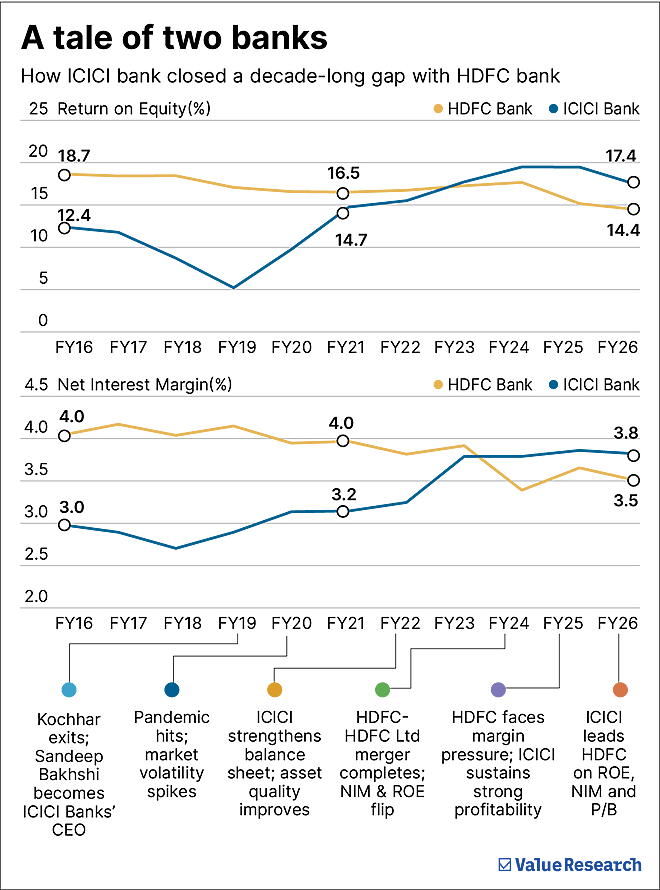
In FY16, HDFC Bank's return on equity was 18.7 per cent, its highest point in this data, and about 50 per cent above ICICI Bank's 12.4 per cent. HDFC Bank traded at 3.6 times book value, while ICICI Bank traded at 1.5 times. On every measure that matters, HDFC Bank was the better bank, by a wide margin.
A decade later, none of that gap remains. ICICI Bank's return on equity is higher. Its net interest margin, the core measure of lending profitability, is higher. Its price-to-book ratio is higher. The two banks did not simply swap places once. They crossed three separate lines, on return, on margin and on price, and the story of how they got there runs through a corporate scandal, a pandemic and the largest merger in Indian corporate history.
Narrowing gap
ICICI Bank has narrowed and even surpassed HDFC Bank in terms of the P/B ratio, over the last decade
| Year | HDFC Bank | ICICI Bank |
|---|---|---|
| FY16 | 3.6 | 1.5 |
| FY17 | 4 | 1.6 |
| FY18 | 4.5 | 1.7 |
| FY19 | 4.1 | 2.3 |
| FY20 | 2.7 | 1.8 |
| FY21 | 3.9 | 2.6 |
| FY22 | 3.3 | 2.8 |
| FY23 | 3.1 | 2.9 |
| FY24 | 2.4 | 3.1 |
| FY25 | 2.7 | 3.1 |
| FY26 | 1.9 | 2.4 |
| Source: AceEquity. P/B ratio as at the end of the financial year. | ||
FY16 to FY19: The reset
ICICI Bank's return on equity fell every year to FY19, from 12.4 to 5.2 per cent, as the corporate lending losses that surfaced after the RBI's 2015-16 asset quality review worked through its book. In October 2018, chief executive Chanda Kochhar resigned over an alleged conflict of interest involving loans to the Videocon Group. Sandeep Bakhshi inherited the bank at its weakest point in this data.
FY20 to FY22: The quiet climb
The pandemic knocked both banks' valuations down within a month. Both recovered. Underneath the noise, ICICI Bank's return on equity climbed from 9.7 to 15.5 per cent and its margin from 3.1 to 3.3 per cent, as growth shifted towards retail and SME lending. HDFC Bank was flat. The gap that had been enormous in FY19 was now in single digits.
FY23 and FY24: All three cross
In FY23, ICICI Bank's return on equity passed HDFC Bank's, 17.7 per cent against 17.2. In July 2023, HDFC Bank completed its merger with parent HDFC Ltd, the largest in Indian corporate history. HDFC Ltd's book was low-margin mortgages, and the effect was immediate: net interest margin fell from 3.9 to 3.4 per cent. Margin and price-to-book both changed hands that year.
FY25 to FY26: The new order
HDFC Bank's return on equity fell to 15.1 and then 14.4 per cent. ICICI Bank eased off its own 19.5 per cent peak to 17.4 per cent, which is not a straight line up either. In FY16, the market paid 3.6 times book for HDFC Bank and 1.5 times for ICICI Bank. In FY26, it pays 1.9 and 2.4.
Where this story leaves off
This piece has answered how HDFC Bank and ICICI Bank swapped places. It has deliberately not answered what comes next, whether ICICI Bank's lead holds, or whether HDFC Bank's still-healthy RoE is the start of a stabilisation the price has not caught up with yet, the same kind of lag this story just spent a decade tracing.
That forward-looking call, on these two banks and the rest of the market, is what Value Research Stock Advisor's buy, hold and sell ratings are for, built on the same fundamentals-first research this story is.
Subscribe to Stock Advisor today
Ask Value Research 

 New episodes every Friday











 New Process Alert
  Seems like you've uploaded a wrong QR code. Please upload the QR code downloaded from MF Central platform.


