




Many investors see a high cash balance in a company's balance sheet as a desirable feature. After all, it suggests that the company has the funds readily available to meet any expenses and to weather any difficult times. It also indicates that the company effectively converts its earnings into cash.
However, high cash balances can sometimes be disadvantageous for two reasons:
Firstly, cash holdings generally offer low yields, which makes it difficult to beat inflation unless the company invests in higher-yielding sources such as equity or reinvests the cash back into the business. Holding onto high cash balances consistently can result in a high opportunity cost for the company. Warren Buffett did not favour holding cash. He once said, "Today people who hold cash equivalents feel comfortable. They shouldn't. They have opted for a terrible long-term asset, one that pays virtually nothing and is certain to depreciate in value."
Secondly, holding a high level of cash can lower the overall return on equity (ROE). ROE is a metric that measures how much profit a company generates with shareholder's equity. When a company holds a consistently high level of cash, it adds to the shareholders' equity which inflates the denominator in the ROE calculation. Higher the denominator, lower the ROE.
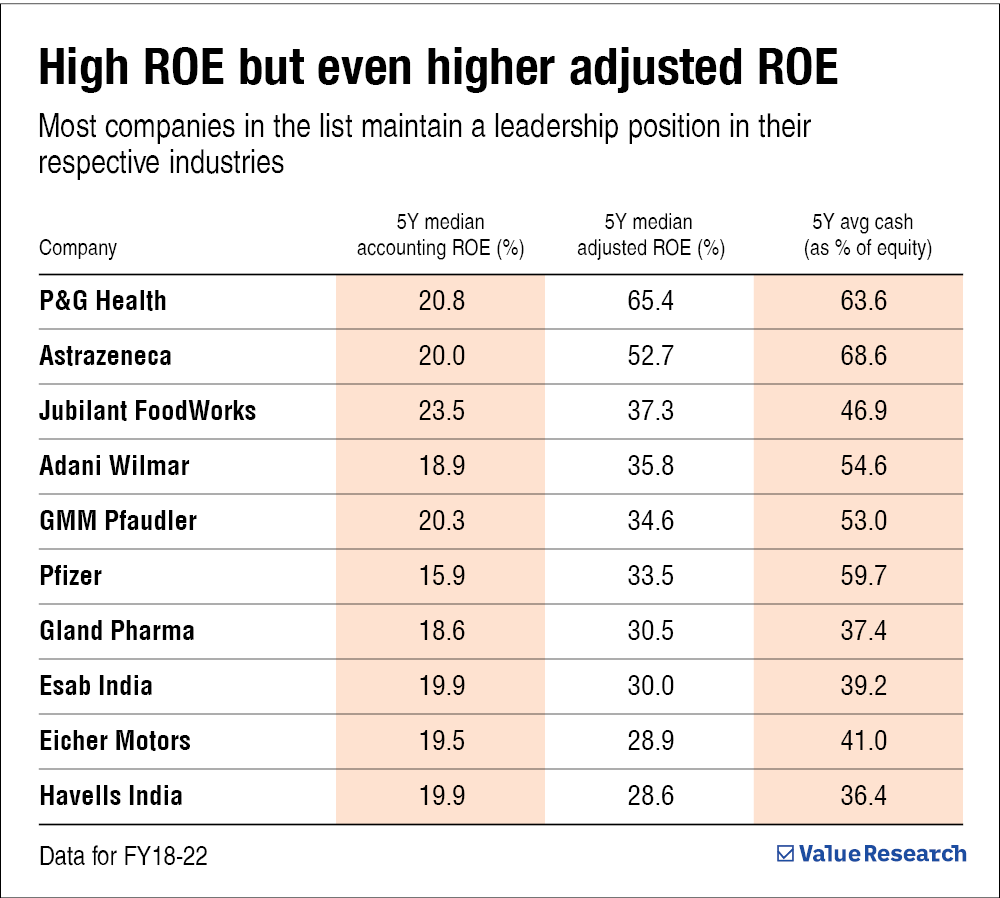
To identify such companies, we took BSE 500 and calculated the adjusted ROE for all companies by deducting cash, bank balances, and current investments from shareholders' funds. We also deducted other income (post-tax assuming a tax rate of 30 per cent) from the net profit since cash and current investments are generally the source of these. To get a better set of companies, we only considered those whose adjusted ROE was higher than the accounting ROE for the last five years.
Here are some companies whose five-year median accounting ROE appear to be low due to high cash while their five-year median adjusted ROE is high.

However, why do companies still hold cash? There could be various reasons:
- Some industries, such as infrastructure, may require companies to maintain high levels of cash.
- If the company is seeking acquisition opportunities or preparing for capital expenditure, it may hold cash to ensure immediate availability.
- At times, a company may raise equity and hold it for some time before investing it into the business. This temporarily inflates cash.
- A company may accumulate cash, but it may not know where to invest it, leading it to hold onto the cash. While holding cash may seem like a positive, as we mentioned earlier, the yield does not compensate for inflation. Failing to allocate available capital and leaving it at low yields for long periods can also be a form of poor capital allocation.
Also read:
The only quarter of earnings
The gold glow may fade in the long run
This article was originally published on April 06, 2023.
Ask Value Research 

 New episodes every Friday







 New Process Alert
  Seems like you've uploaded a wrong QR code. Please upload the QR code downloaded from MF Central platform.


