




In our previous part of Campus Activewear IPO story, we elaborated on the critical details of the IPO and important information about the company. Here we will answer some questions about Campus Activewear and evaluate it on parameters like management, financials, valuations, etc.
IPO questions
The company/business
1) Are the company's earnings before tax more than Rs 50 crore in the last 12 months?
Yes. Before tax, the company's profit was Rs 164 crore in the twelve months ended December 2021.
2) Will Campus Activewear be able to scale up its business?
Yes. After the pandemic receded, the company witnessed an increase in demand, which translated into sales. Further, the company is also increasing the rate of production and integrating online and offline channels, which will help it boost its revenue.
3) Does the company have recognisable brands truly valued by its customers?
Yes. 'Campus' brand is well recognised by the customers, which has given them leadership in the sportswear and athleisure market.
4) Does Campus Activewear have high repeat customer usage?
No. Combining the nature of the product's durability with its presence in a competitive space with individuals as its customers, it is unlikely that the company has high repeat customer usage.
5) Does the company have a credible moat?
No. Although the company has strong brand recognition, several other well recognised global brands could offer similar products.
6) Is the company sufficiently robust to major regulatory or geopolitical risks?
Yes. The company derives all of its revenue only through domestic sales.
7) Is the company's business immune from easy replication by new players?
Yes. New players can enter the market, but it is extremely difficult to gain leadership and have a pan-India presence to dethrone the company as a leader.
8) Can the company's product withstand being easily substituted or outdated?
No. Although footwear is a common accessory, several organised and unorganised players produce similar products.
9) Are the customers of the company devoid of significant bargaining power?
Yes. Since the customers are retailers, they are devoid of significant bargaining power. But it must be noted that since the company operates in this space, customers can easily switch their sellers as alternatives are readily available.
10) Are the suppliers of Campus Activewear devoid of significant bargaining power?
Yes. Since the company buys from several suppliers, especially small and medium enterprises, they do not have significant bargaining power.
11) Is the level of competition the company faces relatively low?
No. The company operates in a highly competitive space filled with various domestic and international players in all price segments.
Management
12) Do any of the company's founders still hold at least a 5 per cent stake in the company? Or do promoters hold more than a 25 per cent stake in the company?
Yes. Post-IPO, the promoter and promoter group will hold about a 74.1 per cent stake in the company.
13) Do the top three managers have more than 15 years of combined leadership at the company?
Yes. Chairman and Managing Director Hari Krishan Agarwal (also a promoter) has been associated with Campus Activewear since its incorporation in 2008.
14) Is the management trustworthy? Is it transparent in its disclosures, which are consistent with SEBI guidelines?
Yes, we have no reason to believe otherwise.
15) Is the company free of litigation in court or with the regulator that casts doubts on the management's intention?
Yes, the company is free from any material litigation.
16) Is the company's accounting policy stable?
Yes, the company's accounting policy is stable.
17) Is the company free of promoter pledging of its shares?
Yes. The company's shares are free of any pledge.
Financials
18) Did the company generate a current and three-year average return on equity of more than 15 per cent and a return on capital employed of more than 18 per cent?
No, the company managed to generate a three-year (FY19-21) average return on equity of 18.7 per cent and a return on capital employed of 20.5 per cent. For FY21, the company generated a return on equity of 9 per cent and a return on capital employed of 18.5 per cent.
19) Was the company's operating cash flow positive during the last three years?
Yes, the company has reported positive operating cash flow during the last three years.
20) Did Campus Activewear increase its revenue by 10 per cent CAGR in the last three years?
No. The company's revenues increased from Rs 594.9 crore in FY19 to Rs 711.3 crore in FY21 at a CAGR of 9.3 per cent.
21) Is the company's net debt-to-equity ratio less than one, or is its interest-coverage ratio more than two?
Yes. The company's net debt-to-equity ratio stood at 0.43 as of December 31, 2021, and its interest-coverage ratio stood at 10.22 in the trailing twelve months ending December 2021.
22) Is the company free from reliance on huge working capital for day-to-day affairs?
Yes. Campus Activewear had a working capital cycle of 15 days for FY21, down from 80 days in FY19.
23) Can the company run its business without relying on external funding in the next three years?
Yes. The company has been doing well off-late, and it has already surpassed its FY21 revenue, operating profit and net profit numbers in the nine months ended December 2021 period.
24) Have the company's short-term borrowings remained stable or declined (not increased by greater than 15 per cent)?
The company's short-term borrowings have fallen by 18.4 per cent from Rs 152 crore in FY19 to Rs 124 crore as of December 2021.
25) Is the company free from meaningful contingent liabilities?
Yes, the company is free from meaningful contingent liabilities.
Stock/valuations
26) Does the stock offer an operating-earnings yield of more than 8 per cent on its enterprise value?
No, the stock will only offer an operating-earnings yield of 2 per cent on its enterprise value.
27) Is the stock's price-to-earnings less than its peers' median level?
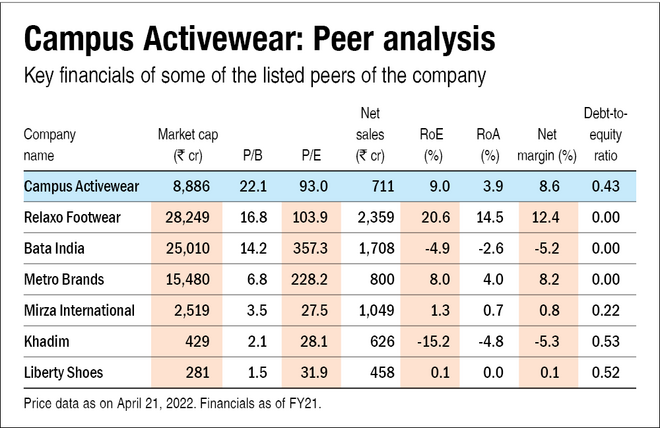
No. Post-IPO, the company's stock will trade at a P/E of around 93, which is more than its peers' median P/E of 67.9.
28) Is the stock's price-to-book value less than its peers' average level?
No. Post-IPO, the company's stock will trade at a P/B of around 22.1, which is more than its peers' average P/B of 7.5.
Also, read our earlier story on Campus Activewear IPO to learn about key IPO details and important company information.
Disclaimer: The authors may be an applicant in this Initial Public Offering.
Ask Value Research 

 New episodes every Friday













 New Process Alert
  Seems like you've uploaded a wrong QR code. Please upload the QR code downloaded from MF Central platform.


