


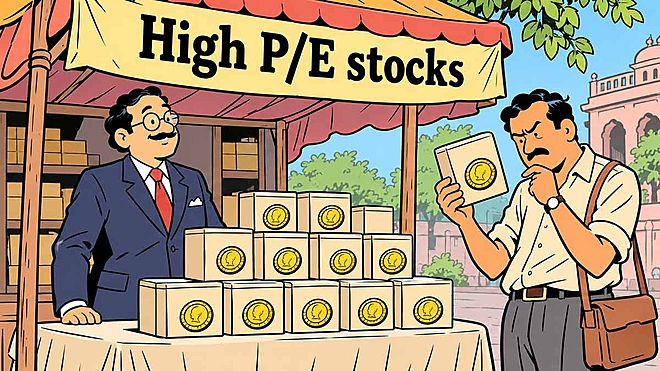
 Anand Kumar/AI-Generated Image
Summary: On a stock screen, two companies can carry the same price tag and still be very different deals. After the market’s best week in years, telling them apart matters more than usual. The clues sit in what companies already disclose, if you know which three questions to ask.
The stock market has just had its best week since February 2021. The Nifty rose 8.6 per cent in five days.
No company's profits grew 8.6 per cent in five days. So for many stocks, you now pay more for each rupee of profit than you did a week ago. For the same business.
That makes this a good week to ask a plain question about every stock you own, or plan to buy. What are you paying, and what are you getting?
The deal inside every share price
Divide a company's share price by its profit per share and you get a number most investors have seen but few use: the price-to-earnings ratio, or PE. A PE of 30 means you are paying Rs 30 for every Re 1 the company earned last year.
Put that way, it sounds like a poor deal. In the first year, Rs 30 earns you Re 1, a little over 3 per cent. A bank fixed deposit pays more.
Yet millions of investors make this deal every day, and some of them are right. The reason is simple. You are not buying last year's Re 1. You are buying every rupee the company will earn from now on. If that Re 1 grows fast enough, for long enough, Rs 30 was a fair price. If it does not, Rs 30 was a mistake, however good the company.
Two companies, one price
Consider two companies, both priced at Rs 30 for each Re 1 of profit.
The first grew its profit sharply last year. But most of that growth came from raising prices, and from comparing against a very bad year before it. Next year, its growth will halve.
The second grew more slowly, but it sold more, to more customers. It pays for its growth from its own cash and has no debt.
On a stock screen, the two carry the same price tag. They are not the same deal. Three checks tell them apart.
Check 1: How fast must the Re 1 grow?
Start with the arithmetic (This is an illustration, not a forecast). Suppose you pay Rs 30 today and the Re 1 grows 15 per cent a year. In five years it becomes about Rs 2. If the market then pays Rs 25 for each rupee, a little less than today, your Rs 30 becomes about Rs 50. That is roughly 11 per cent a year, before dividends.
Now suppose the Re 1 grows only 10 per cent a year, and the market pays Rs 20 at the end. Your Rs 30 becomes about Rs 32. That is under 1.5 per cent a year, for five years of waiting.
Same price paid. Very different outcomes. The difference is how fast profit grows, and what the market pays when you sell. So before you buy, work out the growth the price needs. Then ask whether the business has ever delivered it.
Check 2: Is the Re 1 real?
Not every rupee of profit growth deserves Rs 30.
If your grocery bill rises 10 per cent and your family eats the same food, nobody calls that growth. Companies report exactly this as growth when they raise prices. Read the results presentation, or the transcript of the results call, for the word "volume". It tells you how much more the company actually sold.
Then check what the growth is being compared with. A company whose profit falls from Rs 100 to Rs 70 and returns to Rs 100 reports 43 per cent growth. It has gone nowhere. Compare profit with two years ago, not just one.
Finally, open the segment note in the results. Growth across most of the business is sturdier than growth in one corner of it.
The price you pay should be for the growth that is left after these three adjustments.
Check 3: What happens if things go wrong?
Every investment has a bad case. Most investors never write theirs down.
Write it now. Assume profit grows more slowly than you hope, and that the market pays less for it in five years. Then work out your return, using the arithmetic in Check 1.
If the bad case loses you a lot of money, the price is too full. If it only disappoints you, the price has room for error. The balance sheet matters here too. A company that does not need to borrow in a bad year will still be standing when the good years return.
Putting them together
A high price is fair when the growth it needs is growth the business has delivered before, when that growth is real rather than flattered, and when the bad case disappoints you rather than damages you.
A high price is a trap when any one of these fails, however famous the company or however fast the stock has risen.
One last step. For your largest holding, write down the profit growth its price needs. Then write down the growth you honestly expect. If the first number is bigger than the second, you have your answer.
A share price is a bet on the future. These three checks tell you what the bet is. Only then can you decide whether it is worth making.
See the three checks applied, live
At Stock Analyst Live on Saturday, 14 November, at 12:30 PM, our analysts will run all three checks on a company that is fairly priced, not cheap. It is our new recommendation for Value Research Stock Advisor subscribers.
Subscribers see the name, three five-year scenarios with the worst case first, how much of the recent growth we chose not to count, and the exact conditions under which we would sell. You can register for the session here.
Ask Value Research 

 New episodes every Friday









 New Process Alert
 Seems like you've uploaded a wrong QR code. Please upload the QR code downloaded from MF Central platform.


