




 AMC image
Summary: Few Indian manufacturers lead every market they serve. This gearbox maker does, and it arrives at the market after its best half-year so far. But the designs, the brand and a growing share of its customers sit with someone else. So what exactly are IPO investors paying for?
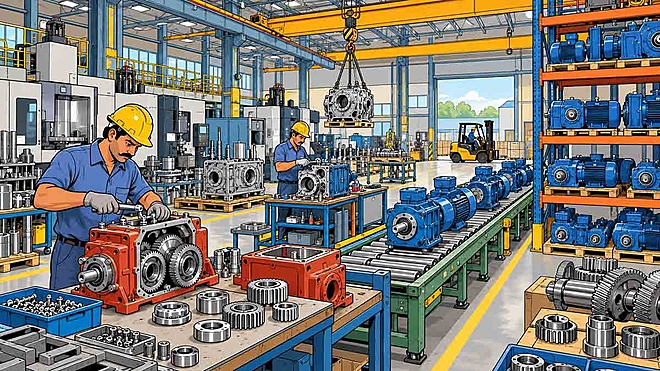
Anyone who has cycled uphill knows the feeling: shift to a lower gear, pedal more easily and move more slowly. The gear helps turn your effort into the force needed to climb. Industrial machines use the same principle to move tonnes of material, turn excavators and keep wind turbines facing the wind
Bonfiglioli Transmissions leads all three markets it serves. Its prospectus says it has about a quarter of India’s small and medium gear motor market, a quarter of off-highway drives and two-thirds of the wind-turbine drives made in India. Its Italian parent, Bonfiglioli S.p.A., is a global leader in wind-turbine drives. But the parent owns the designs and the brand, and a growing share of its customers are group companies.
The IPO opens on October 15, 2026, and closes on October 19. At the top of the Rs 558-586 price band, it raises about Rs 2,534 crore and values the company at about Rs 11,016 crore. It is entirely an offer for sale.
What Bonfiglioli actually does
Industry and automation. Gear motors and gearboxes for conveyors, cranes, mixers and factory equipment, mostly standard products sold directly and through dealers.
Off-highway. Drives for excavators, concrete mixers and road rollers, for makers such as JCB, Hyundai and CNH, each developed with the customer over up to two and a half years.
Wind Industry. Yaw drives turn a turbine to face the wind; pitch drives angle its blades to capture it.
Revenue mix
| Share of revenue | CY25 |
|---|---|
| Industry and automation | 41.00% |
| Off-highway | 25.20% |
| Wind | 31.50% |
| Others (non-core) | 2.30% |
| The company’s year runs January to December; H1 is January to June. | |
In the first half of 2026, off-highway overtook wind as the second-largest business, as US wind-turbine installations were delayed.
The technology comes from Italy
The group designs centrally (Italy) and builds locally. In India, Bonfiglioli machines, assembles and tests. Products launched in the past three years brought in more than a third of CY25 revenue.
Wind shows the advantage. The group says one in three wind turbines worldwide uses its gearboxes. It also sells the Electric motor, gearbox and motor controller as one package, so turbine makers need one supplier, not several. The Indian company began making wind drives in 2006, was the first in India to make pitch drives for 1 to 5 MW turbines, and tests them at India’s only lab for these drives.
Financial summary
| Rs crore | CY23 | CY24 | CY25 | H1 CY25 | H1 CY26 |
|---|---|---|---|---|---|
| Revenue from operations | 1,687.30 | 1,854.20 | 2,013.50 | 960.4 | 1,131.90 |
| EBITDA (ex OI) | 243.9 | 295.1 | 370.8 | 176.4 | 223.9 |
| PAT | 146.7 | 191.6 | 237.9 | 115 | 148.6 |
| Operating cash flow | 198.2 | 188.4 | 187.7 | 68.7 | 129.9 |
Key ratios
| Ratio | CY23 | CY24 | CY25 | H1 CY25 | H1 CY26 |
|---|---|---|---|---|---|
| EBITDA margin (%) | 14.5 | 15.9 | 18.4 | 18.4 | 19.8 |
| ROCE (%) | 24.5 | 30.1 | 34.1 | 18.6 | 20 |
Cheaper raw materials, more local sourcing and in-house machining lifted the EBITDA margin by about four percentage points between CY23 and CY25. Price rises and currency gains also helped in 2026, but may not last.
KPIs
| Operating measures | CY23 | CY24 | CY25 | H1 CY25 | H1 CY26 |
|---|---|---|---|---|---|
| Exports as % of revenue | 23.9 | 25.4 | 27.5 | 25.9 | 30 |
| Group companies' share of exports (%) | 67 | 58.5 | 55.1 | 51.3 | 67.4 |
| Days to collect from group companies | 145 | 115 | 155 | 127 | 129 |
| Days to collect from outside customers | 78 | 74 | 83 | 77 | 75 |
| Royalty and fees as % of revenue | 7.1 | 6.7 | 6.6 | 6.6 | 6.8 |
| Group share of exports and collection days: our calculations from the prospectus. | |||||
Most exports go to group companies, because the licence lets the company sell on its own only in India and four neighbouring countries. Almost all the rest go to one US wind customer, whose orders fell.
The strengths worth paying for
- Leadership backed by global R&D. The company leads in all three of its markets and is the only large supplier serving all three. The industry report notes high entry barriers: costly precision manufacturing, long approval cycles with machine makers and strict reliability standards.
- A bigger market to grow into. Heavy-duty gearboxes, used in cement, steel and sugar plants, form a bigger market than the one Bonfiglioli leads today: about Rs 4,000 crore. Its share is only about 2 per cent, and it plans a dedicated plant beside its Talegaon facility.
- Customers that stay. Drives designed with a customer take up to 30 months to develop, so switching suppliers means starting again. Suzlon has bought from the company for 20 years and JCB for 15. Seven of its top 10 machine-maker customers have stayed for more than a decade.
The risks you should know
- Steady, not fast-growing, markets. The industry report expects its Indian markets to grow 7.5 to 10 per cent a year until FY31. Growing much faster will need market-share gains or more orders from the parent.
- The parent owns the technology and takes a cut. The company pays a 6 per cent royalty to use the parent’s designs, patents and brand, plus fees for central services. Together they take close to 7 per cent of revenue, or about a third of operating profit. The licence is renewed yearly and is not exclusive, and the tax department has repeatedly questioned the fees.
- The group pays late, and drives growth. Group companies take 115 to 155 days to pay, against 74 to 83 days for outside customers. That leaves about Rs 67 crore, nearly half the company’s cash, tied up without interest.
Our verdict
At the top of the price band, the IPO values the company at about 46 times CY25 profit, against 32 to 63 times for listed peers. That suits a market leader with high returns, but it assumes faster growth than the 9 per cent a year it has delivered.
The key question is whether Bonfiglioli India can turn its technical edge into growth of its own. If sales to outside customers rise and cash follows profit, the valuation may be justified. If growth keeps depending on orders, prices and payment terms set by the parent, investors may be paying a premium for decisions made in Italy.
Also read: How Atlanta Electricals earned its price, a year later
Ask Value Research 

 New episodes every Friday











 New Process Alert
  Seems like you've uploaded a wrong QR code. Please upload the QR code downloaded from MF Central platform.


