




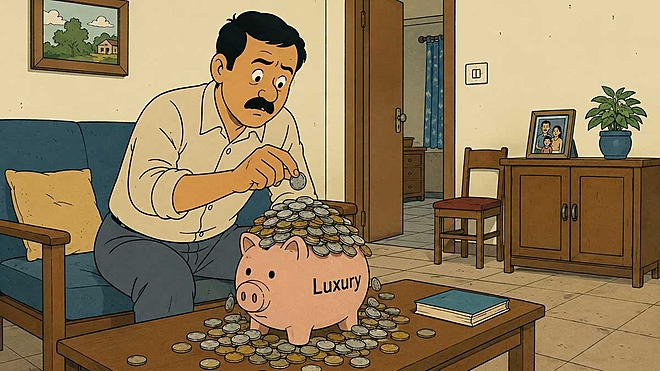
 Anand Kumar/AI-Generated Image
Summary: For many readers, the hardest financial problem wasn't building wealth. It was knowing when it was finally okay to use it. This story explores the deeply personal questions that emerged after an Editor's Note struck a surprisingly familiar nerve.
Dhirendra Kumar’s latest Editor’s Note, The motorcycle and the Ferrari, note was not really about motorcycles or Ferraris. It was about timing, whether the pleasure you take today is matched to where you actually are in your own story. That is what readers heard. The responses that followed were among the most personal this column has received in some time.
The discipline nobody sees
Chaitanya Chakravarthi pulled out the note's sharpest observation and named why it mattered. "The car stands in the garage, but the discipline that paid for it stays invisible," he wrote. "In today's world of social media, we often see only the Ferrari, never the 20 years of quiet decisions, sacrifices and consistency that made it possible. Many people try to imitate the reward while skipping the process." He added a thought the note had not reached: that once financial independence is achieved, real wealth is measured not only by what you can buy but by what you can build for others. "The Ferrari is not the destination. It is merely evidence that the journey has gone well."
Narendra Kumar offered a simpler version of the same life, without the philosophy. He bought a motorcycle on a loan at the start. Six years later, a Fiat. At the end of his career, a BMW SUV, this time without a loan. "Ferrari to nahi," he wrote. The note described a theory. He had simply lived it.
When the rule outlives its purpose
The most unexpected responses came from readers who had not failed to save. They had saved too well, for too long, and found that the habit had stopped obeying them.
Vikas is financially independent by his own account, with more money than he believes he can spend. Yet he still drives a 10-year-old second-hand Chevrolet Cruze. "I am financially independent with more money than I can spend, but I cannot spend money on myself to buy luxury," he wrote. "The question which gnaws from inside is, what purpose would it serve?" He is not frugal because he has to be. He is frugal because the habit formed during the years when he had to be has never let go. "How does one overcome a lifelong instinct of deferred gratification?" he asked. "That is the question."
Nuthan Prasad is 44 and invests in the first week of every month without fail. He does not ignore his family's needs. But spending on himself is different. "When it comes to spending on myself, I always think 10 times before doing it," he wrote. "I think I should start living a bit for myself." He did not write this as a complaint. He wrote it as a realisation, the kind that arrives after reading something that names what you had not quite been able to name yourself.
Aravind Desikamani put the same phenomenon in someone else's life. His friend earns more than a lakh a month, saves Rs 80,000 of it and refuses to buy health insurance for his mother because, in his own words, it would interrupt the compounding. The premium would cost him less than 3 per cent of his annual savings. "I tried my best to talk some sense into him," Aravind wrote. "But he told me he is willing to take that risk even if it wipes his entire savings out. He mentioned that insurance is for the privileged who just don't want to lose their wealth." The logic had turned on itself. The discipline that was meant to serve a life was now protecting itself against the life it was supposed to serve.
Beyond the note
Several readers arrived at the same practical gap. The note told you that spending should match your stage. It did not tell you how to know which stage you are in.
Amit Bajaj put it most directly: "The question still remains, what exactly is the moment when you feel you're ready? How to identify it? No one ever knows if it's too early or too late." He was not disputing the principle, but was asking for the instrument.
Anil Singh drew on a longer life. He left a secure job in 1978, straight out of IIT and IIM, to start a business. What he learned quickly was that for entrepreneurs, the freedom to spend is not a steady privilege but a spasmodic one, appearing in brief windows that do not always align with desire. The clean arc the note described—patience first, reward later—assumes a more predictable life than many people are actually living.
Sreevardhan Agarwal pressed on a different question entirely. "I would add one point here," he wrote. "Whether the person wants the Ferrari because they genuinely love it, or to make a point to those who might have scoffed at the lifestyle business all those years." He was not saying that making the point is wrong. He was saying that knowing which motivation is driving you matters, because one leads somewhere and the other is a treadmill that never stops.
What the responses showed, taken together, is that the note described a risk most readers recognised instantly, not because they were spending too freely, but because many of them were not spending freely enough. The motorcycle was not the problem. The habit that survives past the point where it is needed, that continues to defer and accumulate long after the deferral has done its work, was what readers were actually writing about. Vikas named it most plainly. He has the money. He still drives the second-hand Cruze. The un-Ferrari years have no obvious ending.
Credits
Chaitanya Chakravarthi, Narendra Kumar, Vikas, Nuthan Prasad, Aravind Desikamani, Amit Bajaj, Anil Singh, Sreevardhan Agarwal
Also read: Point at the money. Most readers could not
This article was originally published on August 04, 2026.
Ask Value Research 
 New episodes every Friday



 New Process Alert
  Seems like you've uploaded a wrong QR code. Please upload the QR code downloaded from MF Central platform.


