




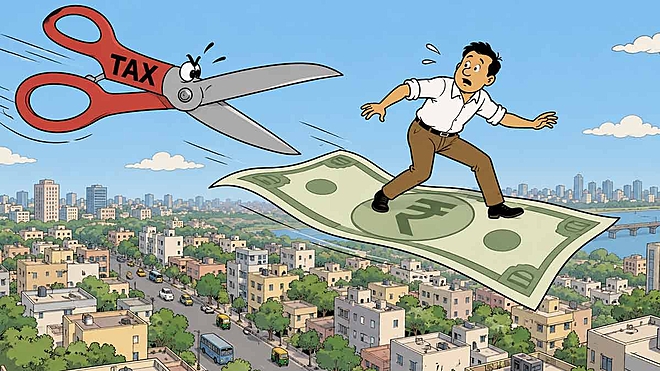
 Anand Kumar/AI-Generated Image
Summary: The Editor's Note argued that personal income tax makes up only a small share of government revenue, and that measured against households rather than individuals, the salaried class isn't shouldering the outsized burden a viral post claimed. Readers wrote back with their own numbers, largely agreeing with the correction itself but pushing on the household math from every direction.
A popular social media post had claimed that 2 to 3 per cent of Indians, nearly all of them salaried, carry the country's entire tax burden. Dhirendra Kumar's latest Editor's Note, "Who really pays for India? It's not who you think," took that claim apart with the actual numbers: personal income tax is only 21 per cent of central government receipts, and once taxpayers are measured against India's 30 crore households rather than its 140 crore people, the salaried class turns out to be carrying roughly its fair share, not the whole burden the post described. Readers arrived with their own denominators, their own models and their own households, and by the end, the conversation had grown well past the post the note had set out to correct.
Readers who rebuilt the denominator
Ashok Rao accepted the 21 per cent figure but not what followed from it. Multiplying that share by the population of 140 crore gives 29.4 crore Indians, he wrote, calling it "a better argument" than dividing three crore taxpayers by 30 crore households.
Atul Bansal reached for a labour force number instead of a population one. Citing a recent report that put India's employed population at 64.3 crore, he divided the three crore taxpayers by that figure and got roughly 5 per cent, then asked for a further breakdown between salaried and non-salaried taxpayers before anyone settled on a single number.
Piyush Kaul went after the logic rather than the arithmetic. Comparing the 10 per cent of households that pay income tax with the 14 per cent of total receipts income tax contributes proves nothing, he argued, since "these two numbers are totally unrelated so why compare."
Rajkr. Ladda wrote the most structured rebuttal in the mailbox. The 21 per cent figure includes firms and other entities, not just salaried individuals, so it cannot be read as their contribution alone. Mixing ITR data from different years to get the 2 per cent number is similarly shaky, and 10 per cent of households paying income tax "cannot be called an official statistic" once you allow for more than one taxpayer per family. His own verdict on the viral claim, "salaried people are running the country's taxes," was straightforward: he didn't think it held up. But he did not think that made the salaried class's complaints wrong too, and proposed a sharper question in their place: what is the total tax burden, direct and indirect, that different income groups carry in proportion to what they earn.
Readers who ran their own numbers
Shashank Nangalia built a table comparing two people with identical income and spending, one paying income tax and one not, and let the gap widen with income. At Rs 20 lakh, the income tax payer hands over about Rs 1.9 lakh more in total tax than the other person, leaving the non-payer with a surplus around 42 per cent higher. By Rs 50 lakh, that surplus gap grows to roughly 65 per cent. Whatever the household statistic says about tax filers, he wrote, it "is not sufficient by itself to conclude that there is no great injustice."
Vikram Pandian ran a simpler version of the same test. He compared someone earning Rs 20 lakh who pays Rs 5 lakh in income tax with someone earning Rs 5 lakh who pays none, then applied the same indirect tax rate to what both had left to spend. The higher earner makes four times as much, he found, but ends up contributing roughly thirteen times as much total tax, which by his estimate is about 93 per cent of the combined tax in that comparison.
Laukik Kathe took the argument to a Mumbai property purchase. A flat costing Rs 1 crore in the city carries about 11.3 per cent in GST, stamp duty and registration on top of income already taxed once, roughly Rs 11.3 lakh in additional tax on a single transaction. He did not think indirect taxes alone settled the question of fairness.
Harshul Narang brought outside data rather than his own model. He had heard a claim that a small share of consumers accounts for half of all GST collections, could not verify it, and set it aside as probably too high. A National Institute of Public Finance and Policy study he trusted more put it modestly: the top fifth of households bear roughly 37 per cent of the GST burden in rural India and 41 per cent in urban India. His real question was whether the formal, higher-income segment carries a disproportionate share once income tax, consumption and corporate participation are counted together, not just how many people file a return.
Readers who made the household math personal
Hemant Kulkarni identified the exact assumption the household calculation rests on. Dividing three crore taxpayers by 30 crore households only works if each household has one taxpayer, he pointed out, and a family of four can just as easily have two, three or four. Without knowing how many households have at least one income tax payer, he wrote, the 10 per cent figure cannot be established from the numbers given.
Rajiv Gupta supplied the example Kulkarni's argument needed. His own household has three earning members, and all three pay income tax, which by his account turns one household into what the note's method would count as three separate contributions to that 10 per cent. He added that income tax payers face what he called a double whammy, paying 20 to 45 per cent of their income as tax and then GST on what remains, while people who avoid income tax pay only the GST.
Vipin Arora argued the household reframe cuts the other way just as often. Take a family where one wage earner supports three or four dependants and pays tax alone, he wrote, and that person is "the sole warrior," carrying the household's entire share of the 21 per cent single-handed rather than splitting it three ways the way Gupta's family does. The three crore people who actually file and pay, in his reading, are still the ones underwriting that 21 per cent of government revenue by direct tax, whichever way the households are counted.
Madhusudhana Modadugu offered the mirror image: a family that pays nothing at all. A household of four filing returns of Rs 12 lakh each, all landing at zero tax, moves that money into fixed deposits worth close to Rs 1 crore over two years, then buys a Rs 5 crore property with the registered value of Rs 1 crore covered by the deposits and the remaining Rs 4 crore paid in cash. A salaried person would need to earn Rs 7 crore and pay Rs 2 crore in tax to take home the same Rs 5 crore, he wrote, and the pattern is "known to every govt, but not focussing on non-employee."
Dawn Antony, a doctor who left India a decade ago, wrote that tax was never the reason. What stayed with him was the absence of a safety net: colleagues in government service had pensions, while he built his own from scratch, aware that if he were hurt rushing to an emergency, "the hospital would have easily found a new doctor the next day," leaving only his family to absorb the loss. He still files returns and still invests in India. He does not expect to work there again.
In the end, the mailbox didn't settle on a number so much as a shared curiosity about the one number missing from the piece: how many of India's 30 crore households actually contain a taxpayer, and how many contain three. It's the natural next question for the note that started this conversation.
Credits: Ashok Rao, Atul Bansal, Piyush Kaul, Rajkr. Ladda, Shashank Nangalia, Vikram Pandian, Laukik Kathe, Harshul Narang, Hemant Kulkarni, Rajiv Gupta, Vipin Arora, Madhusudhana Modadugu, Dawn Antony
This article was originally published on September 08, 2026.
Ask Value Research 

 New episodes every Friday








 New Process Alert
  Seems like you've uploaded a wrong QR code. Please upload the QR code downloaded from MF Central platform.


