




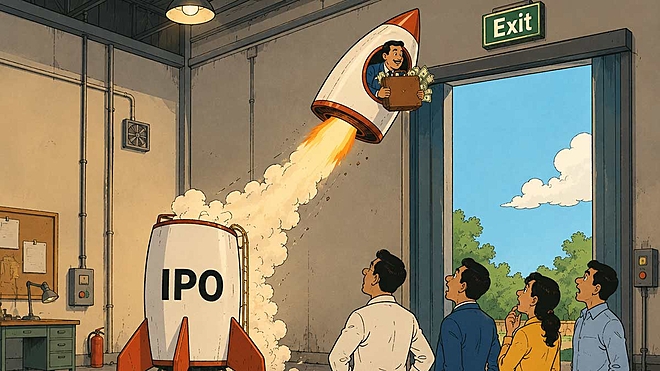
 Anand Kumar/AI-Generated Image

Summary: India's IPO market is booming, but most of the money raised goes to existing shareholders rather than the companies themselves. This story explains where IPO proceeds really go, why subscription numbers can mislead, and the questions every investor should ask before applying.
Mainboard IPOs (initial public offerings) raised close to Rs 1.76 lakh crore in 2025, the highest in a single year since at least 2015. Read that number on its own and it looks like a story about Indian companies raising unprecedented growth capital. Look at where the money actually goes and a different story emerges: across the last decade, most of it has paid off people who already owned the shares, not funded the company itself.
Mainboard IPO activity, 2015 to 2025
| Year | Number of mainboard IPOs | Amount raised |
|---|---|---|
| 2015 | 21 | Rs 13,600 crore |
| 2016 | 26 | Rs 26,500 crore |
| 2017 | 36 | Rs 66,900 crore |
| 2018 | 24 | Rs 31,100 crore |
| 2019 | 16 | Rs 12,400 crore |
| 2020 | 15 | Rs 26,600 crore |
| 2021 | 63 | Rs 1.19 lakh crore |
| 2022 | 40 | Rs 63,600 crore |
| 2023 | 58 | Rs 49,500 crore |
| 2024 | 89 | Rs 1.58 lakh crore |
| 2025 | 104 | Rs 1.76 lakh crore |
| 2015 to 2025 (total) | 492 | Rs 7.44 lakh crore |
Fresh issue versus offer for sale
| Period | Fresh issue | Offer for sale |
|---|---|---|
| 2015 to 2025 (11-year aggregate) | 34 per cent | 66 per cent |
| 2025 | 37 per cent | 63 per cent |
A fresh issue creates new shares, and that money goes into the company. An offer for sale is existing shareholders, promoters, private equity and venture capital investors, or early backers, selling shares they already hold. The company gets nothing from it. Offer for sale has been the largest share of mainboard IPO money in most years since 2015, and the record fundraising of 2025 did nothing to change that pattern.
Before you look at how big an issue is, check how much of it is actually a fresh issue. It is stated on the first page of every prospectus, and most investors never look.
Even the fresh issue is often not growth capital
The part that does go to the company deserves a second look too. A large share of what companies raise through fresh issue does not go toward capital expenditure, new capacity, or expansion in the way the word growth implies. It routinely goes toward repaying existing debt, ahead of capex in many cases. A company can raise fresh capital and still not be investing meaningfully in growing the business; it may simply be swapping borrowed money for shareholder money. That strengthens a balance sheet. It is not the same thing as building a new factory or opening new stores, and the two rarely get told apart in how an IPO is covered.
An IPO application is a lottery ticket
That is a comparison Value Research has made before, and the data backs it up in a specific way. Retail allotment in an oversubscribed issue is decided by a computerised lottery. You do not get shares because you judged the price correctly. You get them if your application is drawn. And the size of the crowd applying tells you nothing about what you would have won.
Subscription versus listing-day gain, select mainboard IPOs
| Company | Subscription | Listing gain |
|---|---|---|
| Tarsons Products | 77 times | 5.7 per cent |
| Krsnaa Diagnostics | 64 times | 7.4 per cent |
| Akums Drugs | 64 times | 6.8 per cent |
| Rashi Peripherals | 60 times | 7.7 per cent |
| Innova Captab | 55 times | 1.8 per cent |
| Credo Brands | 52 times | 0.7 per cent |
| ASK Automotive | 51 times | 8.1 per cent |
| Alivus Life Sciences | 44 times | 4.3 per cent |
| Anupam Rasayan | 44 times | -3.7 per cent |
| Deepak Builders | 42 times | -2.2 per cent |
| Baazar Style Retail | 41 times | 0 per cent |
Two names subscribed over 40 times lost money on day one. A bigger crowd chasing the same lottery does not improve your odds of winning, and it says nothing about how the prize is priced. Applying for an IPO because it is heavily subscribed is buying a ticket because the queue is long.
Who is really taking the risk
Loss-making at listing, and still loss-making at FY25
| Listing year | Loss-making at listing | Still loss-making at FY25 |
|---|---|---|
| 2015 | 4 of 16 | 2 |
| 2016 | 1 of 24 | 0 |
| 2017 | 1 of 35 | 0 |
| 2018 | 1 of 22 | 0 |
| 2019 | 4 of 16 | 2 |
| 2020 | 1 of 15 | 1 |
| 2021 | 12 of 63 | 3 |
| 2022 | 4 of 39 | 2 |
| 2023 | 3 of 58 | 0 |
| 2024 | 7 of 89 | 4 |
Add up the decade and 38 companies listed while reporting a loss. By FY25, 24 of them, roughly six in 10, had turned profitable. The other 14 had not, in some cases years after their public debut.
This points to a shift in who actually carries the risk of an unproven business. For much of the market's history, a company's loss-making years played out in private hands. Venture capital and private equity investors funded that stage, monitored it closely, and typically exited only once the business had proved itself and turned profitable, well after the risk had come down.
Public investors came in afterwards, buying into a tested model. A growing share of today's listings run that sequence in reverse. The loss-making phase increasingly plays out after listing, funded by public shareholders' capital, while it is often the earlier private investors, promoters, PE (private equity) and VC (venture capital) backers alike, who exit at or soon after the IPO through an offer for sale. The risk that used to sit with investors built to carry it – sophisticated, diversified and patient, is, in a meaningful number of cases, being handed to the ordinary public market investor instead.
Still keen on applying? Run this checklist first
- The company has a long, proven record of profits and cash flow, not just a growth story.
- It is priced fairly against listed peers with an established track record.
- A meaningful part of the issue is fresh capital, genuinely going into the business.
- Promoters keep real skin in the game after the IPO, not a token stake.
- You understand exactly how the business makes money and why customers pay for it.
- It shows competitive advantages that can survive a full industry cycle, not just a favourable one.
- Past capital allocation has been sensible and consistent with building long-term value.
- The balance sheet is clean and conservative, free of unnecessary financial engineering.
- Governance holds up on every front, including related-party dealings.
- You would be willing to hold the business for years, not sell it on listing day.
The Value Research view
Three patterns, one conclusion. Most IPO money funds an exit, not the company. Much of what does reach the company repairs its balance sheet rather than grows it. And a rising share of the businesses going public are still proving themselves, with public shareholders now carrying risk that used to sit with private investors built for it.
An IPO application might be a lottery ticket. What you do with an allotment does not have to be. Judge the business the way you would judge any stock already on the exchange, and let the queue outside the issue be someone else's problem.
Also read: Half of SME IPOs sink. Your odds are even worse
Ask Value Research 
 New episodes every Friday








 New Process Alert
  Seems like you've uploaded a wrong QR code. Please upload the QR code downloaded from MF Central platform.


