




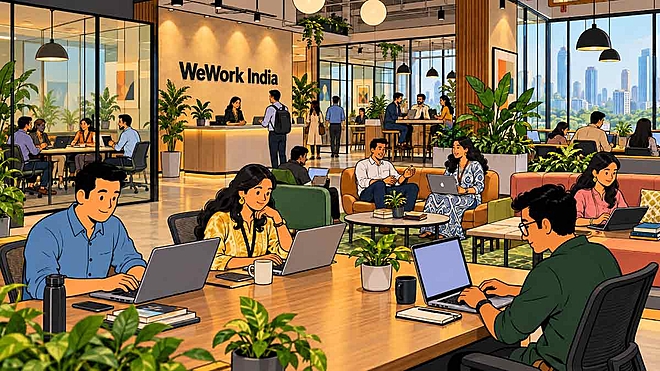
 Anand Kumar/AI-Generated Image

Summary: Its American namesake went bust and its IPO barely scraped through. A year on, WeWork India charges more per desk than any rival. But those rivals are closing the gap and investors are already paying up for the lead. So what does a year of numbers say about the price?
A year ago, WeWork India listed under a name investors distrusted: its American namesake had filed for bankruptcy in 2023, and the debut closed below the issue price. The stock now trades around Rs 670, above its Rs 648 issue price, while the Nifty has fallen.
The IPO reflected sentiment, not the business
WeWork India listed on the NSE on October 10, 2025 at Rs 650, barely Rs 2 above its Rs 648 issue price, and closed at Rs 632. The grey market premium, an unofficial gauge of pre-listing demand, stayed near the issue price, and the issue was taken up just 1.15 times. The global WeWork bankruptcy and already-listed rivals weighed on sentiment. The entire Rs 3,000 crore issue was an offer for sale (OFS): shareholders sold and kept the proceeds, with no fresh capital for the business.
Co-working differs from conventional real estate
India’s flexible workspace market has expanded fast: flex stock across the top cities grew from about 33 million square feet in 2020 to 103 million by end-2025, and is projected to reach 236 million by 2030, close to 18 per cent a year. The driver is the rise of Global Capability Centres (GCCs), the India offices multinationals run for engineering, product and data.
The model earns high returns because operators need not own their buildings. Managed-aggregation operators such as Awfis share revenue with landlords instead of paying fixed rents; straight-lease operators such as WeWork India sign fixed leases and bear the occupancy risk, but strong pricing still pays off.
Premium positioning gives it an edge
About 94 per cent of revenue comes from Grade A offices in prime districts, so WeWork India charges about Rs 18,000 per seat against roughly Rs 8,000 at rivals, and runs fewer desks yet earns more. Large enterprises are 77 per cent of core revenue and GCCs about 37 per cent, on longer commitments, and over half of FY26 revenue came from existing customers expanding. Its Embassy Group parent, which owns more than 85 million square feet of commercial real estate and sponsors Embassy REIT, gives it an edge in sourcing space.
The market already prices it as the leader
On enterprise value to EBITDA (EV/EBITDA), WeWork India is the dearest of the three. EBITDA is earnings before interest, tax, depreciation and amortisation. The figures use a pre-Ind AS 116 basis, which keeps rent as an operating cost, with enterprise value matched to it.
WeWork India commands a premium over its closest peers
FY26 comparison, pre-Ind AS 116 basis
|
Metric
|
WeWork India | Smartworks | Indiqube |
|---|---|---|---|
| Lease model | Straight lease | Straight lease | Straight lease |
| Positioning | Premium, global | Large enterprise campuses | Talent-led, GCC hubs |
| Operational area (MSF) | 8.6 | 10.1 | 9.7 |
| Total seats / desks | 1,26,860 | 2,31,163 | 2,15,000 |
| Occupancy (%) | 86.9 | 82 | 88 |
| Market capitalisation (Rs crore) | 9,297 | 5,425 | 4,123 |
| EV/EBITDA (times) | 18.6 | 17 | 13 |
| Awfis and EFC are excluded as their models differ: Awfis leans on managed aggregation, EFC on backward integration. | |||
The premium buys stronger returns and clients, but less room for disappointment.
The financials are strong, but rivals are catching up
FY26 revenue rose to about Rs 2,432 crore and EBITDA to Rs 499 crore, a margin near 20 per cent for a third year; at the centre level about 28 per cent. Return on capital employed (ROCE) reached 28.3 per cent, the highest of the three. It has been profitable for four years on the pre-Ind AS 116 basis, and even turned net-profit positive under Ind AS 116, which front-loads lease costs.
WeWork India leads on returns, but peers are catching up
Revenue, EBITDA and ROCE, FY24 to FY26, pre-Ind AS 116 basis
| FY24 We Work | FY25 We Work | FY26 We Work | FY24 Smartworks | FY25 Smartworks | FY26 Smartworks | FY24 Indiqube | FY25 Indiqube | FY26 Indiqube | |
|---|---|---|---|---|---|---|---|---|---|
| Revenue (Rs crore) | 1,662 | 1,942 | 2,432 | 1,039 | 1,374 | 1,796 | 831 | 1,059 | 1,451 |
| EBITDA (Rs crore) | 357 | 405 | 499 | 109 | 180 | 314 | 156 | 194 | 308 |
| EBITDA margin (%) | 20.5 | 20.2 | 20.2 | 10.6 | 13.1 | 17.5 | 18 | 18 | 21 |
| ROCE (%) | 25.3 | 25.1 | 28.3 | 1.6 | 7.3 | 16 | 16 | 13 | 17 |
Smartworks has lifted its EBITDA margin to 17.5 per cent from 10.6 per cent in FY24, and Indiqube’s to 21 per cent, so the lead is narrowing. Seats taken by IT-services clients fell about 42 per cent in FY26, to fewer than 2,600, though banking and telecoms offset it.
The stock outperformed, but the valuation is demanding
Entry price mattered more than timing. Rs 1 lakh held from the Rs 648 allotment is worth about Rs 1,03,500 now, and Rs 1,06,200 if bought at the Rs 632 debut close, against about Rs 92,000 in a Nifty 50 fund. The stock beat a falling market but sits only modestly above its issue price, so against that valuation and improving rivals, strong numbers alone do not settle the case.
The risks behind the American bankruptcy still matter
The American WeWork’s collapse exposed the model’s central risk: operators sign long, fixed leases but serve customers on shorter contracts, so when demand falls revenue drops faster than rent. WeWork India carries the same risk, paying landlords whether or not desks are filled. Its safeguards help: staggered lease maturities, a spread of landlords, net cash and, unlike the American business, profitability. But they cannot remove the mismatch between fixed rent and changing demand.
The verdict after the first year
WeWork India has built a strong business in a growing market, with premium positioning, enterprise clients and returns well ahead of its peers. But competition is improving, IT demand has weakened, and the stock trades at a premium, reason to watch rather than proof it will weaken. It has delivered more than its muted IPO suggested; now it must keep delivering enough to justify its price.
Also read: Smartworks Coworking Spaces IPO analysis
Ask Value Research 
 New episodes every Friday








 New Process Alert
  Seems like you've uploaded a wrong QR code. Please upload the QR code downloaded from MF Central platform.


