




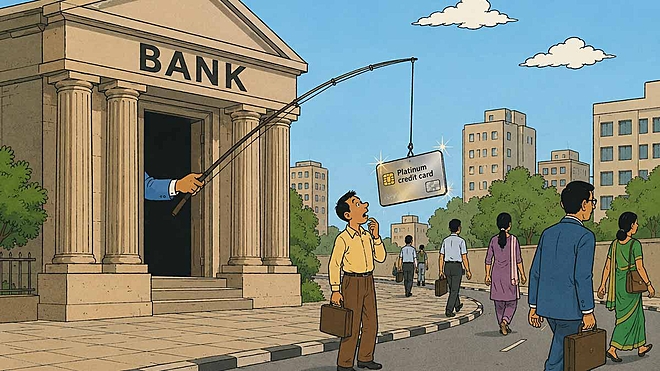
 Anand Kumar/AI-Generated Image
Summary: The RBI named 11 tricks banks use. Readers didn't need convincing the practices were real. What they sent in were the receipts: the actual bank, the actual amount, the actual month it took to get a refund.
The responses to the latest Editor’s Note by Dhirendra Kumar, Read the RBI's new rules as confessions, did something it predicted they would. Readers read the list of 11 banned tricks and recognised, one by one, things that had already happened to them. Nobody needed convincing that the practices were real. What they wrote in with were the receipts.
That recognition is what carried the mailbox.
The personal version of every confession
Manek Kalyaniwala wrote in with what may be the most precise illustration of a dark pattern in action. He has received offers from at least five banks for a "lifetime free credit card with enhanced limit," despite never having used even a quarter of his existing limit, a detail that suggests the targeting algorithm is not paying close attention. And every time he makes a large payment on his card, the same pattern repeats. "Each and every time I use my card to pay a large amount, I promptly get a 'special, for you only' offer to convert that amount into a loan with very easy EMIs."
Devbrat Vidyarthi, writing in Hindi, described being handed an endowment plan in place of the commercial loan he had actually come in for. He tried to refuse. The bank did not relent, and he eventually gave in, not because he changed his mind but because he ran out of room to say no. It is the compulsory bundling the RBI's directive names directly, described from the inside by someone who lived through it.
Kumar's experience with SBI dates back to 2008, when insurance was added to his home loan and he was issued a certificate, with no conversation about whether he wanted it. Had he been told, he wrote, he would have bought the cover separately with his own funds, rather than have it folded into an interest-bearing loan. He also flagged something more current and more quietly troubling: across HDFC, SBI and PGIM mutual fund portals, the option to pause or cancel a SIP is difficult to find, while options to enhance or invest remain front and centre. That asymmetry, easy to add money, hard to stop, is precisely the kind of design the RBI's annexure was written to catch.
Jayaraman T P described a business loan from a nationalised bank where the firm had already insured itself and shared the policy with the bank as required. The bank purchased a second policy anyway, without informing them, deducted the premium from the loan account and charged interest on that deducted amount. It took a month to notice and considerable effort afterward to get it reversed. "I do not know whether an uneducated and uninformed customer would have gotten the same result," he wrote. That uncertainty is the real point of his letter.
Mihir Prasanna Dash's bank, HDFC, started deducting money from his savings account for a mutual fund purchase service he never requested. It went on for five or six months before he noticed and complained, and the refund came only after the complaint, not before. He connected this to the resignation of HDFC's chairman over a mis-selling complaint involving a bank agent, and to the internal inquiry the bank then commissioned and paid for, which found nothing wrong. "This is how a bank we trust with our savings really acts," he wrote.
Arpita Subhash's letter was the most difficult to read. ICICI Bank executives sold a ULIP policy to her 74-year-old widowed mother, in her drawing room, in the names of Arpita and her sister. Her mother understands traditional saving deeply, built over a lifetime of practice. She does not understand newer investment products, and the sale happened at the point of least resistance, in her own home, with nobody present to ask the questions she did not know to ask.
The system readers see underneath
A second group of readers stepped back from their own experience to describe the structure that makes these incidents possible, and to ask why the regulator keeps arriving after the fact rather than before it.
Sambit Misra pointed out something specific about public sector banks: their own service conditions already prohibit employees from acting as agents for other financial institutions, precisely because of the conflict of interest involved. And yet, he wrote, bank employees and even chairmen and managing directors have drawn large incentives for doing exactly that, for years, with what he described as the full knowledge of the RBI and the finance ministry. The new rules, in his reading, do not introduce a new standard. They restate one that already existed and was already being ignored.
Phaniraj A, a retired senior banker, brought the most detailed institutional critique. He laid out a pattern of what he sees as inconsistent RBI conduct: allowing IL&FS to fail even when LIC was prepared to support it, propping up Yes Bank through a hurried SBI-led rescue, allowing the 120-year-old Lakshmi Vilas Bank to collapse while rescuing a bank he describes as having been managed by corrupt directors. His sharpest point concerned Yes Bank's AT1 bonds, sold to retail depositors who had closed fixed deposits to buy them. "If AT1 bonds was not meant for individuals, why RBI allowed it to be sold to retail," he asked. "Now they are closing the door after the robbery of retail public is done."
K Yatish Rajawat described a mechanism inside home loans that he says effectively traps borrowers. EMIs are structured so that interest is front-loaded across the full tenure while principal repayment is concentrated later, meaning anyone who switches lenders early ends up paying interest twice on the same money, and anyone who wants to prepay after a few years finds the benefit of doing so has already been eroded. He says he has raised this with both HDFC Bank and the RBI directly and received no response.
Swaminathan Ramachandran's complaint was smaller in scale but cut from the same cloth. A fixed deposit account cannot be opened at most nationalised banks without an accompanying savings account, and the savings account cannot be closed while the FD remains active, a coupling he discovered only by trying to undo it. Each account also requires its own separate KYC process. None of it is dramatic. All of it adds friction in exactly one direction, toward staying, never toward leaving.
Venkataraman recalled an older version of the same institutional reflex from his time observing FEDAI, the foreign exchange dealers' self-regulatory body. A chief executive once offered what Venkataraman called a classic line on enforcement: if a few violate a rule, take action. If many violate the rule, change the rule. He sees the same logic in how the RBI tends to operate, reactive rather than proactive, across decades of episodes.
Whether any of this actually changes
A final group of readers focused less on what had happened and more on what the new rules can realistically be expected to do, and several were openly sceptical.
Ramit pointed to a structural fix rather than a behavioural one. In Australia, he wrote, wealth managers must agree on a fee with the client in advance and are barred from accepting any payment from product sellers, which removes the incentive to steer a client toward whatever pays the adviser best. "A similar system in India will go a long way in curbing all this mis-selling to unaware customers." It is a more fundamental proposal than anything in the RBI's directive, which restricts specific tactics rather than the underlying commission structure that rewards them.
Leena Dsouza asked the question most readers were circling without quite stating outright: if the RBI is only now banning practices it has tolerated for years, is it fair to call the regulator complicit in the harm, alongside SEBI and AMFI? It is a pointed question, and one the note itself gestures toward without using that word.
Apratim Mukhopadhyay raised a more technical version of the same doubt. Do these instructions carry actual legal force, he asked, or are they merely guidance with no enforcement teeth behind them? Can they be invoked under the Banking Regulation Act, the RBI Act or the Consumer Protection Act, or will banks find the same loopholes that have let earlier rounds of insurance and securities mis-selling rules go largely unenforced? Given how directly the note already flagged this pattern, his question reads less like scepticism for its own sake and more like someone asking the regulator to show its work.
A reader writing under the name Sburner01, offered something rarer: an account of mis-selling reaching into his own family before the regulatory response, and bewilderment at the gap between his expectations of bodies like the RBI and SEBI and what he has actually witnessed. His family received cold calls during the Credit Suisse and Yes Bank AT1 episodes from people he calls "well wishers," not one of whom raised an alarm. He still receives ULIP pitches promising 24 per cent monthly returns and finds himself wondering whether the regulator behind such products is independent at all. "I start doubting if it's actually an independent body or not," he wrote.
In conclusion
The pattern across the mailbox was consistent and, in its way, the strongest evidence for the editor's central claim. Nobody disputed that the 11 tricks were real. The letters that mattered were the ones that supplied the specifics the RBI's annexure could only gesture at in general terms, the actual bank, the actual amount, the actual month it took to get a refund. A regulation can name a pattern. It takes a reader describing their own mother's drawing room, or their own loan statement, to show what the pattern costs.
The deeper question several readers landed on, whether the rules will be enforced any differently than the insurance regulator's earlier and largely ignored instructions, remains unanswered, and will stay that way until enough time has passed to know. Until then, the editor's closing advice holds up as well as anything in the regulatory document itself: treat every unsolicited pitch with suspicion, because the burden of avoiding the trick has not, in practice, moved off the customer's desk.
Credits
Manek Kalyaniwala, Devbrat Vidyarthi, Kumar, Jayaraman T P, Mihir Prasanna Dash, Arpita Subhash, Sambit Misra, Phaniraj A, K Yatish Rajawat, Swaminathan Ramachandran, Venkataraman, Ramit, Leena Dsouza, Apratim Mukhopadhyay, Sburner01
Also read: Musk’s utopia, India’s reality
This article was originally published on July 01, 2026.
Ask Value Research 
 New episodes every Friday





 New Process Alert
  Seems like you've uploaded a wrong QR code. Please upload the QR code downloaded from MF Central platform.


