




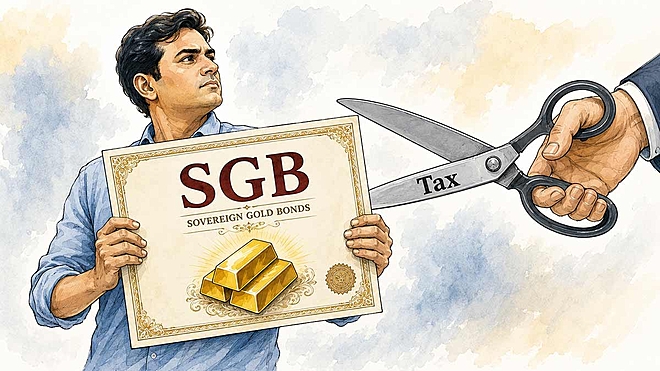
 Anand Kumar/AI-Generated Image

Summary: Sovereign Gold Bonds had one tax feature that made them exceptional: hold to maturity and the capital gains were completely tax-free. Budget 2026 has rewritten that line. And whether it affects you depends entirely on how you got your SGBs.
For years, Sovereign Gold Bonds had a near-perfect tax story: hold to maturity and the capital gains were completely exempt, no matter how you’d acquired the bond. That single line made SGBs the most tax-efficient way to own gold in India, and it’s exactly the line Budget 2026 has rewritten. The exemption still exists. It just no longer covers everyone who thought they had it.
Here’s the change in one sentence. From 1 April 2026, the capital-gains exemption on SGB redemption at maturity applies only to investors who subscribed to the bond at its original issue from the RBI and held it continuously to maturity. If you bought your SGB on the secondary market — on the NSE or BSE — you no longer get the tax-free maturity, even if you hold it all the way to the end. The change amends Section 70(1)(x) of the Income-tax Act, 2025, and applies uniformly across every SGB tranche the RBI has issued.
Why the change?
Because the old rule created a clean arbitrage. Older SGB series often traded on the exchange at a discount to their gold value, and a buyer could pick them up cheap, hold to maturity, and walk away with the gains entirely tax-free — capturing an exemption meant to reward long-term original investors. Budget 2026 closes that door. The exemption now tracks policy intent: it rewards the person who funded the government’s gold programme at issue, not the person who bought the paper later for the tax break.
So the only question that matters for you is: how did you get your SGBs?
If you subscribed at original issue (directly from RBI, through your bank, broker, or post office during an issue window) and you’ve held the same bonds since, nothing changes. Your maturity proceeds remain fully exempt from capital gains. This is most retail investors who bought during the regular issue windows.
If you bought on the secondary market (on the exchange, from another seller), your maturity gains become taxable from April 1, 2026. Long-term gains (holding over 12 months) are taxed at 12.5 per cent; short-term gains at your slab rate.
A few clarifications worth keeping straight. The 2.5 per cent annual interest was always taxable as income — that hasn’t changed for anyone. Selling before maturity on the exchange was always a taxable capital gain too — also unchanged. What changed is narrow and specific: the tax-free maturity that secondary-market buyers were effectively enjoying.
What to do
Pull up your SGB holding statement and check the source of each tranche. If everything was bought at original issue, you have nothing to act on — keep holding. If any of it came from the secondary market, factor a 12.5 per cent LTCG hit into your maturity math, and weigh whether holding to maturity still beats selling, now that the tax edge that justified holding is gone for those units. There’s no way to retroactively convert a secondary-market bond into an original subscription, so the decision is purely forward-looking: hold and be taxed, or sell and be taxed — the exemption isn’t on the table either way.
SGBs remain a sovereign-backed, convenient way to own gold. For original subscribers, they’re as tax-efficient as ever. For everyone else, Budget 2026 turned them from a tax-free instrument into an ordinary one — and it’s worth knowing which of those two bonds you’re actually holding.
Also read: A twist in the gold story
This article was originally published on June 05, 2026.
Ask Value Research 

 New episodes every Friday








 New Process Alert
  Seems like you've uploaded a wrong QR code. Please upload the QR code downloaded from MF Central platform.


