




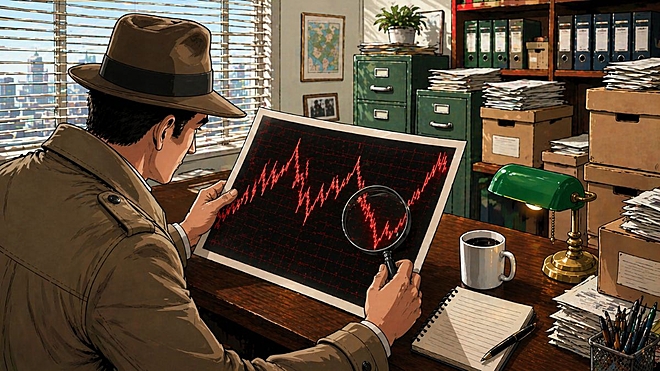
 Aditya Roy/AI-Generated Image

Summary: A stock down 40 per cent looks like a fact. It is actually an argument. The market is saying something has changed. The investor's job is to figure out whether the business has weakened or whether the price has simply run out of patience.
Most investors ask the wrong question when a stock falls.
They ask: is it cheap now? They should ask: is the market right?
These sound similar. They are not. One sends you to a valuation screen. The other sends you to the business. The first question is easy to answer. The second is where the work is and where, occasionally, the opportunity is.
A fall is an argument, not a fact
A stock down 40 per cent from its peak looks like a fact. It is actually an argument. The market is saying: something has changed. The investor's job is to determine what. Has the business deteriorated, or has the price simply run ahead of patience?
The P/E ratio does not answer this. It cannot. A multiple tells you what the market is paying for today's earnings. It says nothing about whether today's earnings are the right number to anchor on, whether the franchise has grown stronger while the stock has grown cheaper, or whether the fall reflects a change in the business or a change in mood.
Statistical cheapness and genuine mispricing are different things. Cheap by the numbers is easy to find. Cheap because the market is drawing a permanent conclusion from a temporary condition, which is rare and it requires a different kind of work to see.
What the work actually looks like
You begin with the business, not the price and ask the right questions
- Is the core franchise intact?
- Are the structural advantages still compounding, or quietly eroding?
- Is the balance sheet strong enough to absorb a difficult phase without permanent damage?
- And most importantly: Is the market's concern about this quarter the right frame for a five-year holding period?
These are not rhetorical questions. They are a sequence. And the answers are sometimes uncomfortable.
Sometimes what looks like a mispricing is genuine impairment. Margins fall not because of transition costs but because the competitive position has weakened. Cash conversion disappoints not because of a working capital build but because the earnings were never as clean as they appeared. When that is the case, the right answer is to exit. The price already paid is irrelevant.
But sometimes a business is being judged by the cost of building something rather than the value of what is being built. The investment is real. The drag on reported earnings is real. The asset being created, whether it is capacity, regulatory approvals, distribution presence, or customer relationships in a market that is difficult to enter, is also real. The market has priced the drag. It has not priced the asset.
That asymmetry is where the better opportunities tend to sit. Not in statistically cheap stocks but in businesses where the market's one-year frame and the investor's five-year frame produce genuinely different answers.
The live test
On May 9, 2026, this is exactly what we will walk you through.
There is a business that the market has marked down more than 40 per cent. Quarterly numbers have been untidy. Margins are under pressure. Working capital is higher than ideal. On trailing earnings, the stock does not appear cheap.
And yet the franchise is stronger than it was three years ago. The balance sheet is debt-free. The capacity investment is largely behind it. The earnings drag traces to specific, explicable causes. None of them points to a deteriorating business model.
Whether that judgment is correct is what the session is for. We will show you the Essential Checks we ran, the questions we asked and the answers that led to the recommendation, in plain language. Live. The thesis is open to scrutiny, and your questions are welcome.
Two kinds of investing
There is a version of stock investing that is comfortable, consensus and expensive. And there is a version that does the work most investors prefer to skip.
Value Research Stock Advisor exists to do the second kind.
Come and see how in the upcoming Stock Analyst Live session on Saturday, May 9, 2026 at 12:30 pm.
Join Stock Advisor
Ask Value Research 
 New episodes every Friday









 New Process Alert
  Seems like you've uploaded a wrong QR code. Please upload the QR code downloaded from MF Central platform.


