




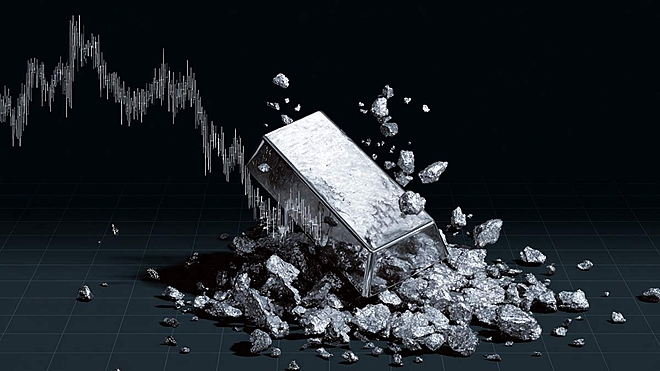
 Vinayak Pathak/AI-Generated Image

Summary: Silver has almost halved in value from its January peak, unsettling many. But this is barely new for the asset known for stunning gains and also reversing them with alarming speed. Our story explains why silver behaves this way and how retail investors should handle it.
Silver, which peaked at roughly Rs 4 lakh per kg on MCX in January, saw its value halve by March and has since recovered about 13 per cent. This is in line with global prices, which are around 40 per cent off their peaks.
This is naturally nerve-wracking for new investors, especially those who joined the gravy train only in the last one or two years. To their dismay, this is not unusual behaviour. In fact, silver is behaving exactly as it always has. And it can continue to be just as erratic in the future. Here’s why.
First, a recap
Silver is not just a precious metal. It is also an industrial metal used in electronics, solar panels, grid infrastructure, electric vehicles, charging systems and data centres. In recent years, industrial demand has been strong enough that the silver market has run a structural deficit for several years. That is the fundamental backdrop behind silver’s extraordinary rally of 158 per cent in 2025, dwarfing gold’s 72 per cent gain and, by a far margin, Nifty 50’s 15 per cent.
Suggested read: The trouble with silver ETFs in a rapidly crashing market
But here is the catch: even when fundamentals are right, the trade can still go wrong, especially in commodities that move in cycles. And cycles have a habit of punishing late entrants.
The correction is part of the cycle
In equities, investors can anchor themselves to sales, profits, cash flows and dividends. In commodities, there is no such anchor. Price is shaped by supply, demand, positioning and liquidity. And the moment prices rise sharply, the system begins to respond.
Suggested read: The silver illusion
Three things happen during a price spike:
- Silver supply increases: Mines that were marginal suddenly look profitable and dormant capacity comes back online.
- Recycling increases: Scrap and electronic waste become more valuable, so recovery efforts accelerate.
- Demand softens: Manufacturers find ways to use less silver, a process called thrifting, or switch to alternatives, called substitution.
This is why ‘demand is rising’ does not automatically mean ‘prices will keep rising’. Rising prices push the system to adapt. The correction, when it comes, is not a surprise but part of how the cycle moves.
Silver has done this before
A quick revisit to history. In 1980, after touching nearly $50 an ounce, it ended the year near $15, a collapse of about 70 per cent. The pattern repeated in 2011 when a record peak of $49.51 gave way to a slide to $20.25 by 2013.
The grey metal is known for racing to dizzying highs and then suffering brutal collapses. When the metal gets hot, speculative money flows in. When the heat becomes too intense, the market structure—exchange-mandated margin calls, liquidity, positioning—turns the correction into a trapdoor. The metal can reward you handsomely, then punish you for getting greedy with position size or timing.
What retail investors miss about sudden liquidity squeezes
Much of the world's silver trading happens in futures markets. Futures let you control a large position with a smaller upfront sum. That upfront sum is called margin. Think of it as a security deposit.
Say you want to trade Rs 10 lakh worth of silver. The exchange might ask you to deposit Rs 1.5 lakh, 15 per cent of the total, to cover the risk. But if prices swing too violently, the exchange raises that requirement. If the margin goes from 15 per cent to 18 per cent, every trader holding a position must immediately deposit more money to keep it.
The rule changes for everyone at the same time.
Some traders add the cash. Many cannot or will not. Their only option is to sell and reduce their position. When a large group sells together, prices fall sharply. That fall triggers stop-loss orders, which cause more selling, which triggers more margin calls. This is how demand appears to ‘vanish overnight’. It does not vanish. Leverage gets squeezed.
What should retail investors actually do
Silver is often described as ‘gold, but cheaper’. That is misleading. Gold is primarily a monetary metal; its price is driven by real interest rates, central-bank buying, currency confidence and risk-off sentiment. Silver is a hybrid: part precious metal, part industrial input. That dual nature makes it more sensitive to economic optimism and speculative flows, and therefore more volatile than gold.
Suggested watch: Silver isn't gold: Here's why passive investors get it wrong
Four things are worth keeping in mind.
- First, treat silver as an allocation, not a bet. It can diversify a portfolio, but it should not dominate one.
- Second, avoid derivatives. Futures are where most retail investors in commodities get hurt. Silver's swings are large enough without it. If you want exposure, invest through ETFs.
- Third, expect sharp drawdowns. If a 20-40 per cent fall would cause you to sell in a panic, your position is already too large.
- Fourth, remember that silver produces no cash flows. A good business can recover with time and compounding. A commodity gives you no such comfort. Your return depends entirely on where you enter the cycle and how well you understand it.
For most investors, that is reason enough to keep silver modest. A 5 per cent allocation is more than enough. Gold remains the better diversifier.
For those who want diversification through the steadier gold, Value Research Fund Advisor offers a curated set of recommended gold funds. It is a simpler and more disciplined way to add precious metals to a portfolio.
This article was originally published on April 01, 2026.
Ask Value Research 

 New episodes every Friday











 New Process Alert
  Seems like you've uploaded a wrong QR code. Please upload the QR code downloaded from MF Central platform.


