




 Aditya Roy/AI-Generated Image


If you’ve been anywhere near social media lately, you’d think we’ve entered the age of silver supremacy. Memes are circulating about how athletes at the next Olympics are aiming for silver medals instead of gold. Someone’s joked that Gold Flake cigarettes will soon be rebranded Silver Flake. And financial influencers are busy posting charts that supposedly prove silver is about to “outshine” gold once and for all.
It’s funny until you realise that this is how every commodity mania begins – when conviction curdles into comedy. A self-reinforcing cycle takes hold: prices rise because people say they’re rising, and people say they’re rising because prices have risen. Industrial demand, supply shortages, and solar-panel stories are just the rational-sounding garnish on what is essentially a fear-of-missing-out movement.
Suggested read: Value, boom and bust
The sanest recent comment came from Nassim Nicholas Taleb, who observed, “It is a mistake to think that silver is in the same asset class as gold.” That deserves repeating. Gold occupies a unique niche because central banks hold it as part of their reserve assets. This institutional demand acts as a structural floor – gold will never be just another traded commodity as long as sovereigns keep hoarding it. Silver enjoys no such privilege. No government counts it among reserves, no central banker worries about its price, and no financial system depends on it. Its value floats purely on private sentiment and short-term industrial demand, which makes it more like copper with delusions of grandeur than gold’s younger sibling. Gold and silver are hyphenated twins only in culture, not in finance. In the 70s, there was a Hindi film called Sona Chandi and another one called Chandi Sona, but that does not mean that the two metals travel together.
The favourite bull argument, that industrial demand is exploding thanks to electric vehicles and solar cells, is hardly new. Silver’s unique electrical and chemical characteristics were not discovered just last year. It was the same story during the 2011 boom, when the metal hit $48 an ounce in New York and Rs 57,000 per kilogram in India – before collapsing around 25 per cent in just eight days. From 2011 to today, silver has returned roughly 3 per cent annually – barely matching inflation. For an asset forever “on the verge of a breakout,” it has spent a very long time standing still.
Suggested read: Turning panic into profits
Some enthusiasts blame currency debasement, claiming silver only seems dull because the rupee’s been doing worse. That’s true but irrelevant; a currency’s decline is not an argument for any particular commodity. Others insist silver has been “suppressed” by shadowy interests and is due for an explosive catch-up rally. Such theories resurface every decade and quietly fade away when the next crash arrives.
In any case, technological changes can point in a different direction, too. Throughout the 20th century, photographic film and paper consumed more than a third of global silver production. This is down to almost nothing now, for obvious reasons. Over the long term, one simply cannot guarantee a sudden spike in industrial demand based on a flashy new technology, unless substantiated.
Suggested read: Embrace disruptions
Gold, at least, plays a defined role: it is an insurance policy against monetary chaos. Silver offers no such discipline. It behaves like a leveraged version of gold – magnifying gains and losses alike without offering the same institutional cushion. If gold rises 10 per cent, silver might rise 20 per cent. If gold falls 10 per cent, silver could fall 40 per cent. That isn’t diversification. Punters may find that exciting, but long-term investors find this alarming. Yes, silver might continue rising for a while yet. Momentum can defy gravity longer than logic allows. But investors should recognise what they’re buying into. When the noise dies down, silver will revert to its historical role: a trader’s plaything occasionally mistaken for an investment thesis.
So by all means, enjoy the jokes and the memes. They’re the healthiest part of the current silver rush. Just remember that in markets, as in sport, chasing silver medals rarely ends well – for one simple reason: they’re awarded only after the game is over.
Also read: Is gold a relic or a refuge?
Ask Value Research 

 New episodes every Friday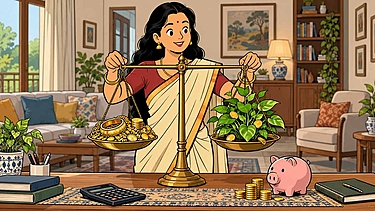











 New Process Alert
  Seems like you've uploaded a wrong QR code. Please upload the QR code downloaded from MF Central platform.


