 Widely read:




Summary: Silver’s 2025 rally has grabbed attention, but its history tells a far more uneven tale. This piece looks at what silver really offers investors today, why interest has surged and how to think about holding it without letting short-term excitement drive long-term decisions.
Silver has spent most of the past decade playing second fiddle to gold. Then, 2025 changed that perception decisively. Silver prices in Indian markets surged over 160 per cent in 2025, taking prices to more than 2.6 times their 2024 year-end level. Looked at in isolation, the move feels extraordinary.
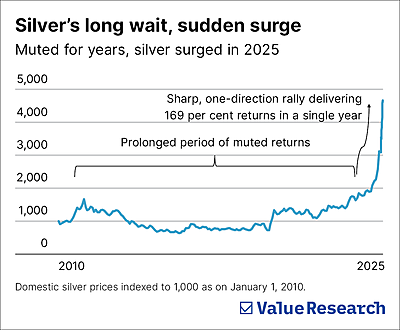
But silver’s long-term record tells a more uneven story. Since January 2010, silver’s compounded average growth rate (CAGR) works out to roughly 10 per cent. Strip out the 2025 spike, however, and the CAGR up to 2024 drops sharply to 3.7 per cent.
This highlights silver’s defining trait: long stretches of indifference punctuated by sharp rallies. While no one can predict the forthcoming move for silver, there is an undeniable surge in investors looking for a practical way to hold the metal in anticipation of market shifts. So, let’s look at how one can hold silver.
Silver ETFs
Spotting a rally is one thing. Acting on it is another. Physical silver comes with storage, purity and resale-related challenges, especially at scale. That friction alone keeps many investors on the sidelines.
This is where silver ETFs step in. A silver ETF is similar to a mutual fund that buys physical silver and issues units against those holdings, which can be traded on the stock exchange. Each unit represents a proportional claim on the fund’s silver assets.
For most investors, transactions happen entirely on the exchange. You buy units through your broker and sell them the same way, just like stocks. The appeal is straightforward. Silver ETFs remove the operational hassle of owning silver while preserving price exposure, making them the cleanest route for investors who want silver in their portfolio without dealing with the metal itself.
Is the ETF market liquid enough?
Ease of access alone does not make an ETF investable. Liquidity determines whether you can enter and exit at prices close to the metal’s true value. To gauge how easy it is to trade silver ETFs, we looked at a ratio of six-month average daily traded value to AUM. While AUM (asset under management) shows how much money is currently invested into silver ETFs, traded value indicates how easily that money can be moved out, especially during volatile phases.
The ratio reveals that the trading activity is pretty high, with the six-month average daily traded value typically ranging between 0.7 to 0.9 per cent of AUM. The activity picked up further in the latter half of 2025 and rose to Rs 1,083 crore, equivalent to about 2.2 per cent of the category’s AUM (based on November-end AUM).
Risks
Even with growing scale, silver ETFs remain a relatively young category, and that brings a distinct set of risks.
- Liquidity is uneven. Lower trading volumes can widen bid-ask spreads, increasing your cost of entry and exit.
- Tracking is not frictionless. Expense ratios, cash balances, transaction costs and the mechanics of sourcing and storing physical silver can all cause ETF returns to diverge from spot silver prices. Tracking error captures this cumulative gap and deserves as much attention as headline costs.
- History is limited. The oldest Silver ETF in India is only about four years old. That means investors have not yet seen how these funds behave across a full commodity cycle or during prolonged periods of stress.
These risks do not negate the product. They simply reinforce the need to approach it with realistic expectations and careful sizing.
How to choose a silver ETF
- Prioritise liquidity. Prefer ETFs with consistently higher traded value and narrower spreads. As a rule of thumb, daily traded value should be at least 50 times your intended investment size.
- Evaluate cost and tracking together. A low expense ratio helps, but tracking error should also be considered while selecting an ETF.
- Balance metrics, don’t optimise one. An ETF that trades well but tracks poorly, or one that tracks well but trades thinly, both can create problems. Seek balance. You can use the table titled ‘How India’s top silver ETFs stack up’ as a reference point. Keep in mind that these numbers can evolve as the market for silver ETFs matures.

What you should know
Understanding the 2025 rally helps put expectations in check.
- Industrial demand provided momentum. Silver’s role in green energy technologies and its positioning as a critical industrial metal supported demand. However, industrial demand is cyclical and sensitive to economic slowdowns.
- Supply responded slowly. Much of silver production is a by-product of other mining, making short-term supply adjustments difficult. While this can amplify rallies, it can also intensify declines when demand eases just as supplies have been ramped up.
- A change in investor sentiment added fuel to fire. Rising gold prices and shifts in the gold-to-silver ratio drew investors toward silver as a relative value play. Such sentiment-driven flows tend to reverse when gold stabilises or the ratio normalises.
Where silver fits in a portfolio
Silver works best as a diversifier, not a return engine. Its volatility and long periods of stagnation argue against large allocations.
A sensible framework is to treat silver as part of a broader commodity allocation alongside gold. One must not allocate more than 10 per cent of the portfolio to commodities.
Within that bucket, silver exposure should remain conservative relative to gold, reflecting its higher volatility and sharper cycles.
This article was originally published on January 20, 2026.
Ask Value Research 












 New Process Alert
  Seems like you've uploaded a wrong QR code. Please upload the QR code downloaded from MF Central platform.


