 Widely read:




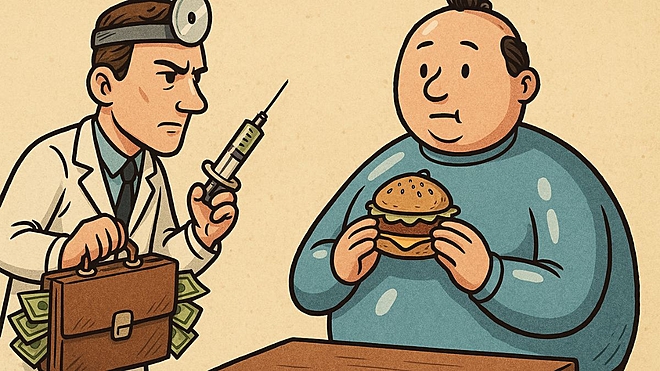 Aditya Roy/AI-Generated Image

Summary: India’s pharma companies are gearing up for the GLP-1 boom, especially as weight-loss anti-diabetic drug Ozempic’s patent nears expiry. But which companies will actually profit when Ozempic goes generic? We map the supply chain, market dynamics and potential winners in the story below.
Few drugs in modern history have transformed global healthcare and even stock markets as dramatically as the new class of anti-diabetic and weight management GLP-1 therapies.
GLP-1 is a hormone that reduces blood sugar and appetite by stimulating insulin release, used especially to treat Type 2 diabetes. Novo Nordisk, the Danish drugmaker behind GLP-1 wonder drugs Ozempic and Wegovy, has seen sales of these two products nearly triple in just two years between 2022 and 2024. The blockbuster growth catapulted its share price to dizzying heights, briefly making it Europe’s most valuable listed company before a recent correction.
American rival, Eli Lilly, is not far behind. With Mounjaro, Lilly has capitalised on the same surge in demand and is rapidly closing the gap. Together, Novo and Lilly generated almost $40 billion in revenues from these drugs last year alone, up from $11 billion in 2022. Yet this may only be the beginning. Supply remains constrained, many countries have yet to see full launches and patent protections still restrict wider adoption.
But 2026 is expected to be the ‘GLP-1 year’ for India, Canada and Brazil, when semaglutide—the molecule behind Ozempic and Wegovy—loses exclusivity. This matters for India, where diabetes is among the highest in the world, with a rising obesity challenge in urban populations. The convergence of a massive disease burden, expiring patents and growing consumer awareness makes the weight loss drug story a market waiting to unfold.
Indian pharma companies are already participating in the drug development process, while many others are waiting to launch their own versions once the patents expire.
Indian pharma companies plugging into the supply chain
The road from a GLP-1 molecule to the final injection is long and complex, with three critical steps—APIs, devices and fill-finish—and Indian players are quietly positioning themselves across each.
- APIs: GLP-1s are peptides, notoriously hard to make at scale. Here, Divi’s Laboratories, with over 15 years of peptide expertise, has reported receiving orders from global patent owners. Neuland Labs also has deep peptide capabilities, though it is not prioritising semaglutide and liraglutide for now, focusing instead on tirzepatide (also a GLP-1 drug). Shilpa Medicare is working on both the API and formulation side of all three molecules. Mankind Pharma is diversifying into GPR-119, a smaller molecule with similar uses, now in phase-2 trials in Australia.
- Pens: These drugs are delivered through sophisticated pen injectors, making device supply a major bottleneck. These devices are also subject to tough certification and patents, which keeps capacity scarce. Back home, Shaily Engineering has invested Rs 125 crore and now controls about 60 per cent share of the generic semaglutide device market. Novo Nordisk has discontinued its disposable insulin pens and thus Wockhardt is eyeing the Rs 450 crore Indian pen market and a $157 million emerging-market niche.
- Fill-finish: This is the final stage: filling sterile drugs into cartridges and assembling the pens. Here, OneSource Pharma is already reporting rising semaglutide orders from generic players, targeting at least 30 per cent market share. Gland Pharma is adding capacity for 140 million cartridges, while Eris Lifesciences is building its own line.
Beyond these, a long list of giants—Natco Pharma, Lupin, Sun Pharma, Biocon, Emcure, Torrent, Cipla, Alkem Labs and Remus—are preparing to launch their own off-patent versions not just in India but also in Canada and other early generic markets. Put together, this marks the start of India’s role in shaping the global GLP-1 supply chain.
How the industry views the opportunity
Although GLP-1s have become synonymous with weight loss globally, their first approved use was for diabetes. That dual identity is shaping how Indian companies see the opportunity.
- Eris Lifesciences: The company believes the market will evolve rapidly. At present, demand stands more in favour of obesity than diabetes (70:30), but Eris expects this ratio to flip after the loss of exclusivity and subsequent price cuts. For global innovators, this transition took nearly a decade, but in India—with lower pricing and high diabetes prevalence—it could happen much faster. Eris estimates the post-loss-of-exclusivity market of semaglutide at Rs 2,000–3,000 crore.
- Mankind Pharma: Mankind doesn’t foresee any significant impact on its existing anti-diabetic portfolio. The company believes India’s large diabetic population and affordability barriers will ensure oral therapies remain relevant for years to come.
- Sun Pharma: Sun Pharma echoes this sentiment, expecting minimal disruption to its current diabetes business.
- Cipla: Cipla sees GLP-1s as a major growth driver for its domestic business. It already has formulations lined up to capture demand as prices fall and adoption increases post-loss of exclusivity.
- Dr Reddy’s Laboratories: Dr Reddy’s Laboratories describes GLP-1s as a multi-year, high-margin opportunity and expects this category to become a sustainable growth driver once supply stabilises and pricing normalises.
The common thread is clear: whether as an extension of diabetes care or as a mainstream obesity treatment, GLP-1s are no longer viewed as niche. For Indian pharma, they represent both a hedge against disruption and a gateway to the next blockbuster opportunity.
The possible second-order impact
So far, GLP-1 adoption has been limited by price and supply. But if these drugs go mainstream, the impact on consumer behaviour could be profound. As noted in some surveys done overseas, a ripple effect could be seen on quick-service restaurants due to low food appetite; demand for protein-rich diets could rise as these drugs accelerate muscle loss; dermatology products may see more demand as the rapid weight loss leads to a wrinkled or sunken appearance of the face. In India, these trends, if they play out, can impact QSRs such as Jubilant FoodWorks, Westlife Foodworld and Devyani International while giving a tailwind to India’s dairy sector. Players like Kaya could benefit from demand for treatments that restore skin smoothness and volume. Nonetheless, it’s too early to predict whether these trends will play out or not.
What could go wrong
Not everyone is convinced this is a gold rush. Drug maker Kopran, for instance, points out that even as “at least 100 companies in India are working on semaglutide,” oral formulations are still struggling, injectables are culturally less accepted in India, and obesity remains largely an affluent-market problem. Moreover, while semaglutide will lose exclusivity, other GLP-1s remain under patent and it may be next-generation oral molecules that matter more for India. Competition will be fierce and success uncertain.
What should investors do?
The opportunity is vast, but so is the uncertainty. Investors will need to track which Indian companies can establish real leadership in any part of the value chain—be it APIs, devices or fill and finish.
But more importantly, they must ask the harder question: will the GLP-1 boom truly play out in India, or will cultural, competitive and medical realities dull the hype? The story is unfolding, but conviction must come from evidence, not excitement.
Which pharma stocks should you invest in now?
The GLP-1 boom may well reshape pharma, but not every player will emerge stronger. The key for investors is to separate real opportunities from passing hype and know which pharma stocks deserve to be backed for the long run.
That’s where our Value Research Stock Advisor can help. With in-depth analysis, disciplined stock selection and a focus on long-term wealth creation, we identify not just the trends but the right companies to ride them. Join us to find which pharma companies are part of our recommendations.
Also read: Is Yatharth the next breakout in healthcare?
This article was originally published on October 06, 2025.
Ask Value Research 

 New episodes every Friday









 New Process Alert
  Seems like you've uploaded a wrong QR code. Please upload the QR code downloaded from MF Central platform.


