 Widely read:




 Aditya Roy/AI-Generated Image


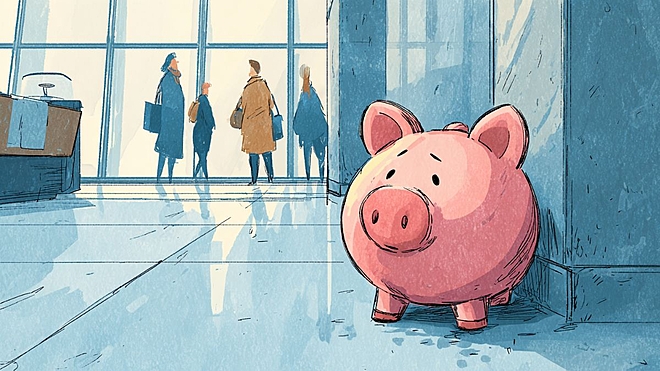
The headlines have been uniformly cheerful. GST rationalisation will make most things cheaper. Income tax cuts mean more money in your pocket. The government's message is clear: spend more, drive growth, make India a consumption powerhouse. It's an economic strategy that makes perfect sense. But here's the uncomfortable question that keeps occurring to me: are we creating a generation that simply cannot save? The numbers suggest we might be doing exactly that, and the implications for individual financial security are not great.
India’s household savings cushion is thinning fast. Net financial savings – the money families put aside in deposits, insurance, or markets after subtracting their borrowings – have slipped to barely 5 per cent of national income in 2023-24, the lowest in decades except for the Covid years. A decade ago, this figure was generally close to 8 per cent. At the same time, debt is climbing – household debt load is now nearly 38 per cent of GDP, and liabilities are rising faster than savings. The most visible sign is that credit card outstandings surged from Rs 2.53 lakh crore to Rs 2.92 lakh crore in just a year.
The pattern is particularly stark among younger Indians. They're borrowing not to buy assets or start businesses, but for what economists politely call "instant gratification" – the latest phone, weekend trips, dining experiences, and lifestyle upgrades that previous generations would have saved for months to afford.
Suggested read: Tax incentives: A debate on habit formation
Now, before this sounds like the usual generational finger-wagging, let me be clear: the current policy direction isn't inherently wrong. Lower taxes and reduced GST rates will indeed boost consumption and drive economic growth. A thriving consumption economy creates jobs, increases business revenues, and can lift living standards across the board. Countries like the United States have built tremendous prosperity on consumption-led growth models.
The problem isn't with the policy; it's with the assumption that individuals will naturally maintain healthy financial habits regardless of the incentive structure around them. When everything becomes easier to buy and taxes become lower, when credit becomes more accessible and social media constantly showcases consumption as a lifestyle aspiration, saving becomes the last priority.
This matters a lot for your personal finances, regardless of what it means for GDP growth. The mathematics of compound interest works both ways. Just as saving early creates enormous wealth over decades, the habit of spending everything you earn – or worse, spending more than you earn – creates a financial hole that becomes progressively harder to escape.
Suggested read: The habit machine
Consider this: someone who invests Rs 1.2 lakh once a year starting at age 25 will have about Rs 3.2 crore by age 60, assuming a modest 10 per cent annual return. Delay the habit by just ten years, starting at 35, and the final corpus shrinks to barely Rs 1.2 crore. The person who never saves and only consumes? They’ll reach retirement with little beyond their EPF balance and whatever their children might provide.
The encouraging news is that developing a savings habit doesn't require you to live a life of deprivation or ignore the real benefits of lower taxes and cheaper goods. The trick is to automate your savings before you get a chance to spend the money you're saving on taxes. When your take-home salary increases due to lower income tax, immediately set up an SIP for the difference. When GST cuts make your monthly shopping cheaper, transfer those savings into a separate investment account.
The most insidious aspect of consumption-led behaviour is how reasonable it feels at the moment. After all, you're earning more due to tax cuts, things cost less due to GST rationalisation, and credit is readily available for anything else. Each individual purchase decision seems perfectly rational. It's only when you step back and look at the cumulative effect over the years that the problem becomes apparent.
This is what the cheerful headlines about consumption-led growth don't mention – economies can recover from poor policy decisions, but individuals rarely recover from decades of poor financial habits.
Also read: GST cut boost: Our top-rated auto stocks that can gain
Ask Value Research 


 New episodes every Friday








 New Process Alert
  Seems like you've uploaded a wrong QR code. Please upload the QR code downloaded from MF Central platform.


