 Widely read:




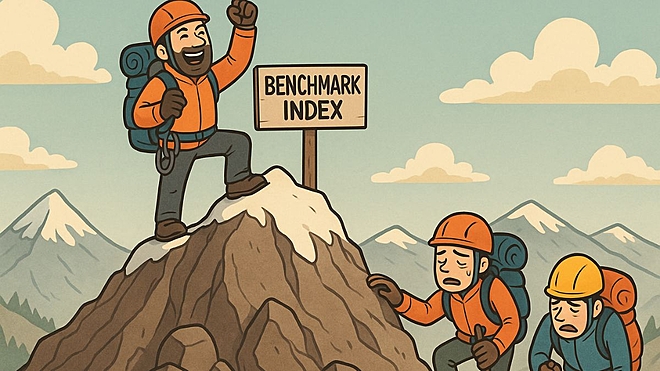 Aditya Roy/AI-Generated Image

Summary: Large-cap funds are meant to be the “safe bets” of equity investing, managing nearly Rs 4 lakh crore. But here’s the catch: when tested over a long term, only 9 of 26 funds consistently beat the BSE 100 TRI. The rest? They trailed despite charging higher fees. Want to know if your fund made the cut?
Large-cap funds are often seen as the “comfort zone” of equity investing. They put your money in the country’s 100 biggest companies, like Reliance, Infosys, HDFC Bank and TCS. Basically, names that feel familiar and safe. For many investors, that familiarity translates into trust.
And it shows. As of June 2025, large-cap funds manage a massive Rs 3.97 lakh crore of net assets, making them the third-largest pure equity fund category after flexi-cap and mid-cap funds. So far, this financial year, they have attracted fresh inflows of Rs 7,700 crore.
But here’s the uncomfortable truth: despite all the faith and money flowing in, most active large-cap funds haven’t managed to beat the benchmark itself.
Why beating the benchmark matters
Large-cap funds with an active investing strategy are required to put at least 80 per cent of their investors’ money into India’s 100 largest listed companies. The idea is simple: instead of just copying an index like the Nifty 100, the fund manager tries to outsmart the market by picking the right stocks at the right time.
If the fund manager succeeds, you as an investor should earn more than what you would get from a plain-vanilla index fund. If not, you’ve basically paid higher fees for no extra benefit.
So, how do we check if they’ve succeeded?
Understanding rolling returns
We analysed the five-year daily rolling returns over the last five years.
Sounds very fancy, but here’s a simple explanation: Imagine you started investing on January 2, 2020, and stayed invested till January 2, 2025. That’s one five-year snapshot. Then we shift by a day, start on January 3, 2020 and end on January 3, 2025. That’s the second snapshot. We kept repeating this for every trading day.
In total, we got 1,235 such five-year snapshots. For each one, we asked: did the fund beat the benchmark or not?
This way, we can tell if a fund is winning most of the time, or if it only looks good because of a few lucky streaks.
What the data reveals
We studied all 26 active large-cap funds with at least a 10-year history. While their benchmarks vary — some follow the Nifty 100 TRI, others the BSE 100 TRI — we used the BSE 100 TRI for consistency.
We found that the BSE 100 TRI’s average five-year rolling return was 15.5 per cent annualised returns.
Based on BSE 100 TRI’s performance, we had the following observations:
- Only nine out of 26 active large-cap funds managed to outperform the benchmark.
And the top three were:
- Canara Robeco Large Cap (Direct): 17.54 per cent
- Nippon India Large Cap (Direct): 16.26 per cent
- ICICI Prudential Large Cap (Direct): 16.24 per cent
The other large-cap funds that beat the benchmark are: Axis (15.51 per cent), Baroda BNP Paribas (15.97 per cent), Edelweiss (16.1 per cent), Invesco India (15.65 per cent), Kotak (16.01 per cent) and Mirae Asset (15.58 per cent).
Direct vs Regular: A quick detour
Every mutual fund comes in two flavours: direct plans and regular plans.
- Direct plans are bought directly from the fund house and come with lower expenses.
- Regular plans are bought through distributors or agents and include their commission.
Over time, this cost difference means direct plans always deliver slightly higher returns than their regular counterparts.
A closer look at the top three
- Canara Robeco Large Cap: The standout performer. It beat the benchmark 87 per cent of the time, something we covered recently. That’s the kind of consistency investors dream of.
- Nippon India Large Cap: Its average return looks good at 16.26 per cent, but the ride has been uneven. It beat the benchmark only 45 per cent of the time, which means it delivered higher returns than BSE 100 TRI in 555 of the 1,235 trading days.
- ICICI Prudential Large Cap: With a 16.24 per cent average return, it looks solid on paper. However, it outperformed the benchmark just 41 per cent of the time, or 516 of the 1,234 rolling periods.
Our take
The sobering truth is clear: most active large-cap funds have failed to justify their management fees. If you’re paying a professional to beat the market, shouldn’t you expect consistent results?
That’s why you need to be selective. At Value Research Fund Advisor, we do the hard work of identifying which active large-cap funds are truly worth owning, those that combine strong returns with reliability.
And if you’d rather not take that risk at all, consider passive large-cap funds that simply mimic the benchmark. They won’t beat the market, but they won’t lag behind either. And they come at a fraction of the cost. We recommend the best options in this space, too, in Fund Advisor.
Also read: 8 top-performing large-cap mutual funds in last 10 years
Ask Value Research 

 New episodes every Friday










 New Process Alert
  Seems like you've uploaded a wrong QR code. Please upload the QR code downloaded from MF Central platform.


