




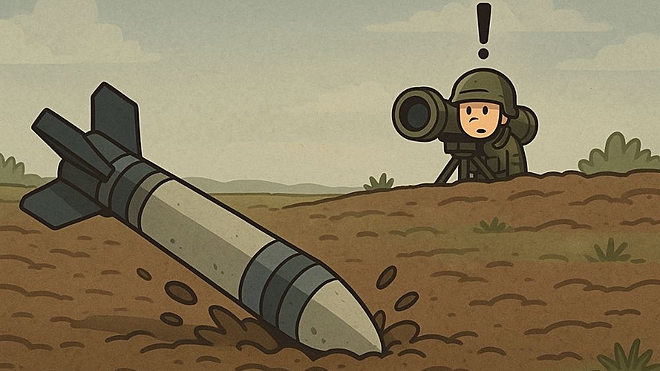
 AI-generated image

Defence stocks have gone ballistic in the past month. As geopolitical tensions flared between India and Pakistan following Operation Sindoor, investors, anticipating a ramp-up in government spending on military modernisation, rushed to grab shares of defence manufacturers. Paras Defence is up 32 per cent, Ideaforge 31 per cent, and Data Patterns 27 per cent in just one month.
Explosive rally
| Company | 1-month returns (%) |
|---|---|
| Paras Defence | 32 |
| Data Patterns | 27 |
| Cochin Shipyard | 5 |
| DCX Systems | 24 |
| Mazagon Dock | 10 |
| Bharat Dynamics | 11 |
| Hindustan Aeronautics | 6 |
| Bharat Electronics | 9 |
| MTAR Tech | 7 |
| Ideaforge | 31 |
| Data as of May 12, 2025 | |
Such rallies are not a first. The sector, in recent years, has been on the upswing. The recent conflict is sparking renewed interest in hopes that it will keep orders and revenue growth flourishing. However, the optimism may not hold up if the past is anything to go by. The rally has mostly been driven by sentiment overshooting reality. And when you heed other risks, the current euphoria further seems overdone. Here's why:
The reality of past gains
Here's the truth about the stellar returns of recent years—they have mainly been driven by P/E re-rating rather than earnings growth. A look at the industry's gains over the past five years reveals that much of the share price appreciation has come from rising valuations, not matching business performance. Take Bharat Dynamics and Cochin Shipyard , for example; their stock prices have surged more than 13 times each, but their earnings per share (EPS) grew only 1.2 and 1.4 times, respectively. This indicates that investors assigned a steep premium to these businesses over time, possibly anticipating future growth, but earnings haven't kept pace. This means if prices remain ahead of profit growth, all these gains can erode.
Prices mount while EPS lags
5-year growth (in times)
| Company | Share price | EPS | P/E |
|---|---|---|---|
| Zen Technologies | 38.2 | 3.6 | 10.6 |
| Hindustan Aeronautics | 17.5 | 3.0 | 5.8 |
| Solar Industries | 15.5 | 3.9 | 4.0 |
| Astra Microwave | 13.0 | 2.9 | 4.5 |
| Bharat Dynamics | 14.3 | 1.2 | 11.9 |
| Garden Reach Ship | 14.1 | 2.7 | 5.2 |
| Cochin Shipyard | 13.4 | 1.4 | 9.6 |
| Bharat Electronics | 13.0 | 3.6 | 3.6 |
| Dynamatic Tech | 11.7 | 2.6 | 4.5 |
| Mishra Dhatu Nigam | 1.5 | 0.5 | 3.0 |
|
Data as of April 29, 2025
Companies with at least five-year trading history P/E and EPS growth calculated based on trailing 12 months EPS of December 2019 and 2024 |
|||
Order uncertainty is the Achilles' heel
Defence stocks often ride on the strength of their order book, but a few good quarters don't necessarily indicate a sustained pipeline. Order inflows are usually lumpy and erratic. This is a key structural limitation for the industry due to its near-total dependence on the government for business. Since defence firms typically cater to a single buyer—the Ministry of Defence—this concentrated customer base limits pricing power and exposes companies to policy delays and budget uncertainties. The result is a business model marred by uncertainty and unpredictability, where revenue growth is often inconsistent.
This is evident from the books of many industry players. Take Zen Technologies , a known-market favourite for its anti-drone systems and combat training simulators. Its order book surged from Rs 431 crore in FY22 to a peak of Rs 1,402 crore in FY24, only to dramatically shrink to Rs 816 crore as of December 2024, with negligible fresh orders in the past two quarters. In Q1 FY25, new wins were just Rs 11 crore. Over the following months, this shaved off more than half of the stock's value.
Similarly, Ideaforge —seen as a leader in drone manufacturing—has seen a sharp decline in its defence business. Revenue contribution from the segment has dropped from 75 per cent in FY24 to 59 per cent in FY25 and just 4 per cent in Q4 FY25! Its order book has plunged from Rs 311 crore in FY22 to a mere Rs 14 crore in FY25. These fluctuations underscore how uneven and unpredictable the execution pipeline tends to be.
Frothy valuations
Another sobering factor investors should revisit is the sector's valuations. The average P/E of the stocks given in our table was around 15 times until five years ago, which is 60 times now. Individually, too, they are trading at steep multiples—Bharat Dynamics at 100 times, MTAR Tech at 102 times,s and Paras Defence at 88 times—far above their historical averages. Value Research's valuation scores also flag most of them as expensive. Such elevated valuations mean the stocks are priced for perfection, leaving no margin for error. However, the above weaknesses suggest the businesses are anything but perfect.
Searing multiples
| Company | Valuation Score | Current P/E |
|---|---|---|
| Paras Defence | 2 | 88 |
| Data Patterns | 3 | 74 |
| Cochin Shipyard | 2 | 50 |
| DCX Systems | 7 | 64 |
| Mazagon Dock | 2 | 43 |
| Bharat Dynamics | 2 | 100 |
| Hindustan Aeronautics | 2 | 34 |
| Bharat Electronics | 2 | 47 |
| MTAR Tech | 4 | 102 |
| Ideaforge* | 3 | - |
|
*Ideaforge P/E is negative due to net losses A Valuation Score between 1-3 is expensive, 4-6 reasonable and >6 attractive |
||
Your takeaway
While defence stocks have captured investor imagination with their recent rally, separating sentiment from substance is important. Much of the past performance is driven by valuation re-rating rather than earnings, order books remain patchy and dependence on a single client adds structural vulnerability, even if the recent conflict leads to increased defence spending. These factors make the sector vulnerable to disappointment if expectations aren't met. Investors would do well to tread cautiously.
Also read: Defence Stocks Surge Amid Record Orders
Ask Value Research 
 New episodes every Friday













 New Process Alert
  Seems like you've uploaded a wrong QR code. Please upload the QR code downloaded from MF Central platform.


