




 Aditya Roy/AI-Generated Image


A reader asked me recently what percentage of one's equity portfolio should be invested in foreign stocks. It's a common question, and many investors expect a neat, tidy number - perhaps 20 or 30 per cent - that they can apply to their portfolio and sleep soundly. But after thinking about it, I realised there's no theoretical basis for this, unlike debt-equity allocation guidelines.
When discussing debt versus equity allocation, we deal with fundamentally different asset classes with distinct characteristics. Debt is predictable, contractually defined, and generally less volatile. Equity represents ownership, with all its attendant risks and potential rewards. The differences are clear, and allocation rules make sense.
Suggested read: Yehi hai right balance
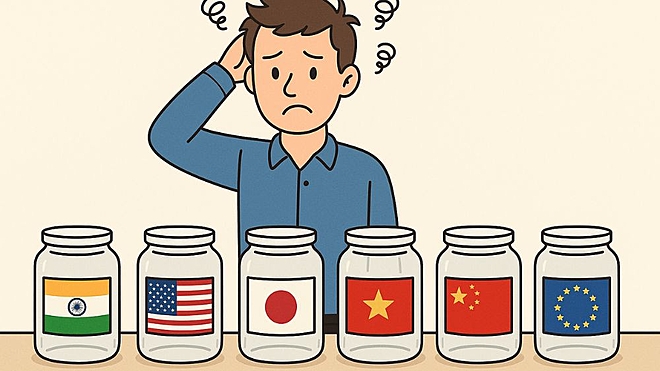
But what about Indian versus American versus Japanese equities? Note that they're all the same asset class. Equity is equity, regardless of which country's stock exchange it trades on. In theory, there's no reason why an Indian investor shouldn't have 100 per cent of their equity portfolio in US stocks, Japanese, European, or any combination thereof. The same applies to investors in those countries considering Indian equities.
This might sound radical to those fed a steady diet of "home bias" investment advice. But think about it: if a company is a sound investment with strong fundamentals and growth prospects, why should its geographical location be anything more than another detail to consider? When you buy shares, you buy ownership in a business, not a slice of national territory.
Suggested read: Be a real investor
Of course, reality complicates this theoretical purity considerably. Regulatory constraints exist in most countries, including India, where direct foreign investment options for retail investors are limited in type or size. Our tax laws treat foreign investments differently and less favourably. Then there's the perpetual uncertainty of exchange rates, which can significantly impact returns (positively or negatively) when translated back to rupees.
Other considerations further compound these practical constraints. Legal recourse is considerably more challenging when investing across borders. If something goes wrong with your investment in a foreign land, good luck navigating unfamiliar legal systems, perhaps in a different language, with other standards and at a much higher cost.
Suggested read: Starting with foreign stocks
We also live in times where geopolitical stability can no longer be taken for granted. Trade wars, sanctions, and diplomatic spats can suddenly transform a sound investment decision into a frozen asset overnight. Ask anyone who had investments in Russia when the Ukraine conflict began, or Western companies that found their Chinese operations under unexpected scrutiny.
Information asymmetry presents another challenge. Despite our hyper-connected world, local investors still have access to nuances and cultural contexts that aren't easily transmitted through quarterly reports or press releases. An acquaintance who works in an industry might provide insights that a foreign investor thousands of kilometres away would never learn.
But despite these very real complications, investors should approach geographical allocation with the same clear-eyed rationality they (hopefully) apply to other investment decisions. The question shouldn't be "what percentage should I invest abroad?" but rather "where can I find the best investment opportunities given my constraints?"
Suggested read: Why Buffett likes capital efficiency over growth
Some investors might conclude that the complications of foreign investing outweigh the benefits. Others might see particular opportunities in specific markets that warrant considerable allocation. The tech enthusiast might see more potential in American markets, while someone bullish on manufacturing might look to regions with growing production capabilities.
What's important is to recognise that there's no magic number or universal rule that applies to everyone. Equity allocation across geographical boundaries is ultimately a personal decision based on your specific circumstances, knowledge, goals, and risk tolerance.
So if someone confidently tells you you should have exactly 25 per cent of your portfolio in international equities, remember. Unlike the sensible distinction between debt and equity, this "rule" has little theoretical basis. It may be practical advice for some, but it's not a universal truth. In investing, as in life, the most important borders are often created in our minds.
Also read: Zero or hundred?
Ask Value Research 

 New episodes every Friday









 New Process Alert
  Seems like you've uploaded a wrong QR code. Please upload the QR code downloaded from MF Central platform.


