




 AI-generated image
Most businesses don't die with a bang. They just quietly rot from the inside. You don't see it in a single quarter or even a single year. But give it time—and the decay becomes impossible to ignore.
That's why Buffett keeps returning to one simple idea: return on capital. Not revenues. Not growth. Not "transformational vision." Just this: how much does a business earn relative to what it needs to keep running and growing?
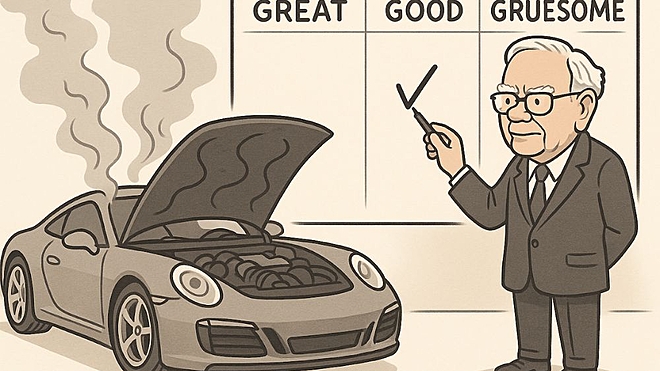
This was the basis of Buffett's investing framework laid out in his 2007 letter. The framework, which separates businesses into three kinds—great, good and gruesome—is so elegant and useful that it deserves a place in every investor's toolkit. The letter also goes into how to actually evaluate investment performance when the market is shouting at you every day. We have unpacked it all in this story, a part of our series on Buffett's annual letters.
The art of picking a business
Investors love to obsess over business models. And why wouldn't they? It's fascinating to analyse how a company makes money, scrutinise its growth prospects and find out its uniqueness. But knowing the business model is not enough. What you need to understand first is the economics of the business.
Buffett's framework of the great, the good and the gruesome businesses is an antidote to this obsession with business models. Stop getting lost in the glamour of a company's product or service. Instead, look under the hood. Ask yourself: what kind of returns does this business generate? How much capital does it require to grow? And what does that mean for you, the investor?
The great business
A great business is more than a clever idea or an iconic product-it's an economic engine that compounds wealth with minimal effort. Buffett's See's Candies is the perfect example.
See's sells chocolates but what makes it great is not the product-it's the numbers. Since its acquisition in 1972, See's has required just $32 million in additional capital to grow pre-tax profits from $5 million to $82 million (2007). Meanwhile, it has sent $1.35 billion in pre-tax profits to Berkshire Hathaway.
The greatness of See's Candies
| Particulars | Value |
|---|---|
| 1972 | |
| Purchase price | $25 million |
| Sales | $30 million |
| Profit before tax | $5 million |
| Capital required | $8 million |
| Return on invested capital | 63 per cent |
| 2007 | |
| Sales | $383 million |
| Profit before tax | $82 million |
| Capital required | $40 million |
| Return on invested capital | 205 per cent |
| Profit before tax reinvested in the company | $32 million |
| Total profit before tax from 1972 to 2007 | $1,350 million |
| $1 reinvested resulted in earnings of | $42 |
This is what makes See's "great." It's a business that generates cash faster than it consumes it, creating an ever-widening moat as it grows.
Now, compare this with the frenzy over tech startups today. They may boast innovative business models, but many guzzle cash just to stay afloat. The real test is not what they sell but how efficiently they turn capital into profits.
The good business
Good businesses have solid economics but lack the compounding magic of great businesses. They deliver decent returns but need significant reinvestment to grow.
Take FlightSafety, another Berkshire Hathaway company. It dominated flight training, offering great value to customers. But it operates in a capital-intensive industry. Growing its earnings has required continuous investment in simulators to match new aeroplane models.
The economics of a good business: FlightSafety International
| Particulars | Value |
|---|---|
| 1996 | |
| Profit before tax | $111 million |
| Net investment in fixed assets | $570 million |
| Return on invested capital | 19 per cent |
| 2007 | |
| Cumulative depreciation | $923 million |
| Cumulative capex | $1,635 million |
| Profit before tax | $270 million |
| Net investment in fixed assets | $1,079 million |
| Return on invested capital | 25 per cent |
| Incremental investment | $509 million |
FlightSafety's profits have grown significantly since Berkshire acquired it, but only because it continuously put up more capital. As Buffett puts it, this is the "put-up-more-to-earn-more" story faced by most companies.
The gruesome business
Then there's the gruesome category. These businesses have a toxic combination: rapid growth, insatiable capital needs, and pathetic returns.
The airline industry is a classic example. While passenger numbers may rise, the economics are brutal. Airlines require huge sums of capital to maintain fleets and compete on razor-thin margins. In the end, investors are left holding the bag, funding growth that generates little to no return.
How to use Buffett's framework
As investors, our job is to allocate capital wisely. This means seeking out great businesses that compound returns with minimal reinvestment, settling for good businesses when necessary and avoiding gruesome businesses at all costs.
Buffett's framework also serves as a reminder to look beyond growth alone. A rapidly growing business might seem appealing, but if it requires constant capital and delivers mediocre returns, it might not be worth it. Conversely, a slow-growing business with high returns on capital can be a wealth-building machine.
The next time you evaluate a company, ask yourself: Is this a great, good or gruesome business? The answer might make all the difference in your investing journey.
How does Buffett evaluate performance?
Buffett doesn't care what the stock price does in any given year. It's not the scoreboard. The real questions are:
-
Given the industry conditions, are earnings growing?
- Has the company's moat widened?
This sounds subjective and it is. But that's the point. Investing is not a science experiment with perfect measurements. It's a judgement call, made with imperfect information.
The bottomline: Don't just seek growth, seek greatness
The 2007 letter reminds us that the best investments are not always the fastest-growing or the flashiest. They are the ones that quietly earn more on each dollar of capital, year after year, without needing a reinvention every few quarters.
If your business can keep growing earnings without growing capital at the same pace, you have got something special. If it needs heavy reinvestment just to stay afloat, tread carefully. And if it can't earn its cost of capital at all—run.
In Buffett's world, greatness is not about size or hype. It's about returns that compound quietly and moats that hold firm. The rest is just noise.
Also read: Buffett's 2005-06 letters: On moats, managers and money
This article was originally published on April 26, 2025.
Ask Value Research 

 New episodes every Friday











 New Process Alert
  Seems like you've uploaded a wrong QR code. Please upload the QR code downloaded from MF Central platform.


