




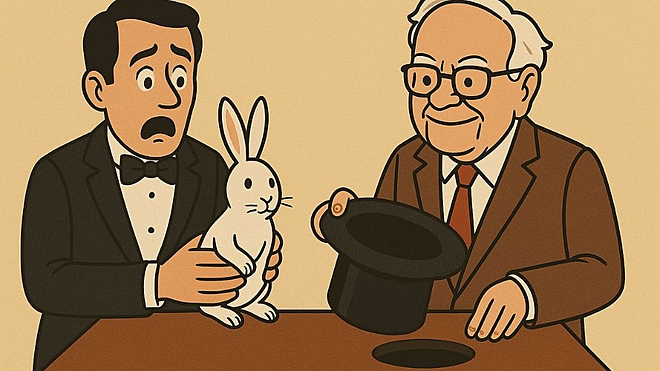
 AI-generated image

By the early 2000s, Wall Street was grappling with a growing sense of distrust. The dotcom bubble had burst, leaving many investors burned, and corporate scandals like Enron and WorldCom shattered faith in financial reporting. In the midst of this turmoil, Warren Buffett stepped forward with his trademark clarity, questioning the practices that were driving the market's instability and calling out the myths that were masking the risks.
Buffett's letters from 2002 to 2004 may not have been his most glamorous but they were some of the most consequential. They marked a shift from Buffett as the sage investor to the outspoken critic, unafraid to call out the systemic issues threatening the financial world. We lay out his insights in this story, part of our series on his annual letters.
Derivatives: When profits are made up and the risk is real
In 2002, Buffett famously called derivatives "financial weapons of mass destruction." That line made headlines. But the deeper insight was this: derivatives are not just risky—they are deceptive.
Derivatives are essentially contracts that promise future payments based on the value of something else—like interest rates, stock prices, or even the weather. What's troubling is that before these contracts settle, companies can record these future promises as either profits or losses, even though no actual money has exchanged hands yet.
To value these contracts, companies often rely on internal models—called "mark-to-model"—rather than actual market prices. In theory, it sounds reasonable, but in practice, this can lead to inflated profits on paper and bloated bonuses for executives. Buffett called this "mark-to-myth" because it often painted a misleading picture of a company's financial health.
The real danger comes when the market shifts. Many derivatives require companies to post additional collateral if their financial standing worsens, which can lead to sudden liquidity crises. And because so many financial institutions are interconnected through these contracts, a problem in one can quickly escalate throughout the entire system.
Buffett was not saying derivatives had no use—he himself used them selectively. But he believed the growing complexity, weak accounting standards, and poor incentives made the system fragile. His advice to investors and regulators: Don't mistake complicated contracts for intelligent risk management.
Why boards fail and what to fix
One of Buffett's sharpest commentaries during these years was on the failure of corporate governance—particularly the passivity of boards.
Buffett observed that boardrooms are social environments. Challenging the CEO, questioning a proposed acquisition, or pushing back against excessive pay often feels impolite. Especially when advisors and consultants are already nodding along.
That is why he endorsed regular meetings of outside directors without the CEO present. But structure alone is not enough. What matters is mindset. Independent directors must also be business-savvy, shareholder-oriented and willing to challenge the consensus when needed.
He criticised the rise of compensation consultants and the tendency of boards to follow their recommendations unquestioningly. He also pointed out a deeper problem: many directors rely on board fees for income or are hoping for future appointments. That dependence compromises their independence far more than regulators admit.
Buffett was simply of the view that governance reform won't succeed without engaged owners. Large institutional shareholders have the power to demand change but they need to act like owners, not spectators.
Auditors, answer these four questions
Audit committees, Buffett says, can't audit. So what can they do? Their real job is to ask tough, specific questions that force auditors to be honest about the numbers. These questions should be asked early. Before the earnings are published. Before the press release goes out.
Buffett proposed four key questions for auditors:
- Would you have prepared these financials differently if it were up to you?
- As an investor, do these statements tell you what you need to know?
- Are the company's internal controls strong enough to rely on?
- Have any revenues or expenses been shifted between quarters?
If the answers are recorded, disclosed and discussed, a lot of funny business gets caught before it starts. If they are not, well, don't act surprised when the cockroach skitters out of the footnotes.
Three investing rules worth framing
Buried in the 2002 letter is a trio of Buffett's principles that should be printed, framed, and stuck on every investor's wall:
- Watch out for weak accounting. If a company won't expense stock options or uses unrealistic pension assumptions, assume similar corner-cutting is happening elsewhere.
- Beware of jargon-filled disclosures. If you can't understand a footnote, it's often because management doesn't want you to.
- Be sceptical of precise earnings guidance. Businesses don't operate in straight lines. When CEOs consistently hit their numbers quarter after quarter, it may be because they are managing expectations or managing earnings.
It's classic Buffett. Less about formulas, more about sniff tests.
Why most investors underperform—and what to do instead
In 2004, Buffett tackled a painful truth: Corporate America has delivered terrific returns over the decades. Yet most investors have lagged far behind. Why?
He identified three reasons:
- High costs. Excessive trading, management fees, and commissions eat into returns.
- Fads over fundamentals. Too many investors chase tips and trends rather than studying businesses.
- Poor timing. Many investors buy after markets have risen and sell after declines.
His solution? Keep costs low, invest for the long term and avoid timing the market. Buffett acknowledged the temptation to be "greedy when others are greedy." But discipline matters more than predictions.
Insurance: The quiet engine behind Berkshire's power
Behind the investment philosophy and all the shareholder wisdom lies the engine that powers Berkshire Hathaway—insurance.
Float, Buffett reminds us, is money Berkshire gets to invest for free—so long as underwriting is done at a profit. And at Berkshire, it often is. Why? Because they do what most insurers can't stomach: they shrink when pricing is stupid.
From 1986 to 1999, Berkshire's insurance business contracted massively. Not because they could not win business, but because they refused to underprice it. No layoffs. No growth-at-any-cost. Just relentless discipline.
At GEICO, they win by being the low-cost operator. In reinsurance, they win by being the name you trust when catastrophe strikes. And across the board, they win by remembering that insurance is a commodity—but promises aren't.
The quiet power of restraint
If there is a theme that runs through Buffett's 2002 to 2004 letters, it's this: Restraint is underrated.
Don't inflate earnings. Don't overpay the CEO. Don't bet on things you can't understand. Don't chase growth if it means writing dumb insurance. Don't forget that even in capitalism's great casino, the house can go broke.
And most of all, don't mistake complexity for insight. The world is noisy enough. Investing doesn't have to be.
Also read: Agatha Christie's investing mysteries: Case closed
This article was originally published on April 25, 2025.
Ask Value Research 

 New episodes every Friday








 New Process Alert
  Seems like you've uploaded a wrong QR code. Please upload the QR code downloaded from MF Central platform.


