




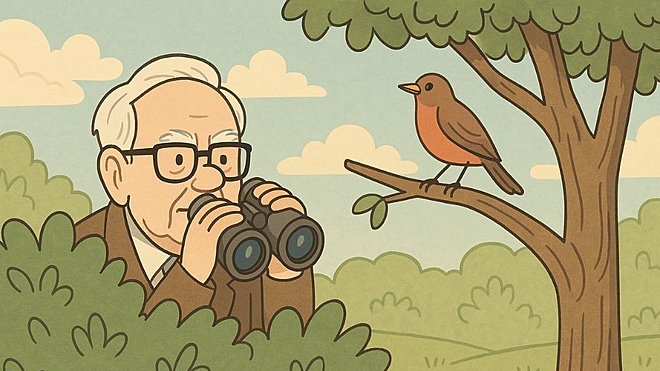
 AI-generated image
In investing, the hardest truths often come dressed as clichés. "A bird in the hand is worth two in the bush" sounds like something your grandmother might say. But in Buffett's 2000 letter, it becomes a full-blown framework for valuing businesses.
This was a time when dot-com madness was at its peak. Everyone was chasing birds they couldn't see, let alone catch. Buffett, as usual, stayed grounded. He reminded us that valuation is not about buzzwords—it's about cash flows, certainty, and time.
In this story—part of our series on Buffett's annual letters—we dive into what he wrote in 2000 and 2001. From ancient fables to insurance accounting, it's a lesson in how not to lose your head when the world is busy doing just that.
Aesop, valuation, and the illusion of growth
Some 2,600 years ago, Greek storyteller Aesop dropped a line that has outlived empires: "A bird in the hand is worth two in the bush." Most people quote it to suggest you shouldn't get greedy. Buffett used it to explain how to value everything from stocks to oil wells.
In his 2000 letter, Buffett took that old proverb and turned it into the foundation of capital allocation. "A bird in the hand" is what you already have. The "bush" is the future. And there are three real questions:
- How many birds are actually there? (cash flow, profit, etc.)
- How long will it take for them to emerge? (payoff period)
- What should you pay today to swap one for two tomorrow? (interest rate for discounting future cash flows)
This idea is not new. But our ability to mess it up? Enduring.
Value ≠ growth ≠ style
Buffett takes a swipe at what he calls "fuzzy thinking" in the markets. You know the type—the pundits and portfolio managers who claim "growth" and "value" are opposing styles. But growth, he says, is just one input in the value equation. Sometimes a big one, sometimes not. Sometimes, even a negative.
If chasing growth burns through more capital than it will ever return, you have destroyed value, not created it. Just ask the long line of dotcom companies that blew up in the early 2000s—many of whom made no money but raised a lot of it.
The point is, growth can be addictive, but it is not free. And more importantly, it is not always worth paying for.
When in doubt, stay out
There's a kind of wisdom in knowing when not to play. Buffett says even brilliant investors often find themselves staring at a bush and seeing only fog. The best of them pass such opportunities due to the unpredictability of the future. That is what separates a value investor from a venture capitalist. It's not about the potential reward—it's about the clarity of the outcome.
You don't need a genius IQ, he reminds us. But you do need business sense and a tolerance for waiting. The only time you swing is when the math—and your conviction—line up. Even if the rest of the world is screaming "Buy!"
The discipline that drives insurance
In insurance, size doesn't matter. Neither does branding. What separates the winners from the wreckage is a cold, unsexy word: discipline.
Buffett lays out three principles for underwriting that should hang on the wall of every insurance CEO's office.
Stay within your circle of competence
Good insurers only underwrite risks they truly understand. That sounds obvious—until you realise how many players chase market share by pricing policies foolishly. Buffett's rule: if you can't evaluate the full spectrum of outcomes, especially the remote but ruinous ones, walk away. Don't stretch for volume. Don't get tempted by price. And don't worry about the fool willing to underwrite what you won't.
Avoid aggregation risks
In other words, don't let one bad day wipe you out. Smart insurers constantly scan for hidden correlations—places where seemingly separate risks can converge into a catastrophe. That is what brings down the house. And it's why underwriting is not just about individual policies. It's about how they interact in the worst possible scenario.
Never do business with bad people
The technical term is moral hazard, but Buffett doesn't sugarcoat it. Some clients will cheat. Some brokers will lie. And no matter how juicy the premium looks, you are better off walking away. In insurance—as in investing—the best results come not from brilliance but from avoiding stupidity.
When you look closely, these are not just underwriting rules. They are principles of good judgment. And in insurance, good judgment is your only real edge.
When earnings are a mirage
Buffett doesn't mince words: a lot of reported earnings in the insurance industry are fiction. Not because of fraud (though that happens too) but because of something more routine—bad estimates.
At the heart of insurance accounting lies a strange truth: the biggest number on the books—the loss reserve—is not cash in the bank but a guess. It's the company's best estimate of what it will eventually have to pay for claims that have already occurred, whether reported or not.
And here is the kicker: if those estimates are wrong (as they often are), then the earnings being reported are wrong, too. Under-reserving makes profits look inflated. It delays the pain, but not forever.
Buffett takes issue with the euphemisms used to explain this. Terms like "loss development" or "reserve strengthening" make it sound like some natural event unfolded. But the losses didn't "develop" later—they were always there. What changed was management's willingness (or ability) to admit it.
The fallout of under-reserving is nasty. It leads to:
- inflated profits in good years,
- surprise charges in bad ones,
- premature tax bills, and
- unjustified bonuses to managers who didn't actually earn them.
And because insurance accounting is largely self-policed—with auditors relying on management's numbers—it becomes a playground for both honest mistakes and deliberate manipulation.
Buffett's message is simple: when it comes to insurance earnings, trust only those who get their reserves right. Everyone else is just guessing—or worse, bluffing.
The thread that ties it all together
From Aesop's bush to Berkshire's balance sheet, there is a single thread running through both letters: clarity. The clarity to know what a business is worth, the clarity to say no to bad risks, and the clarity to admit when you got it wrong.
That kind of clarity doesn't come from models or spreadsheets. It comes from thinking. From understanding what drives cash flows. From knowing your own limitations.
And maybe that is the real lesson here. The best investors are not the ones with the flashiest theories or the most complicated tools. They are the ones who remember that old bird-in-hand rule—and apply it with rigour, not romance.
Also read: Despite family debt, how she started investing
This article was originally published on April 14, 2025.
Ask Value Research 

 New episodes every Friday








 New Process Alert
  Seems like you've uploaded a wrong QR code. Please upload the QR code downloaded from MF Central platform.


