




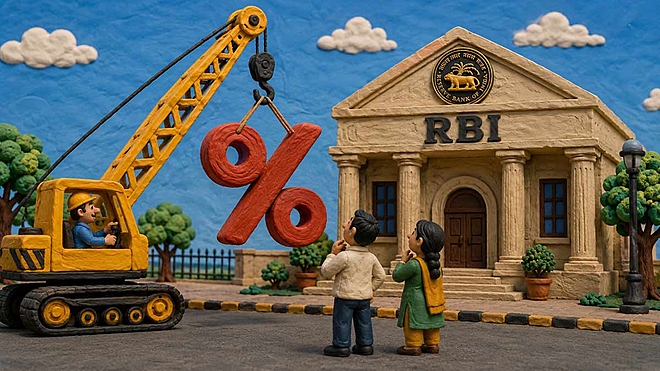
 Anand Kumar/AI-Generated Image
Summary: The RBI's Monetary Policy Committee held the repo rate steady at 5.25 per cent at its June 2026 meeting, making it the third consecutive pause. The central bank revised its FY27 inflation forecast upward to 5.1 per cent and trimmed its GDP growth projection, flagging geopolitical tensions and monsoon risks as key uncertainties.
The Reserve Bank of India's (RBI) Monetary Policy Committee (MPC) kept the benchmark repo rate unchanged at 5.25 per cent on Friday (June 5, 2026), the third consecutive meeting at which the central bank has held rates steady.
The neutral stance was retained alongside the decision, signalling that the MPC is keeping all options open rather than committing to a directional bias toward either further easing or tightening.
Inflation forecast increased to 5.1 per cent
The RBI projected India's Consumer Price Index (CPI) inflation for FY26-27 at 5.1 per cent, about 50 basis points higher than previously projected. Core inflation has been projected at 4.7 per cent for the year.
The upward revision reflects persistent inflationary pressures stemming from elevated energy prices, global supply chain disruptions and emerging risks to the southwest monsoon associated with El Niño.
Growth forecast trimmed
The RBI cut its FY27 GDP growth forecast to 6.6 per cent from 6.9 per cent, citing the US-Iran war supply shock as a factor weighing on the near-term outlook.
Crude oil prices have been climbing, driven by geopolitical tensions, including the West Asia conflict, adding pressure on India's inflation trajectory and the rupee. The decision was in line with market expectations, reflecting the central bank's cautious approach as it balances inflation risks, global uncertainties, and growth considerations.
Measures to boost foreign capital inflows
Governor Malhotra noted that, so far in FY26-27, net FPI flows into India have been outflows of $13.7 billion, primarily in the equity segment. To address this, the RBI has announced the following measures:
- The central bank expanded the range of specified securities under the Fully Accessible Route (FAR) to include all new issuances of 15-year, 30-year and 40-year government securities. It also removed limits on short-term investment, concentration and individual securities for FPI investments under the general route. This is expected to attract foreign capital for government borrowing, alongside tax benefits announced by the government.
- A concessional foreign exchange swap facility was introduced until September 30, 2026, to encourage external commercial borrowings by public sector undertakings.
- A similar facility to cover the full hedging cost will be available until September 30, 2026, for authorised dealer banks, to help raise fresh three-to-five-year FCNR(B) deposits.
The RBI also announced a relaxation of FPI norms for investing in government securities, in conjunction with the government's move to make the country's debt market more attractive by offering tax exemptions to foreign investors in Indian bonds.
Also read: RBI cuts repo rate: What should debt investors do?
Ask Value Research 

 New episodes every Friday









 New Process Alert
  Seems like you've uploaded a wrong QR code. Please upload the QR code downloaded from MF Central platform.


