




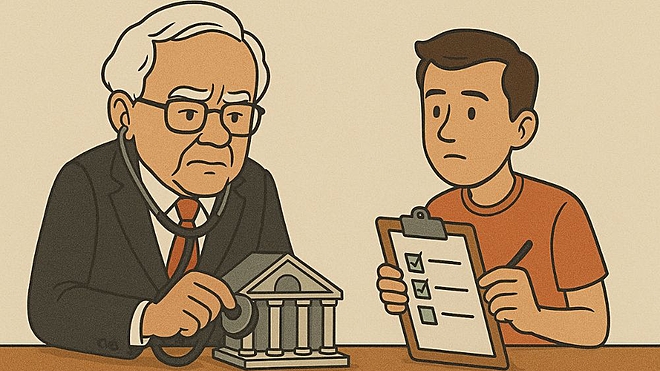
 AI-generated image

In investing, what seems simple on the surface often hides surprising depth. Warren Buffett's 1990 letter to shareholders is a perfect reminder. In this instalment of our ongoing Buffett series , we understand how to really measure an insurance company's performance, why many banks are ticking time bombs and why investors should welcome falling stock prices.
Let's break down three big takeaways from that letter in plain language.
What is float—and why it matters
Most businesses make money by earning more than they spend. But insurance companies are different. They come with a unique feature: float.
Float is the money insurers temporarily hold—the premiums collected from customers that haven't yet been paid out in claims. Though this money doesn't belong to the insurer, it can be invested until it's needed. If managed wisely, the float can generate significant investment income.
But here's the catch: not all float is equally valuable, and profitability in insurance isn't just about making more in premiums than you pay out in claims. It's about managing something called the combined ratio.
The combined ratio is a simple measure: Claims + Operating expenses/Premiums
If the ratio is 100 per cent, it means the insurer breaks even from its core operations—it pays out exactly what it earns in premiums. Anything above 100 per cent means the company is losing money from its insurance operations. But if it can earn enough investment income on the float, the overall business can still be profitable.
Let's look at two types of insurance:
-
Short-tail insurance
(like crop insurance): Claims come in soon after the policy is sold, so there's little time to invest the float. A combined ratio of 100 per cent here means no profit, no matter how well you invest.
- Long-tail insurance (like medical): Claims can take years to arrive and even longer to settle. That gives insurers more time to invest the float. Even a combined ratio of 110-115 per cent might still lead to profits if the investment income makes up the difference.
But this strategy can backfire. If claims are underestimated, they could balloon years later, pushing the actual combined ratio to 200 per cent or more, turning what looked like a profitable business into a money pit.
That's why Buffett cautions against pricing long-tail insurance too aggressively. He says insurers should aim for a combined ratio close to 100 per cent, meaning the business breaks even on underwriting, and let investment income be the bonus, not the lifeline.
But Buffett goes further. Rather than just looking at combined ratios, he focuses on the cost of float. This is the price the insurer pays (in the form of underwriting losses) to access and use float. For example, in 1990, Berkshire had an underwriting loss of $27 million while holding $1.6 billion in float—a cost of about 1.6 per cent. In some years, the underwriting was profitable, which meant Berkshire was effectively being paid to borrow money. That's the holy grail.
Still, he reminds readers that float isn't free. Insurers have to pay taxes on the income generated. But if the cost of float stays low over time, the insurance business can become a serious value creator.
Why Buffett is cautious about banks
Buffett does not mince words when it comes to banking. He is wary, and for good reason.
Banks borrow heavily to fund their operations. For every rupee of their own money (equity), they might borrow Rs 20 in assets—like loans to businesses and individuals. This means they're operating with 20 times leverage.
That works well as long as everything goes smoothly. But if just a small portion of those loans go bad, the bank's thin layer of equity can get wiped out. That's the dangerous flip side of leverage—it magnifies both gains and losses.
And worse, banks often fall into the trap of copycat behaviour. Buffett calls this the institutional imperative—the tendency of banks to do what their peers are doing, regardless of whether it's wise.
In good times, banks tend to lend money aggressively, mostly because almost every other bank does it. But when things turn sour, they often get caught swimming naked.
However, not all banks are the same. Buffett praised Wells Fargo for managing risk wisely. Even after taking big losses on loans, it still earned over $1 billion before taxes. Even in a severe downturn—(say) if 10 per cent of its $48 billion loan book went sour and lost 30 per cent of principal—it would likely still break even. That's the kind of careful management Buffett values.
How Buffett evaluated Wells Fargo in 1990
A conservative way to evaluate banks
| Particulars | $ million |
|---|---|
| Profit before tax | 1000 |
| Loan losses | 300 |
| Profit before tax and loan losses | 1300 |
| Loan book | 48000 |
| If 10% of all loans were hit by problems and these produced losses (including foregone interest) averaging 30% of principal | 1440 |
| New profit before tax and loan losses | -140 |
His advice is simple: don't buy a bank just because its stock looks cheap. If it's poorly managed, the leverage will crush it. Only buy into banks that are run by people who know what they are doing. And price does not matter as much as management does.
When prices fall, be happy
If you plan to keep investing for the rest of your life, then falling prices are your ally—not your enemy.
This might sound obvious. After all, if you are going to buy something repeatedly, wouldn't you prefer to pay less for it? That is how we feel about groceries, clothes and fuel. But strangely, investors don't apply the same logic to stocks. When prices fall, they panic. When they rise, they cheer.
Buffett says that at Berkshire, they're buyers of businesses year in and year out—whether through full ownership or stock purchases. So they prefer lower prices. High prices actually make it harder for them to invest.
The best time to buy, Buffett reminds us, is when pessimism is thick in the air. Not because it feels good but because it leads to better prices. But don't mistake this for blind contrarianism. Just because something is hated doesn't make it a good buy. What you need is independent thinking, not just going against the crowd for the sake of it.
He quotes Bertrand Russell to drive the point home: "Most men would rather die than think. Many do."
Conclusion
Buffett's 1990 letter doesn't shout. It nudges. It reminds us that good investing is less about intelligence and more about mindset, about thinking clearly when everyone else reacts blindly.
Whether it's evaluating the real cost of float, resisting the glamour of over-leveraged banks or embracing market pessimism, the lesson is the same: think independently, stay grounded and remember that price is what you pay; value is what you get.
Simple? Yes. Easy? Never. But that is what makes it fun.
Also read: How Buffett evolved as an investor
This article was originally published on April 04, 2025.
Ask Value Research 

 New episodes every Friday








 New Process Alert
  Seems like you've uploaded a wrong QR code. Please upload the QR code downloaded from MF Central platform.


