




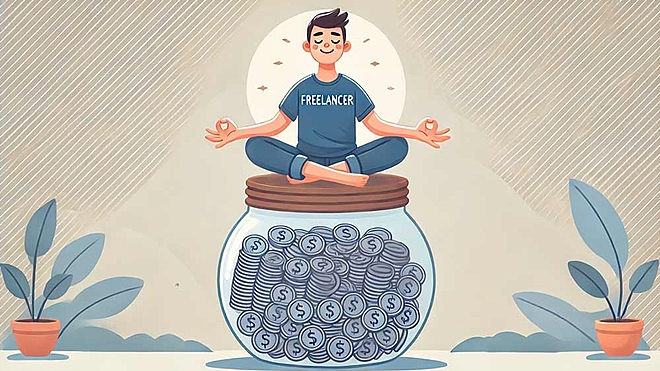

A couple of years ago, I made the leap from a comfortable 9-to-5 job to freelancing, drawn by the promise of freedom, flexibility and creative fulfilment.
However, the reality was far from what I expected. Not only did I struggle to find consistent projects, but getting timely feedback from clients was a challenge, and worse, payments were often delayed.
How do freelancers ensure financial safety, then?
Most financial advice out there is geared towards those with a stable income, like salaried employees. But what about freelancers who are mostly unsure when or where their next paycheck will come from? How can we secure our financial future while enjoying the benefits that freelancing offers?
Rather than sitting and bemoaning my lack of financial stability, here's what I did to ensure financial stability while building my freelance career.
My three-step path to building a financially secure future
Step 1: Build a safety net
As a freelancer, your source of income can be highly unpredictable. One month, you may earn Rs 1 lakh; the next, you may struggle to earn Rs 40,000-50,000. That is why it is critical to build an emergency corpus that can cover at least six months of your expenses so that you can at least make ends meet without getting anxious about your next paycheck.
To do so, calculate your monthly expenses (both personal and professional) and set aside a sum that can cover you for at least six months.
Suggested read: How can a three-layered emergency corpus help you ride out emergencies?
What's more, you should also buy a health insurance policy. Medical inflation is real, and a single hospital stay or emergency can seriously dent your finances. So, buy adequate health insurance for yourself and your family.
Step 2: Invest every month
This may seem easier said than done since you don't know how much you will earn monthly. But this doesn't mean that you don't invest at all.
Here's a simple approach you can follow:
- While your income will vary, you can estimate the minimum amount you expect to earn every month.
- Then, calculate the amount you need to cover your basic monthly expenses.
- Once done, deduct your expenses from the minimum amount you expect to earn monthly. What's left should be your monthly investment.
Step 3: Decide where to invest
Just because you are a freelancer doesn't mean you have to compromise on the joys of life, i.e., shopping or going on a holiday. At the same time, you don't need to spend hours scratching your head trying to find the best investment product. Thanks to mutual funds, any investing need can be catered to.
The right way to invest in mutual funds is to determine your financial goals and the time horizon needed to achieve them. Here's how I did it.
For goals that are less than a year away
Choose liquid funds. They are stable, carry low risk and provide better returns than a bank savings account.
For goals that are 1-3 years away
Invest in short-duration debt funds. Like liquid funds, they, too, have low risks. Yet, they typically provide higher returns than bank FDs (fixed deposits) and don't come with a lock-in, making them ideal for meeting short-term goals, such as purchasing a car.
For goals that are 3-5 years away
Consider equity savings funds. These funds invest part of the money in equity while the rest is in debt. The equity portion helps grow your money, while the debt portion cushions it from fluctuations and provides safety.
For goals that are more than five years away
Invest in diversified equity funds like flexi-cap or multi-cap funds. These funds provide exposure across sectors and market caps (large, mid and small).
The takeaway
As a freelancer, it can take time to ensure a steady flow of income every month. But with a financial roadmap by your side, you can at least secure your financial future and achieve peace of mind.
Also read: For freelancers and businesspersons, STP, not SIP, is your best friend
This article was originally published on February 24, 2025.
Ask Value Research 

 New episodes every Friday









 New Process Alert
  Seems like you've uploaded a wrong QR code. Please upload the QR code downloaded from MF Central platform.


