




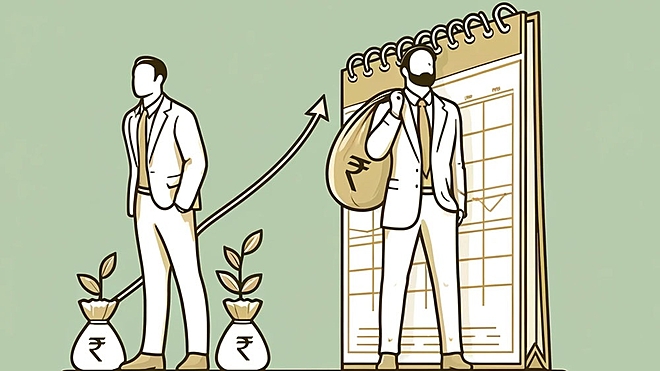
 AI-generated image

Reader’s question: I will be retiring after five years. Presently, I have a large sum of money invested in fixed deposits and want to double it over the next five years. Where should I invest my money? - Manoharan Varadarajan
Let's be straight: doubling your money in five years is not easy. To get there, you would need annual returns of around 15 per cent, which is a stretch even for a portfolio invested entirely in equities.
So rather than chasing that number, the better question is: how much will you depend on this money after retirement?
If your post-retirement expenses are largely funded by your investments, putting everything into equities is too risky. Equity markets can be volatile, and a sharp fall right before or after retirement can hurt you badly. At the same time, keeping everything in fixed deposits is not smart either, since those returns often don't keep pace with inflation over time.
A more sensible approach is to build a balanced portfolio, with roughly half in equity and half in debt. Don't move into equities all at once. Stagger your investments over two to three years to reduce the risk of buying at the wrong time.
With debt returning around 6-7 per cent and equity delivering 11-12 per cent on average, you could realistically expect annual returns of 9-10 per cent. That won't double your money, but it could grow your corpus by 50-60 per cent over five years. To put that in numbers: Rs 10 lakh today could become around Rs 16 lakh by the time you retire.
One more thing to keep in mind: hold at least one-third of your portfolio in equity to protect your purchasing power during retirement. And try to limit withdrawals to no more than 6 per cent of your corpus each year.
If, on the other hand, you have other income sources and won't be heavily dependent on these investments, you could push your equity allocation up to 70-75 per cent. But even then, 15 per cent annual returns are not a realistic expectation. And given how much equity can swing in value over short periods, you would genuinely be better off staying invested for longer than five years if you can.
Also read: Should you exit a mutual fund after two bad years?
This article was originally published on May 13, 2024, and last updated on May 20, 2026.
Ask Value Research 
 New episodes every Friday









 New Process Alert
  Seems like you've uploaded a wrong QR code. Please upload the QR code downloaded from MF Central platform.


