




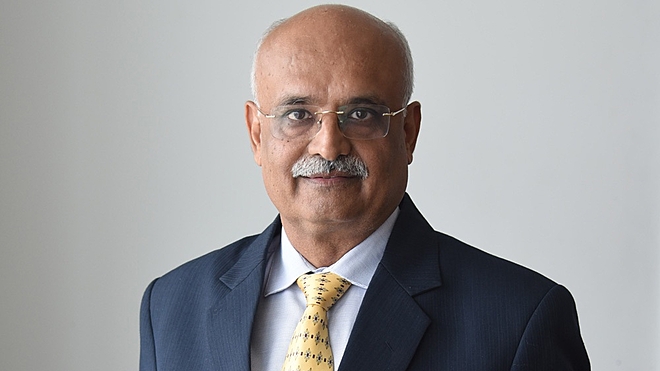


In our chat with Sanjay Chawla, Chief Investment Officer (Equity) at Baroda BNP Paribas Asset Management India, he spills the beans on assessing a company's management quality, the asset allocation model behind their balanced advantage fund, and much more. Here is the edited transcript.
You started as a management consultant in 1990. How did the switch to asset management happen?
The actual journey began when I was in class 10th. During that time, I realised that I needed to understand the stock markets, perhaps purely out of curiosity. This led me to approach a couple of bank managers, as they were the hottest people back in the early 80s and guided me all about the stock market. But, since my entire family was a bunch of engineers and I did well in class 12th, I did engineering. But my ultimate aim was to get into the stock market. So, I did my MBA. Unfortunately, at that time, the role of a stock market analyst was not well-defined. I needed a bridge to get into that business. Hence, I got into management consultancy to look at the demand-supply and get the feasibility of the companies, etc. This gave me an excellent grounding to get into the equity markets.
What kind of stock is untouchable for you?
There are certain principles that we go by. We may not really like certain sectors based on return parameters. There needs to be business predictability, management accountability, and valuation. These are the three things that we would look at. Let me give you an example. In 2010, the sugar industry was doing extremely well based on all the parameters. The domestic prices were rising, and globally, there was a shortage, but the inflation in India was so high that the government came and clamped them down heavily. So, you had a beautiful industry, which, if left alone, would have done extremely well. But you saw a selling interaction; the area in which you could sell and the sugar cane price were also being determined by the government. So, these are the red flags that we look at. When looking at a sector, we try to see all the factors that are under the management's control and those that are not. If too many factors are externally determined, we tend to have the risk profile raised out there.
Within the companies, we need to look at the quality of the management and be very careful. We focus a lot on management. People tend to look at corporate governance as one of the issues; for us, this is a filter before a company comes into our investment universe. We look at management in a much deeper sense. How do they treat the minority shareholders and their employees? What's the depth of the management? How well is the decision-making going all the way down the line? So, if there's a red flag on the management, we tend to be very careful.
So, when and what kind of stock becomes a compelling buy for you?
Typically, we look at if we like the business and the valuations are good. Taking it to a different extent, we see if there's a massive gap between what our research is telling us and what the market believes. When the gap is highest, there's a bold call you have to take because the entire market thinks otherwise, and you believe something else is going to happen, whether in terms of business or stock price. In the last 30 years, there have been many such instances not only on the buy side but even on the sell side, which nobody was willing to look at. There's a company called Solar Industries; earlier, it was called Solar Explosives. This is way back in 2010-2011. People did not believe in the kind of business model that they had. I hand-held the company, saw through the public listing, and subsequently, the company has done extremely well. At the time of the listing, it had a market cap of Rs 450-500 crore. Today, it's over Rs 50,000. We've seen the whole company evolve over a period of time, transitioning from a local company to a global company, challenging the dominant global player in the explosive business.
Another one, which was very early in my career, was the time when there were just Kelvinator and Godrej fridges, and that's when Coke was already in the market, and Pepsi was entering. They came up with an innovative open-glass refrigerator, which was a novelty. All you had to do was look behind those refrigerators and see who the manufacturer was. At that time, the total market for refrigerators was about 50 to 75,000 units per annum. Even if you do simple maths in terms of what it takes to supply to all the merchants, you have a 10-bagger out there.
What red flags make you initiate a 'Sell' decision?
The biggest red flag for us is always on the management. If we discover something that is not right, or something that we've discovered later on that's not ethical, or there are some issues in the books, that's a big red flag for us. Another red flag is in terms of the business environment, where there's a change in government policy, which can significantly impact the company's business. The simplest of all is that when we invest in a company, we have a certain investment thesis based on which we invested. Although we look at it from a long-term perspective, that has to be broken down into smaller periods, and we have to monitor how it pans out. The easiest thing is that the growth numbers we were expecting are different from what the company delivers. It's a slow process; the one where we don't wait at all is when we discover something different than what we thought was there.
How do you gauge the actual quality of the management besides the accounting numbers?
Many softer aspects need to be focused on when you interact with the company. We interact with the company at least once a quarter if it's in our portfolio. Not only that, we look at the entire supply chain and gauge what's happening and how they behave with the suppliers, whether they've been paid on time or not. We also tend to look at informal checks with the other employees etc. Formally, it could be as simple as the salaries being paid on time or not. We've seen cases where certain companies look very great on paper, but it doesn't work that way. It's not just the top guy we should be speaking to; it's across the company management that we look at and focus on whether the marketing people are behaving ethically or not. I visited a plant in Gujarat where all the workers were Gujaratis, but all the signs about safety were in English. So what do you make out of it? Were the signs put up for me or for foreign visitors, or was it for the workers? So that's what other soft aspects you need to watch out for in the management quality. If I bifurcate it within the space, the large companies are all clear. So we need to focus on the business part. It's the men in the small-cap companies that we need to focus a lot on management quality.
What drives the asset allocation for your balanced advantage fund?
Baroda BNP Paribas Balanced Advantage Fund is a model-driven fund, where we determine what's going to be the net equity based on our model. There's a lot of science that has gone behind this product in terms of determining what the net equity allocation should be, which is between 30 and 100 per cent. In addition, we have spent a lot of time fine-tuning the model regarding what factors to look at. We started with 47 factors and zeroed it down on four factors—PE ratio, PB ratio, dividend yield, and earnings yield gap. We kept challenging them at every stage - if we should include this factor or not. This continues because we believe the market is very dynamic, and you need to keep challenging the model. Just because it's done well doesn't mean it will continue to do well. Every month, when we are rebalancing, we keep challenging ourselves on why we should continue with this or not.
In the portfolios of your flexi-cap fund, ELSS and diversified categories, we noticed a bullish stance on the construction and real estate sector compared to category averages. What promise do you see in this sector?
We tend to split both construction and real estate separately. When talking about construction, we are looking at one company which is L&T. Our investment thesis is based on three factors, the three C's: the credit cycle, consumption cycle, and capex cycle. The credit cycle is something that was very strong, and we played it out in the last one-and-a-half years. We believe that the consumption cycle will continue to be strong. L&T is a classical play on the construction cycle, and as a house, we are generally overweight across our funds.
On the real estate front, COVID has taught us the need for bigger homes. A lot of IT sector people were going back home, creating a lot of vacancies in various pockets of the market, which led to a slowdown in new construction projects, but with the return to the office, there's a surge in demand for rentals and property purchases. The COVID has led to the realisation that you need a bigger space, and there has been a change in people's attitude towards it. Both these factors have led us to view the sector favourably, and the performance of the real estate sector has reinforced our belief that the decision we made a year-and-a-half ago was correct.
Also read: Interview with Manish Gunwani of Bandhan AMC
Ask Value Research 

 New episodes every Friday








 New Process Alert
  Seems like you've uploaded a wrong QR code. Please upload the QR code downloaded from MF Central platform.


