





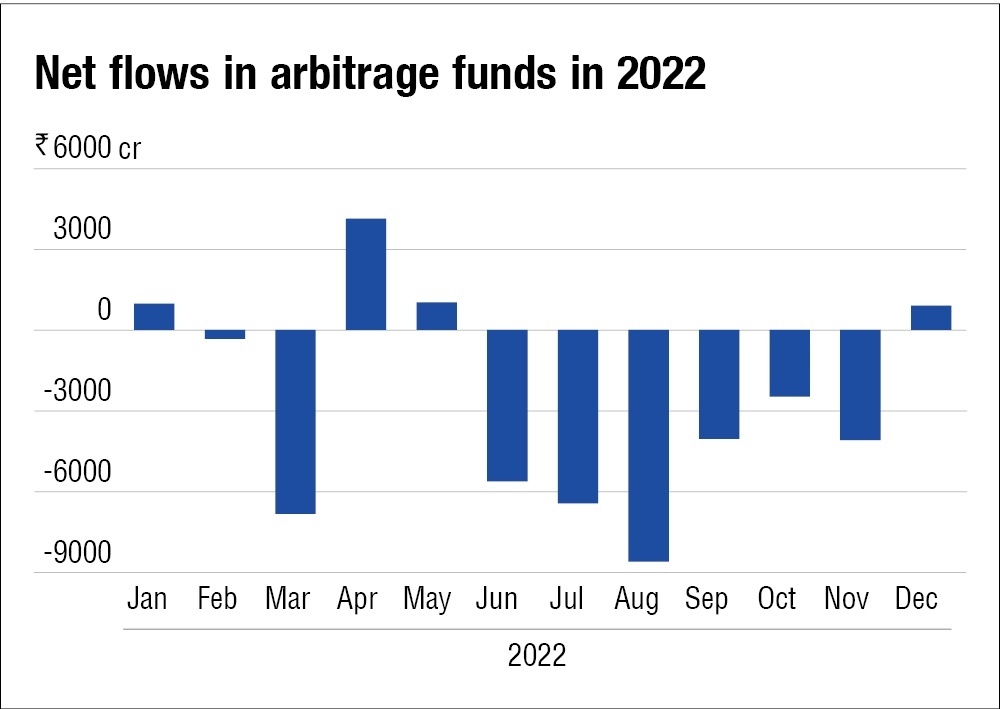
Arbitrage funds, which witnessed sharp outflows for most of 2022, saw a turnaround in December after a gap of six months. These funds received net inflows of Rs 883.29 crore as returns improved and spreads also edged higher.
"The spreads, which were in the range of 5.5-6 per cent per annum, have moved to 7.50 to 8.5 per cent per annum in the last couple of months," said Anoop Bhaskar, Head - Equity at IDFC Asset Management Company Limited.
"We continue to expect the return yields to be in the same or relatively higher range, as spreads on arbitrage funds move in line with interest rate regime," he added.
What are arbitrage funds and spreads
For the uninitiated, arbitrage funds generate returns by simultaneously buying and selling securities in different stock markets to take advantage of price differences.
Let's say Stock A is priced at Rs 200 on the Bombay Stock Exchange (BSE) and Rs 202 on the National Stock Exchange (NSE). An arbitrage fund can jump in and buy the stock from the BSE and sell it at a higher price on the NSE for a Rs 2 profit.
This price difference is known as the spread.
Similarly, there may be a price difference between its current and future prices. For instance, the current price of Stock A might be Rs 150, but the futures market has it at Rs 155. This would give the manager of the arbitrage mutual fund a chance to make a risk-free profit of Rs 5 when the current price matches the future price at the end of the month.
4 Million+ copies sold! Get investment insights, market guidance, fund analysis, data stories, case studies and more. Subscribe to our digital & print magazine - Mutual Fund Insight.
The leading funds in December
Returning to the December performance, DSP, HDFC and ICICI Prudential arbitrage funds were the main beneficiaries of the positive net flow.
Market players believe the spreads can inch higher if the markets remain bullish.
The mini-bounceback comes following a dark few months for the entire category of arbitrage funds. The period between June and November was especially bruising, with more than Rs 31,300 crore getting pulled out from these funds.
Rising interest rates played a part in their poor performance. Investors saw debt funds as a better alternative and moved their money there.
Why people invest in arbitrage funds
Investors typically park their short-term money in arbitrage funds because they are tax-friendly and can deliver better post-tax returns than some debt funds.
Arbitrage funds enjoy the same tax structure as equity funds. Short-term returns (held for less than a year) are taxed at 15 per cent, while long-term returns (held for more than a year) are taxable at 10 per cent. Furthermore, long-term capital gains under Rs 1 lakh do not attract tax.
That said, arbitrage funds incur higher expenses than liquid funds. On average, direct plans of liquid funds have an expense ratio of 0.20 per cent, while for arbitrage funds, it is 0.37 per cent.
Suggested read: Are long-duration funds a good investment choice?
Ask Value Research 

 New episodes every Friday








 New Process Alert
  Seems like you've uploaded a wrong QR code. Please upload the QR code downloaded from MF Central platform.


