




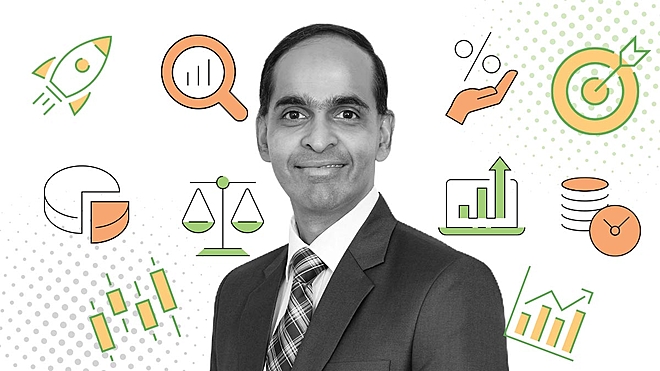
Summary: Discipline, patience and a healthy scepticism of market narratives define Dinesh Balachandran's investing approach. In this wide-ranging conversation, he pulls back the curtain on how he thinks about risk, value and the long game.
Certain equity funds at SBI Mutual Fund have been sitting on higher-than-usual cash positions, not as a house strategy, but as a deliberate call by Dinesh Balachandran. Presently the Head of Investments at the AMC, he explains it simply: when good ideas are scarce, capital should wait. While he admits that holding cash, particularly in bull phases, can hurt performance, being forced into buying something simply because there are inflows is a far worse outcome. Prudence, in Balachandran’s view, is not a constraint; it is the strategy.
Balachandran thinks of investing as a marathon, and he has the credentials to pace one. With over 22 years of experience spanning two continents, he began his career as a structured finance analyst at Fidelity in Boston before returning to India and joining SBI Funds Management in 2012. An IIT Mumbai and MIT alumnus and CFA charterholder, he manages the SBI Contra Fund, which has been rated five stars by Value Research, alongside the multi-asset and balanced advantage schemes.
In this conversation, Balachandran also discusses the AI overhang on IT stocks, the evolving ‘China+1’ thesis in healthcare, how he approaches position sizing in his multi-asset allocation fund and what SIP investors sitting on muted returns should remind themselves of.
Across both your equity funds at SBI Mutual Fund, you actively take cash positions. Is this a house strategy, or is it something unique to you?
This is definitely not a house strategy. It is more specific to me and my approach. The thought process here is that we are not actively trying to time the market. That is not the intent.
While, in some sense, market timing does come into play in our asset allocation funds, where there is an explicit objective of determining the optimal asset mix, in pure equity funds, that is not the endeavour.
The primary goal is to identify good stocks to buy. The challenge, however, lies in defining what constitutes a good investment. We typically evaluate opportunities through the lens of owning quality businesses. You obviously do not want poor businesses, but at the same time, you do not want to overpay. So the real question is: How do you balance the two?
At that point, we were struggling to find enough ideas that met our criteria. That naturally led us to hold a higher cash position, because we did not want to be forced into buying something simply because there were inflows. We did not want to deploy capital for the sake of it. That was the core idea behind maintaining cash.
Cash can be a double-edged sword. In volatile markets, it provides stability, but in a strong bull rally, it can also hurt performance. Are you consciously accepting that trade-off, willing to underperform in the short run because you do not find value in current opportunities?
Yes, that is an active call I take, and I do not take it lightly. I am not overestimating my ability to predict market swings. That is not the objective. The idea is that if I remain prudent in how I invest and focus on the longer-term horizon rather than what may happen immediately, then that prudence should eventually play out in our favour.
But like everything else in investing, it is ultimately a game of probabilities. There will be periods when it looks like you made the wrong decision, and there will be periods when it appears to have been a very strong, well-timed call. Over time, however, these outcomes should logically average out. That is how I think about it.
The Nifty IT index has fallen nearly 20 per cent this earnings season. In our previous discussion, you mentioned that hiding in IT, pharma and consumer goods as defensives had hurt you because those sectors lagged. Now that IT has actually experienced a meaningful correction, with the AI narrative casting a long shadow over the entire space, has the sector entered ‘contra-worthy’ territory for you? How do you see this space currently?
This is one of the most difficult calls a fund manager can make right now. We never went significantly overweight in IT. If I go back a couple of years, we were actually meaningfully underweight because we believed there were better opportunities elsewhere in the market. However, over the past two years, we increased our allocation as we felt the sector offered defensive characteristics.
What are these characteristics? One, the cash flow profile of these firms is quite strong. Two, corporate governance is generally reliable across most companies in the space. And three, if you believe the currency is likely to weaken, IT tends to act as a natural hedge. In that sense, it provided a layer of defensiveness. That was the thought process. However, we never moved to a significantly overweight position because we were also grappling with what AI could mean for this space. Internally, we have had extensive discussions on this, and frankly, the jury is still out.
On the one hand, it is evident from our own usage that AI adoption is increasing rapidly and becoming more relevant. But the key question is, from an enterprise perspective, will companies be able to adopt AI capabilities on their own, or will they continue to rely on vendors to help them transition? If it is the latter, IT services firms could actually be beneficiaries. If not, the implications could be very different. These are still open questions, and while one can form hypotheses, the uncertainty remains high.
From a valuation standpoint, it is also not easy to take a strongly negative view. Many of these companies are offering attractive cash flow yields, and dividend yields for large-cap names are now in the 5-6 per cent range, which is quite compelling. So you do not want to be overly bearish. At the same time, when you extend the horizon to 5-10 years, it is difficult to completely rule out the possibility of AI-driven disruption to some of these business models. And that is a real concern.
In summary, there are coherent and logical arguments on both sides. Because of that, I find myself taking a middle path, which is not something I typically prefer, but in this case, it seems necessary. I do not want to be too bearish, but I also do not see the sector as clearly ‘contra-worthy’ enough to take a strong positive bet. So for now, I remain balanced in my approach.
IT companies are sitting on cash of over Rs 50,000 crore. These are large, established players that have been in the industry for 20-30 years. Do you think it will be difficult for these firms to pivot, leverage the AI opportunity and protect their revenue streams?
Yes, and that is precisely why, when you look at our IT exposure within the fund, the companies we have chosen to invest in tend to have a turnaround element. The thought process was that these are not necessarily the largest companies in the space. In fact, we are significantly underweight in the biggest IT companies, largely for the reason you mentioned. Conceptually, the larger a company becomes, the more difficult it is to change its business model.
So in general, I would take a cautious view on their ability to pivot quickly and be nimble. Instead, we wanted to identify IT services companies with management changes or clear opportunities to gain market share and improve margins. That is the specific segment of the opportunity set we are trying to play. To that extent, our IT services exposure is more focused on turnaround stories within the sector than on simply allocating capital to the largest IT companies.
In the post-Covid period, the ‘China+1’ theme gained significant traction in the healthcare space. Do you think it actually delivered on its promise? And going forward, do you believe this theme will remain relevant?
I think it has played out in a two-steps-forward, one-step-back manner. Immediately after Covid, there was a lot of excitement around the ‘China+1’ story. However, what many market participants did not fully appreciate at the time was that part of the incremental growth was driven by China being completely shut down. When China reopened, some of that competition was bound to return.
If you look at what happened post-2022 and into early 2023, Chinese competition came back quite strongly, which affected the theme's performance. So, in the near term, it appeared the thesis had not fully delivered. However, if I step back and look at the broader picture, the direction is quite clear. Globally, governments and economies want to reduce their dependence on China. That, to me, is an unambiguous structural shift.
At the same time, a couple of other factors are at play. One, even within China, there is a growing realisation that excessive export dominance is creating trade imbalances, and there are signs of some moderation in aggressive export behaviour. Two, currency movements are also starting to play a role. If you compare the depreciation of the Indian rupee with the Chinese renminbi, the difference is meaningful. If import pressures persist, this gap could widen further. That is typically how macroeconomic adjustments play out: currencies tend to correct imbalances over time.
Thus, while Chinese competition is still intense and unlikely to disappear completely, I do think it will gradually moderate. The extreme dumping behaviour we have seen in certain phases is unlikely to sustain indefinitely. Given all of this, I remain a believer in the ‘China+1’ story. But it is not a blanket theme; you have to be selective and identify the right companies that can truly benefit in such an environment.
Across your funds, disciplined position sizing clearly stands out, even in multi-asset strategies. For instance, during last year's gold and silver rally, you capped your exposure rather than letting it run. How do you consistently stay objective and rebalance, especially when strong returns create euphoria and make it difficult to stick to intended weights?
This really comes down to how I think about investing. For me, it is always about balancing risk and return. I do not look at returns in isolation. When you approach investing this way, you operate within a defined framework, with clear objectives for each asset class. If a particular asset is well on its way to achieving the objectives you had set for it, then at some point, you have to acknowledge that the risks are increasing.
Paradoxically, this is the exact opposite of a momentum-driven approach. A momentum strategy would typically say that when an asset is doing well, you should allocate more to it. But that is not how I operate. For me, once an asset runs up significantly, I start thinking about reducing exposure.
Take silver, for example. We were relatively early in allocating to it. We began building exposure around mid-2024, when it was not in the spotlight, because we believed the gold-to-silver ratio was skewed in favour of silver. We had a certain framework in mind regarding what the long-term ratio should look like under different scenarios. But when silver significantly overshot those levels, the question became: What should we do now? If you want to remain objective and disciplined, and continue to think in terms of risk-reward, then the answer is to reduce exposure. Otherwise, you are simply taking on disproportionate risk.
You also have to consider new investors entering the fund. They are coming in after the rally. They have not benefited from the earlier gains. So you have to manage the portfolio in a way that is fair and prudent for them as well. At any given point in time, the goal is to continuously optimise the risk-reward equation. Sometimes this approach works very well; at other times, it may not. But over time, I believe that maintaining this discipline puts you in a better position overall.
Looking at your multi-asset allocation and balanced advantage funds, both categories have been given considerable leeway on dynamic allocation. Yet, you have held net equity in a moderate band of roughly 35-55 per cent, with a similarly steady allocation to gold and silver in the MAAF. Why have you chosen restraint over the full dynamic range available to you?
That is a fair observation. Ideally, dynamic asset allocation funds should operate across a much wider range.
However, we are guided by a structured framework for these hybrid funds. For instance, in the balanced advantage fund, we follow an asset allocation model that incorporates valuations, sentiment and the near-term earnings outlook.
Looking back over the past three years, valuations have never been sufficiently attractive for us to become very aggressive on equities. At least from our framework, that has been the case.
As I mentioned earlier, in 2024, we turned quite conservative. In our multi-asset allocation fund, the model indicated an equity allocation of around 20 per cent within the 0-100 per cent range. As a fund manager, I typically have a leeway of about 10 per cent around the model, and since we could still identify some reasonable stock-specific opportunities, we were positioned at around 28-29 per cent. That was the lowest equity allocation we have had.
Today, in the balanced advantage fund, we are at roughly 53 per cent. So we have moved from around 30 per cent to about 53-54 per cent.
Now, why has it not gone up to 80 per cent or 90 per cent? I would be happy to do that, and we have the flexibility to take that level of equity exposure. But market conditions need to justify such a move.
Even last month, when markets corrected, our framework suggested that valuations had only reverted to slightly below long-term averages. Sentiment had cooled from euphoric levels to slightly below neutral. Earnings downgrades seemed largely behind us, but we were not seeing any meaningful earnings upgrades either.
Putting all of this together, the framework indicated that while we should move away from a very conservative stance and become more neutral, it did not warrant going all-in on equities.
So ultimately, it is a function of what the market is offering. I would be comfortable being more aggressive when the setup justifies it. But in our assessment, those conditions have not yet emerged, which is why the allocation range has remained narrower than what one might ideally expect from a fully dynamic strategy.
Additionally, the equity portfolio in the mutli-asset allocation fund (MAAF) seems to be built for stability. However, the debt portfolio appears to be taking more risk than what we usually see in this category, as you hold nearly 16 per cent weight in AA-rated papers, compared to the category average of 2 per cent. How do you weigh the promise of higher returns here against the possibility of credit trouble?
First, let me clarify that our fixed-income exposure is not managed like a credit risk fund, where you are taking aggressive credit bets. We are not investing in lower-rated or high-risk instruments. Our exposure is largely to AA-rated papers.
Looking at the broader corporate credit cycle, I believe we are currently in a relatively favourable phase. Corporate balance sheets are, in general, quite strong. Even within the lending ecosystem, the risks we are more concerned about are on the retail side, particularly in unsecured or personal lending, rather than on the corporate side.
So from a corporate credit perspective, I am not particularly worried. Even within our portfolio, the companies we are exposed to are backed by large groups with established promoters. These are businesses where I am quite comfortable from a credit standpoint.
Now, coming to the strategy: within MAAF, we have consciously taken the view that fixed-income returns will be driven more by accrual rather than by actively taking duration calls. Broadly, in fixed income, you either position the portfolio for duration, that is, interest rate movements, or you focus on accrual, earning carry from yields.
Given our assessment that there is not a strong opportunity in duration at this point, we chose to lean towards an accrual strategy. But even within accrual, our approach remains conservative. We are focusing on AA-rated instruments backed by fundamentally strong corporates. So in our view, this is not taking on disproportionate credit risk. It is a measured way of enhancing yield while staying within a comfortable risk framework.
Could you help our readers understand the actual filtering process inside a contra strategy? When you sit down to evaluate a stock that the broader market has seemingly ignored, what screens does it have to clear, and what makes you say ‘this is contra-worthy’ versus ‘this is just cheap for a reason’?
One phrase that often comes up here, and is probably one of the most overused in investing, is ‘margin of safety’. But despite being overused, it remains absolutely central, because while it is easy to talk about, it is very difficult to execute consistently. Everything I do revolves around that core principle: ensuring a healthy margin of safety when entering a stock.
Margin of safety does not mean simply buying low-P/E stocks. That is a very narrow interpretation. In fact, it is a much more holistic concept. It starts with avoiding poor-quality businesses altogether. Even if such companies appear cheap on the surface, there is no real margin of safety because the business model itself may not be sustainable, or governance risks could harm minority shareholders. So the first filter is to avoid fundamentally weak or unreliable businesses, regardless of how cheap they look.
This is where many investors confuse cheapness with value and margin of safety. The objective is not to buy cheap stocks, but to ensure that the overall risk-reward equation is in your favour. In practical terms, that means buying a business at a meaningful discount to its intrinsic value. Now, intrinsic value itself is not static; it varies based on the nature of the business, its medium- to long-term growth potential, the size of the addressable opportunity and broader industry dynamics.
This framework also allows me to invest in new-age companies that may currently be loss-making. If I am convinced about the robustness of the business model, the strength of unit economics and the long-term growth trajectory, then near-term losses driven by aggressive growth are acceptable.
So the distinction is clear: I am not simply buying low-P/E stocks. I am trying to assess intrinsic value with a reasonable degree of conservatism and then evaluating whether the current price offers a sufficient margin of safety. At its core, it is about doing the basics right, applying common sense consistently, and not getting carried away by short-term narratives or noise.
By definition, contrarian investing means going against the prevailing narrative, and the market can stay irrational longer than an investor's patience. How do you personally handle extended stretches when a call seems right to you but the market hasn't yet agreed? And is there anything you do at the portfolio level to cushion the investor's journey?
This is where clear communication and transparency become very important. I am glad you are raising this, because investors should always understand what kind of fund they are getting into.
First, at a basic level, investors should not approach equity investing with an expectation of instant gratification; this applies to any equity fund, not just a contra fund. Over shorter timeframes, outcomes are often driven by factors beyond your control. Markets can behave far better or far worse than expected; in the near term, it can almost feel like a coin toss.
Second, even from a medium-term perspective, investors need to ask themselves which risk-return profile suits them. There is no right or wrong answer here. In the case of a contra fund, the expectation is that long-term outcomes can be rewarding, but the journey may include extended periods with relatively muted or unexciting returns. That is something investors need to be comfortable with.
If you compare this with a momentum-based approach, the opposite end of the spectrum, you will likely see much higher volatility. The upside can be very strong, with sharp rallies and impressive returns, but the downside can be equally sharp. It becomes a question of temperament; some investors are comfortable with that kind of volatility because of the potential for higher peaks.
A contra strategy is generally better suited for investors who prioritise steady, long-term outcomes and want to avoid extreme negative outcomes, even though some drawdowns are inevitable. So if someone is looking for excitement in investing, a contra fund is probably not the right fit. But for those who value discipline, patience and a smoother risk-adjusted journey over time, it can be a more suitable approach.
As you mentioned, being contrarian is inherently costly. It demands patience, conviction and often comes with financial and psychological strain. As a fund manager, do you consciously take steps to cushion that journey for investors? Can it at least be made more manageable?
Yes, and I think this is where I have refined my approach over the years. I am also very grateful for the environment within the fund house. It is not a one-style shop; we have colleagues who follow very different investment philosophies and frameworks. Being able to interact, debate and challenge each other's views really helps sharpen your own thinking. It forces you to question your assumptions more rigorously.
Earlier, I may have been more singularly focused on intrinsic value. Over time, I have evolved that approach by trying to combine value with identifiable catalysts. The idea is to improve the internal rate of return (IRR) rather than just focusing on absolute undervaluation.
This is an ongoing learning process; you never really reach a ‘finished’ state as a fund manager. But the evolution lies in shifting the focus from simply finding the cheapest stock or calling the absolute bottom, to identifying opportunities where there is both value and a clear trigger for re-rating. From a purely intellectual standpoint, calling the exact bottom can be satisfying, even ego-driven. But from an investment perspective, what really matters is whether you can generate strong compounding returns over time.
So instead of waiting for the perfect entry point, it can often make more sense to buy at slightly higher valuations if there is a clearer catalyst that can drive returns. Incorporating this thinking has helped make the overall investment process somewhat less painful, both for me and, hopefully, for investors as well.
The February SEBI circular allows a single AMC to run both a value and a contra fund, provided the portfolio overlap remains below 50 per cent. SBI Mutual Fund does not have a separate value fund today. Given the contra fund's size and your description of your style as having evolved beyond pure value into a framework that combines valuation, business longevity and management quality, would launching a complementary value fund actually serve a different investor, or would it just cannibalise the contra fund's identity?
I would put it this way: the day we are genuinely convinced that the contra fund cannot generate meaningful alpha is the day we would consider closing it. We have done that in the past with other funds where we felt the scope for outperformance had become very limited.
We have not taken that step with the contra fund because we still believe we can generate meaningful alpha. While the extent of alpha may moderate over time, I remain confident that outperformance is achievable. Whether that plays out in the short term is a different matter, but structurally, the opportunity still exists.
Coming to the value fund question, we have not yet taken a definitive call on launching one. The key consideration is differentiation. We would only launch a value fund if we are convinced it can meaningfully differ from the contra fund.
If two funds are largely similar in approach and portfolio construction, it serves little purpose. For me, contra is not the same as a traditional value strategy. It goes beyond simply buying low-P/E or ‘cheap’ stocks. We invest across a wide spectrum, including underperforming businesses, turnaround stories and even new-age companies that may currently be loss-making but have strong underlying potential.
One could conceptualise a more concentrated, strictly valuation-driven strategy. But before launching such a fund, we need to be convinced that it is a robust and differentiated approach. As of now, we have not reached that level of conviction. The moment we are confident that we can offer a clearly distinct and compelling strategy, we will consider launching a value fund.
Today, many investors looking at their 2-3-year SIP returns are either in the red or barely positive. What would you say to such investors to help them sleep a little easier at night?
If you look at the history of Indian equities, even investors who entered at the worst possible times, near major market peaks, have done reasonably well over the longer term. There have been clear instances in the past when markets reached euphoric highs, and investors who entered at those points would have appeared particularly unlucky in the short term. But if you extend the horizon to five or 10 years, the outcomes have still been quite strong. That is the fundamental nature of equities; the power of compounding eventually comes through. And that is what differentiates equities from fixed income.
But it is important to remember that investing is a marathon, not a sprint. It is perfectly normal to go through one or two years of muted or even negative returns. In fact, the longer the phase of underperformance, the sharper the eventual recovery can be, because the compounding effect starts to play out more meaningfully. So nothing unusual or fundamentally wrong has happened. Markets will always move through cycles: periods of overvaluation and euphoria, followed by phases of correction and pessimism.
If you are investing with a long-term horizon, you are likely to be fine. I genuinely believe that. Even if someone invested around a market peak, say, August 2024, my view is that over a 5-10-year period, the outcomes should still be satisfactory. The key is to stay invested and allow compounding to do its job.
Also read: We don't throw good money after bad valuations: Nippon India Mutual Fund's Sailesh Raj Bhan
Ask Value Research 
 New episodes every Friday









 New Process Alert
  Seems like you've uploaded a wrong QR code. Please upload the QR code downloaded from MF Central platform.


