






Let's say you want to invest a certain amount of money in mutual funds but are not ready to take a heavy risk. If you're looking for a low-risk fund, then instead of looking out for a particular mutual fund scheme, it is important to zero down on the right category or the type of mutual fund.
There are several categories meant to suit the different needs of investors. If you're looking at investing for the short term, that is, if you require this money within the next five years, then don't look beyond a fixed-income fund.
There are several categories in the debt-fund space. If you have a horizon of at least one to one-and-half years, you can go for a high-quality short duration fund. These funds invest in bonds and are a suitable investment avenue for your short-term goals. But do remember while debt funds are low-risk in comparison to an equity fund, they still carry a bit of risk. Check out the risks associated with debt funds.
If you're unlikely to need this money for the next five to seven years, then you should consider investing in equity-oriented funds. You can go for an aggressive hybrid fund if you're new to investing, haven't invested in equities before or simply want to limit the risk. These are hybrid funds that invest about 65-80 per cent of the portfolio in equities and the rest in fixed-income. An allocation towards fixed-income cushions the downfall during a market crash. And since the fund continues to invest a major portion of the portfolio in equities, it generates reasonable inflation-adjusted returns for your long-term goals. The advantage of these funds is that they are a lot more stable and less risky than a pure equity fund. They gain well when the markets go up, but fall less sharply than pure equity funds when the markets crumble.

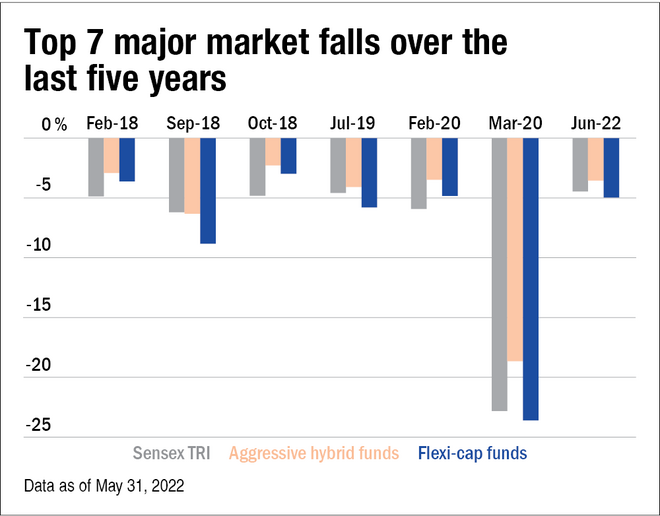
As we can see from the chart, whenever the market crashed, aggressive hybrid funds fell less than pure-equity flexi-cap funds.
Somehow if you feel that 70 per cent in equities would be too much and would like to reduce your exposure, then you can consider going for an equity savings fund. These are hybrid funds with an exposure of about one-third each in equities, arbitrage and fixed-income. While arbitrage is considered equity for taxation purposes, it is quite similar to fixed-income when it comes to the associated returns and risk. These funds are even less risky than aggressive hybrid funds. But remember, since the equity allocation is less, they are likely to generate less returns than an aggressive hybrid fund over the long term.
Also, whenever you are investing in any equity-oriented fund, don't go dumping all the money at once. Try to spread it. The usual thumb rule is to spread it over half the period you took to earn it. If it's your annual bonus, then spread it over six months.
Once you finalise the right category, look for a fund within it. In case of a debt fund, the objective is not higher returns but to look for a high-quality portfolio. Read more on choosing a debt fund. Likewise, while choosing an equity fund, compare the fund's performance across different phases of the market in comparison to its peers. Don't fall victim to attractive short-term returns. Learn how to choose an equity fund.
This article was originally published on July 06, 2022.
Ask Value Research 

 New episodes every Friday





 New Process Alert
  Seems like you've uploaded a wrong QR code. Please upload the QR code downloaded from MF Central platform.


