


Engineers India
Engineers India provides EPC (engineering, procurement and construction) and engineering-consultancy services primarily to the hydrocarbons and petrochemicals industry. Broadly, the company derives its revenues from turnkey projects and consultancy and engineering projects. Under turnkey projects, the company provides 'total solutions', ranging from design and engineering to procurement and construction.
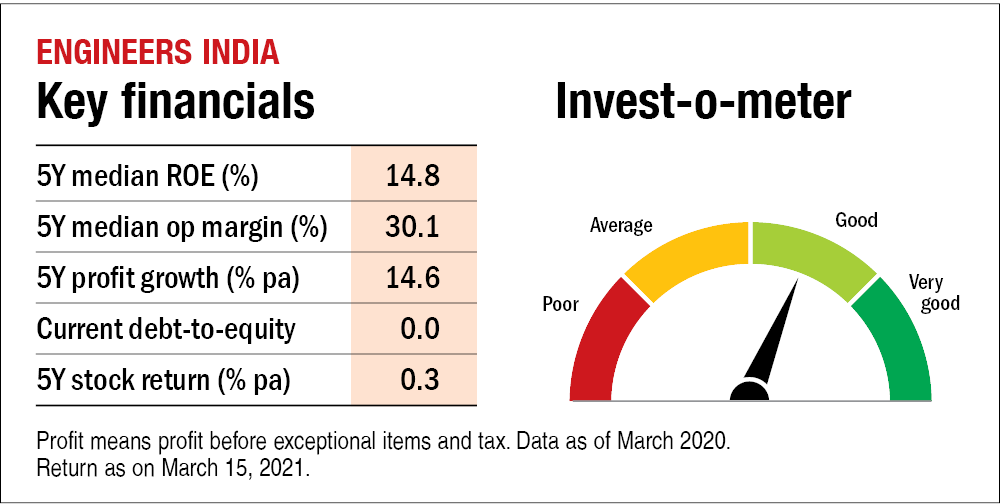
EIL's order book stood at Rs 8,978 crore as on September 30, 2020 with order inflows of Rs 594 crore in Q2FY21 primarily from customers like GAIL, Odisha Mining, Bangladesh Petroleum, etc. The company has a strong balance sheet, with zero debt. It is also enjoying superior growth in its revenues.
Despite having a robust order book, the total order backlog declined by 17 per cent year-on-year, which was the lowest in the past four years. While this may be attributed to superior execution, a depleting order book remains an area of concern in the near term. Also, the turnkey projects, which form the majority of its order book, have lower margins as compared to the consultancy segment, thus putting downward pressure on the overall margins.
Recently, the company came out with buyback of its shares to the tune of Rs 587 crore. The central government raised Rs 310 crore by tendering its shares and now holds 51.3 per cent in the company.
HMT
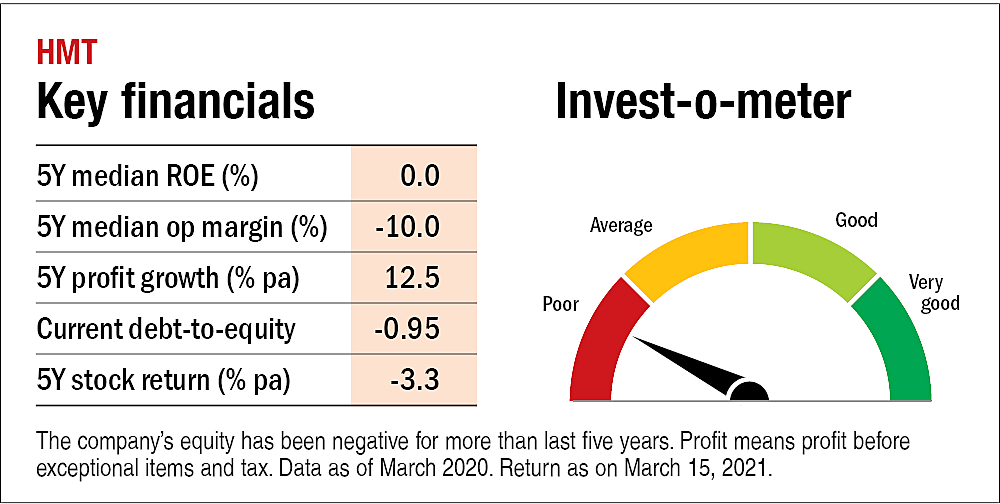
Once known as an iconic watch brand, HMT today is a company in crisis. Following a government's order in 2016, the company has closed the operations of its watch, bearing and tractor business. Land parcels belonging to these businesses have either been sold out or put into a separate division. The erstwhile engineering company is now left with its food-processing machinery business (10 per cent of the FY20 revenue), providing products such as centrifugal pumps, cream separators, Homogeniser and others; machine-tools business (65 per cent of the FY20 revenue); and exports of machinery (25 per cent).
With its association with other government entities such as DRDO, Indian Railways and ISRO, the company is planning to revive its operations under the government's 'Make in India' campaign. The company is also undertaking plant modernisation and pursuing technology upgradation through in-house R&D and technology tie-ups.
However, as history tells us, government-owned companies rarely turn around. With the presence of domestic and global players, the engineering sector in India today is highly competitive. Unlike earlier times, government companies are rarely able to attract the best talent. To upgrade its facilities and improve its R&D capabilities, HMT needs to invest significantly. But it continues to be a loss-making entity. More importantly, although the company's market cap stands at around Rs 4,000 crore, its free float is less than 1 per cent. It means that price discovery isn't there. The government would try to revive the company to some extent in order to make it saleable. Nevertheless, its long-term prospects look pretty dim.
ITDC
Incorporated in 1966, India Tourism Development Corporation (ITDC) was established for the development, promotion, and expansion of tourism in India. The company's operations span across various business verticals, with its hotels (69 per cent) and event (11 per cent) divisions being major contributors to the revenue in FY20. The company owned the prestigious Ashok Group of Hotels and Hotel Samrat in the heart of Delhi. Apart from this, the company is also a pioneer in the duty-free business in India and has its shops at 13 seaports. ITDC also has its tours and travel, consultancy and entertainment divisions. Besides, it runs the Ashok Institute of Hospitality & Tourism Management, which provides training for tourism and hospitality.
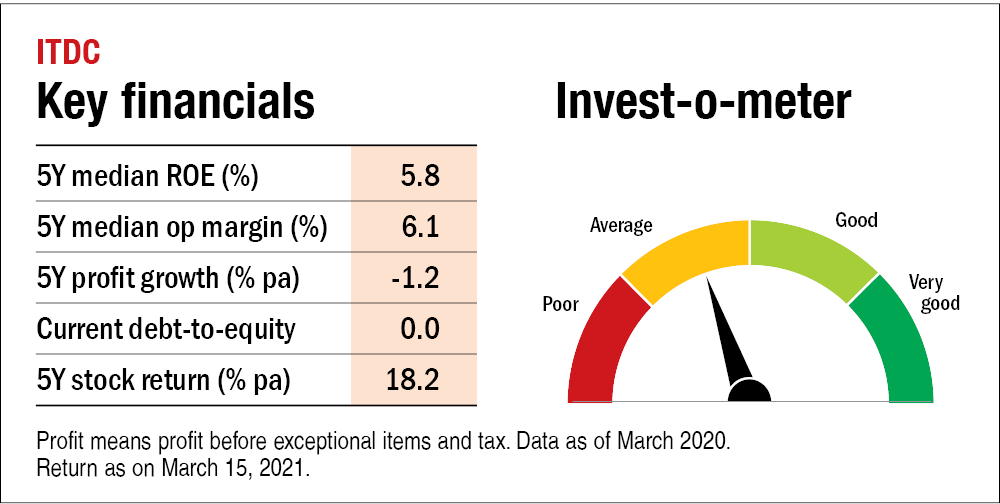
The disinvestment process of ITDC has already been initiated, with nine hotel properties and three joint-venture hotel properties having already been sold. In line with its view that running and managing hotels is not a government's job, the government has decided to lease/sub-lease the hotels of the company and its subsidiaries to the state governments after receiving a fair value of these hotels. So, the disinvestment of other hotels and subsidiaries of the company is on the government's radar.
The company's hotel properties have started ageing and are facing tough competition from international hotel chains and other luxury hotels. In addition, the operational costs of running a hotel are pretty high, which squeezes the company's overall margins. With ITDC generating the majority of its revenue from the hotel division, the disinvestment drive seems to cast a shadow over the company's future.
MOIL
Incorporated in 1962, MOIL (Manganese Ore India Ltd) is involved in the exploration, exploitation and marketing of manganese ore and products, such as electrolytic manganese dioxide and high-carbon ferromanganese alloy. It is the largest producer of manganese ore in India, with a market share of more than 45 per cent and a total production of 1.3 million metric tonnes (MMT) in FY20. Manganese is one of the key raw materials in the production of steel and thus, its demand is directly correlated with that of steel, which makes its business cyclical.
Currently, India is the second-largest producer of steel in the world after China. With the steel industry recovering from the pandemic-led demand disruption, the company is well placed to capitalise on the demand recovery. In order to meet domestic requirements in the future, the company has planned to increase its production to 2.5 MMT by 2025 and 3 MMT by 2030 on the back of a planned capital expenditure of more than Rs 2,500 crore.
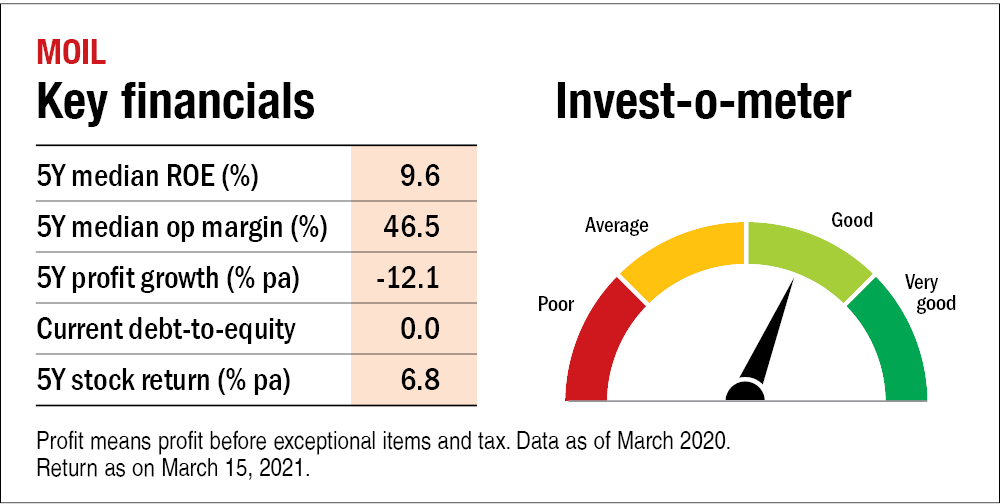
In FY20, the company's revenue was drastically hit, when its sales plummeted by more than 28 per cent, owing to a fall in global manganese ore prices, which fell by approximately 25 per cent. It can be an area of concern in the future as well. Cheap manganese imports can challenge the company's margins. Environmental regulations and high costs involved in mining could be possible hindrances to its expansion plans.
However, the company's strong balance sheet, with no debt and cash and cash equivalents of more than 50 per cent of its market capitalisation, is a big positive.
Ask Value Research 
 New episodes every Friday










 New Process Alert
 Seems like you've uploaded a wrong QR code. Please upload the QR code downloaded from MF Central platform.


