




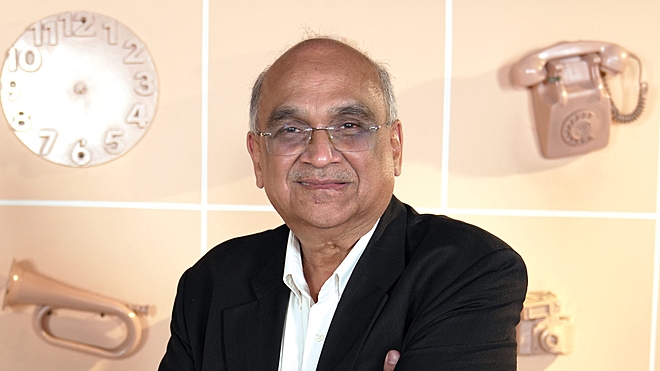
 Photo: Manish Yadav
Summary: Bharat Shah, interviewed again 24 years after the first issue of Mutual Fund Insight, explains why he buys only quality businesses, treats a valuation as an opinion rather than a fact, and sees returns as a growth annuity, a quality annuity and a one-time margin of safety.
Summary: Bharat Shah, interviewed again 24 years after the first issue of Mutual Fund Insight, explains why he buys only quality businesses, treats a valuation as an opinion rather than a fact, and sees returns as a growth annuity, a quality annuity and a one-time margin of safety. When I was putting together the inaugural issue of Mutual Fund Insight in October 2002, my first interview was with Bharat Shah. It was a long one. Twenty-four years later, I sat down with him again for our ‘Money Masters’ series. Shah is the Founder and CIO at Bharat Shah Capital Ideas Private Limited. A rank-holding chartered accountant and cost accountant, he topped his finance class at IIM Calcutta and managed institutional money at Birla in the early 1990s. Shah is now preparing a new venture. The credentials are not the point. What sets Shah apart is how he thinks, and how clearly he can explain it. He buys quality. He waits. He is candid about his mistakes. Here, he sets out the filters he uses, the arithmetic of where returns come from and the lesson that taught him to sell. None of it depends on what the market does next month. That is why it was worth asking him again. You were studying investing long before you had money to invest. Where did it begin? In college. I came from a modest family. We didn’t have money to buy shares, and investing was seen as a luxury. But something inside me kept pulling me towards it. Investment books came from the US and cost too much. So, I went to the raddiwala and bought annual reports by the kilo. That was my first foundation course. I was digging into companies long before I had a framework. For me, the biggest reward of investing is the joy of playing the game well. The learning is worth more than any financial reward. If you play well, wealth will follow, well beyond your needs. But that is an outcome, not the purpose. Your accounting training must have helped. Isn’t investing mostly about numbers? Only a small part. Investing is the art and science of managing risk intelligently and prudently. It is not risk-free. You are not playing a game with a fixed outcome. You are playing a game of probability. People think investing is about precision. It is anything but. It is about judging the future, assigning probabilities, discounting it back to today, and weighing risk against reward. You need some mathematics to turn that judgement into a number. But the mathematics is the smaller part. At its heart, investing means paying X today in the hope of getting X plus Y plus Z later. It is a game of postponed gratification. That creates stress, because you are pushing something you could have had now into an uncertain future. Human beings spend 95 per cent of their time on the past or the present. Investing is the other way round. The past and the present are only a backdrop. The real work happens in the future. Yet, the market treats forecasts as if they were exact. Excel lets analysts estimate quarterly earnings to the third decimal. Someone forecasts 1.65 per cent growth for a software company. If it comes in at 2.1 per cent, there is euphoria. If it comes in at 1.2 per cent, there is gloom. How much more inane can this be? Businesses aren’t designed for that kind of precision, and investing doesn’t call for it. The danger is that once you derive a mathematical ‘truth’, you start believing it. You start believing your own guess about the future. And you lose the most important capability i

 New episodes every Friday












 New Process Alert
 Seems like you've uploaded a wrong QR code. Please upload the QR code downloaded from MF Central platform.


