


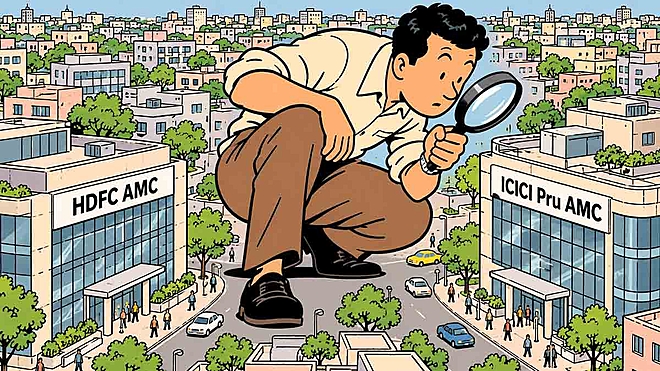
 Anand Kumar/AI-Generated Image
Summary:Two fund houses serve almost the same number of investors and keep nearly the same profit on every Rs 100 they manage. Yet one runs a wide shelf and the other a few big funds, and the market pays more for one of them. Whether that premium is earned is less obvious than it looks.
For two decades, if you asked an Indian investor to name a fund house, the answer was HDFC. Its funds were the ones distributors recommended and relatives argued about at weddings. It was also the country's most profitable fund house.
Then, quietly, the crown moved. ICICI Prudential AMC overtook HDFC in profit, and when it listed in December 2025 its market value passed HDFC AMC's within days. The obvious explanation is that ICICI got bigger. That misses the better story. The two serve almost the same number of investors, grew operating profit at the same pace and keep almost the same profit on every Rs 100 of assets.
The two at a glance
|
Measure
|
HDFC AMC | ICICI Pru AMC |
| Average fund assets | 9.69 lakh crore | 11.61 lakh crore |
| Share of industry assets | 11.10% | 13.30% |
| Fund assets growth (YOY) | 10% | 14.40% |
| Operating profit per Rs 100 of assets, a year | 36 paise | 37 paise |
| Own investments | 8,746 crore | 5,190 crore |
| P/E | 38 | 41.6 |
| Return on equity (ROE) | 33% | 86% |
What each earns, segment by segment
A fund house earns a fee on its assets, and the fee depends on the type of fund. Equity funds pay the most, debt and liquid funds much less, passive funds least. So mix matters as much as size.
Here the two differ in an interesting way. ICICI earns a higher yield on equity and debt: 67 paise a year per Rs 100 on equity against 61 at HDFC, and 32 on debt against 28 to 29. But HDFC's money sits in the richer segments. Active equity and hybrid funds are 63 per cent of its assets against 57 per cent at ICICI, and bring about 79 per cent of its revenue against about 66 per cent.
| Type of fund, Q2 FY27 | HDFC share of assets | HDFC yield | ICICI share of assets | ICICI yield |
|---|---|---|---|---|
| Equity | 67% | 58 (61 active) | 57% | 67 |
| Debt | 17% | 28 to 29 | 16% | 32 |
| Liquid | 9% | 13 | 7% | 12 |
| Passive | not given | not given | 17% | 12 |
| Whole company, after commissions on alternatives | 48 | 48.8 | ||
| Yields are paise a year per Rs 100 of assets. | ||||
The two effects cancel out. A higher price per segment at ICICI and a richer mix at HDFC leave the whole-company yield almost level, 48.8 paise against 48, and operating profit at 37 and 36. Measure only the assets that pay, active equity, hybrid and debt, ICICI keeps about 51 paise against 42 at HDFC (June 2026 quarter), because its passive book dilutes the headline.
Why ICICI AMC is ahead, and why the lead shrinks
HDFC's model is a few big funds with strong reputations: When those flagships stumbled in 2019 to 2022 its share slid, but the turnaround left 67 per cent of its assets in equity against 57.5 per cent for the industry, and equity pays best. ICICI took the other road: under S Naren it became the asset-allocation house, holding about 26 per cent of equity-oriented hybrids. Then it kept launching, early in PMS, AIFs, ICICI Venture’s private equity funds, specialised investment funds, GIFT City and Dubai.
That wide shelf shows up in revenue first. In the September quarter ICICI earned Rs 1,674 crore against HDFC’s Rs 1,170 crore, 43 per cent more, and about 29 per cent more on mutual funds alone (size, and 67 paise a year per Rs 100 on equity against 61). The rest comes from PMS, AIFs and advisory, which HDFC barely has.
Then the shelf sends its bill. Distributors take about half of what ICICI earns on PMS and AIFs, Rs 133 crore in the quarter, so its costs run nearly double HDFC’s and its operating profit lead shrinks to 30 per cent. The lead on reported profit shrinks further, to 19 per cent, because HDFC’s own investments add more: Rs 504 crore over 12 months against Rs 217 crore. In the end HDFC loses on price, ICICI loses on mix and costs, and both keep 36 to 37 paise per Rs 100 of assets. So the market’s preference for ICICI is a bet on the shelf, not on today’s profit.
Where the P/E gap sits
Fund houses manage other people’s money, yet they invest almost all of their own. HDFC AMC has about Rs 8,700 crore in investments and ICICI Prudential AMC about Rs 5,200 crore, close to their entire equity.
How they invest it differs. HDFC keeps about two-thirds in liquid and debt funds, a steadier pile. ICICI keeps about half in equity-linked assets (equity and hybrid funds, AIFs and REITs), which swing with the market.
The results show: in the last eight quarters HDFC’s income from its own investments never turned negative, while ICICI’s lost money twice, including Rs 90 crore in March 2026. Yet HDFC’s pile is bigger relative to its profit, 13 per cent of pre-tax profit over the last year against 5 per cent at ICICI, which flatters its earnings and makes its P/E look lower: 38.0 against 41.6. Strip out that other income and both trade at about 43.6 times core profit, so ICICI’s premium disappears.
The lesson
Two fund houses can earn the same profit today and be built for very different tomorrows. HDFC's model rewards patience and a few great funds, until those funds grow too big to pay well. ICICI rewards breadth and speed, until everyone else builds the same shelf.
When you look at an asset manager, don't stop at how much money it manages. Ask what it earns on each rupee, where its next rupee is coming from, and whether that source is getting more crowded or less.
Also read: PTC India vs IEX: Same power market, different businesses
Ask Value Research 

 New episodes every Friday












 New Process Alert
 Seems like you've uploaded a wrong QR code. Please upload the QR code downloaded from MF Central platform.


