




 Anand Kumar/AI-Generated Image

Summary: No one in India sells more thermal imaging to the military, and its sights let soldiers see in the dark. Yet it is listing just after its weakest year, and not a rupee of the IPO reaches the company. So what exactly are investors paying for, and what has to go right next?
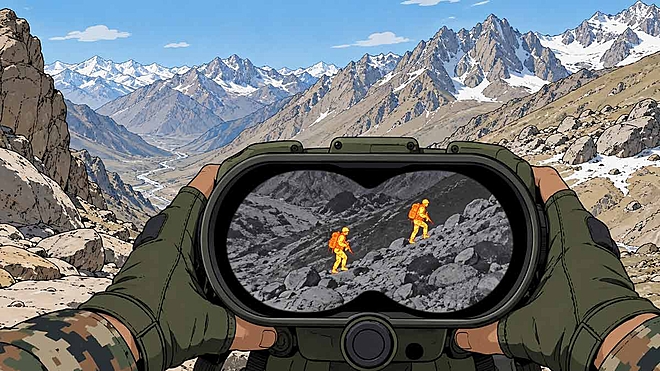
Picture a soldier on a dark border ridge. She cannot see the slope 200 metres ahead, but the sight on her rifle can. That sight is the kind of thing Tonbo Imaging makes. In plain terms, the company lets soldiers and machines see in the dark and at long range, and turns that picture into something a weapon or a commander can act on.
It is a good business to be in. It is also a business having a difficult year. In the year to March 2026, Tonbo’s revenue fell nearly 23 per cent, its profit dropped 30 per cent, and the cash it generated from running the business was negative.
The Tonbo Imaging IPO opens on October 15, 2026, and closes on October 19, 2026 and is sized at up to about Rs 852 crore. It is entirely an offer for sale. Not a single rupee reaches the company. Every rupee goes to the shareholders who are selling.
The three founders are trimming, not leaving. Most of the shares on sale come from the company’s investors. One of its investors, CEAQ Technologies, is leaving the company altogether. The reasons for the offer are that early investors get an exit, the founders cash in a little, and the company gains visibility.
What Tonbo actually does
Tonbo designs and owns the technology for electro-optical and infrared systems. These fall into two main families. Tactical systems are the soldier-worn devices, chiefly thermal and night sights. Platform systems are the heavier assemblies built into vehicles, aircraft and drones, such as gimballed camera turrets, targeting systems and missile seekers. Between FY24 and FY26 it was the largest supplier, by sales value, of thermal imaging to the Indian government and defence agencies.
Financial summary
| Particulars (Rs crore) | FY24 | FY25 | FY26 |
|---|---|---|---|
| Revenue from operations | 428 | 469 | 363 |
| EBITDA | 112 | 139 | 105 |
| Profit after tax | 69 | 73 | 51 |
| Operating cash flow | 78 | -136 | -63 |
Key ratios
| Ratio | FY24 | FY25 | FY26 |
|---|---|---|---|
| EBITDA margin (%) | 26.2 | 29.7 | 28.9 |
| Return on capital employed (%) | 67.8 | 27.4 | 14.5 |
| Debt-to-equity ratio | 0.4x | 0.2x | 0.2x |
KPIs
| Operating Measures | FY24 | FY25 | FY26 |
|---|---|---|---|
| Confirmed order book (Rs crore) | 563 | 219 | 279 |
| Working capital days | 152 | 280 | 517 |
| Exports as % of revenue | 48.6 | 65.5 | 5.6 |
| Bid-to-win ratio (%) | 40.9 | 35.9 | 31.3 |
| R&D spend as % of total expenses | 1.3 | 2.4 | 8.6 |
Management blames FY26’s revenue fall on a big export order slipping into FY27 after the West Asia conflict disrupted logistics. Material costs fell in step with sales, so margins held near 29 per cent.
Tonbo’s operations drained Rs 63 crore, while reporting a profit after tax of Rs 51 crore. The deferred export order is parked as unsold inventory, and the company stocked up further ahead of expected FY27 orders and to guard against supply shortages. Receivables also rose as customers took longer to pay. So the profit never became cash; it is tied up in warehouses and unpaid bills.
One number cuts the other way: R&D spending rose even as revenue fell. The company is investing through the downturn, not cutting corners.
The strengths worth paying for
- It owns its technology. Tonbo owns the intellectual property for its designs rather than licensing it from a foreign partner, so the value stays with the company. Manufacturing is outsourced to certified partners, which keeps capital needs low and lets Tonbo put its money into design and research.
- Unrestricted access and a price edge. Its products are non-ITAR, meaning they carry no United States export controls, so Tonbo can sell to countries that cannot easily buy American equipment. And by its own account, it builds to the quality standard of developed markets but prices for developing ones, which is its core competitive pitch.
- It competes on capability. Tonbo’s business is specialised, high-value defence systems used for surveillance, sighting and thermal imaging. In defence tenders it wins on technical ability, trial performance, quality, track record and price, not on manufacturing volume alone. That lets a smaller company hold its own against far larger rivals, because the contest is about what the product can do.
The risks you should know
- The business is lumpy by design. Revenue comes from individual tenders with little repeat work, so it swings year to year. In FY25 a single customer was 57 per cent of revenue, and the top five were 86 per cent. In FY26 the largest customer fell to 14 per cent.
- Critical components come from difficult places. Tonbo’s infrared optics depend on materials such as germanium and rare earths, sourced from a supply chain concentrated in a few countries, including China and Russia and subject to export curbs and price swings. The company is researching germanium-free lenses, but success is not assured.
- Demand rises and falls with conflict and budgets. Orders spike when geopolitics flares and governments buy in a hurry, then fade when tensions ease. Defence budgets can also be cut or delayed. That makes revenue episodic and hard to forecast, as FY26 showed.
Our verdict
The market behind Tonbo is growing. The global market for electro-optical and infrared systems is forecast to roughly double by 2030, because passive infrared sensors give off no signal and hence are far harder to jam than radar.
At the upper band price of Rs 700, the IPO values Tonbo at about Rs 4,010 crore, or nearly 79 times its FY26 profit after tax. That is a steep price for a company coming off its worst year, and it leaves little room for disappointment. The technology and the market position are real, but investors are being asked to pay full price before the recovery has shown up in the numbers.
So the whole debate reduces to one test. If the deferred orders are delivered in FY27, if the inventory converts into shipments, and if the receivables turn into cash, then FY26 was an air-pocket and the business is as strong as its margins suggest.
Also read: Rentomojo IPO: Real profits, rich price
Ask Value Research 

 New episodes every Friday











 New Process Alert
  Seems like you've uploaded a wrong QR code. Please upload the QR code downloaded from MF Central platform.


