




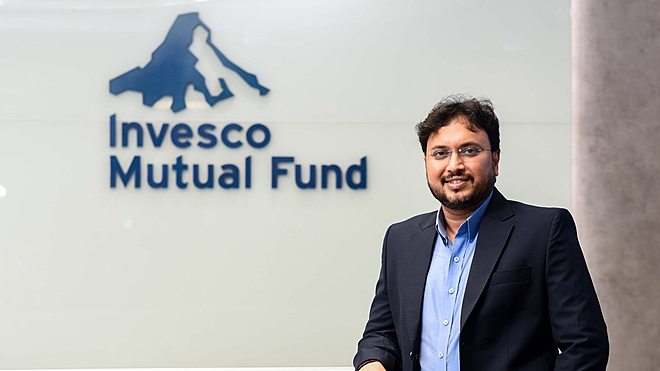
 Photo/Manoej Paateel
Summary: Which parts of the market still offer room to grow, and where has optimism already gone too far? Invesco Mutual Fund’s Aditya Khemani shares how he is thinking about manufacturing, power, AI and the investment opportunities that could shape the years ahead.
The Indian equity market today is a mixed bag. Some pockets look overheated, others hold genuine long-term promise. According to Invesco Mutual Fund’s Aditya Khemani, sectors like semiconductors and renewable module-making appear richly valued, while manufacturing, power equipment and select industrials still offer room to grow. He believes the next five years will be shaped less by hype and more by execution, particularly around how companies apply AI to their businesses rather than merely talk about it.
Khemani is currently Head of Equity at Invesco Mutual Fund, where he manages five equity schemes, including the Invesco India Small Cap Fund, rated five stars by Value Research. He has previously worked at ICICI Prudential AMC, HSBC Mutual Fund and Motilal Oswal AMC, and holds an MBA from IIM Lucknow.
In this interview, Khemani also discusses his blended investing style, his views on the Capital Goods and Industrials space and where he sees the biggest opportunities (or threats) from AI.
Having experienced both value-style at ICICI Prudential and growth-style at Motilal Oswal, how would you describe your investment philosophy?
This is a very pertinent question, because different fund managers evolve into different investing styles — an investor's style is a function of how he's managed money in the past.
You're correct that I started with ICICI Prudential, but those were very early days. In the first three, four, five years, you don't really have a style. You're trying to grapple with what the different areas of the market are and what an investor looks like, so there's no bias at that point.
After that, I was with HSBC Mutual Fund for 12 years, and during that time it was a more value-oriented fund house; we used a price-to-book, ROE framework when we looked at companies. So that's probably where I got a flavour of what value investing is. After that, I was at Motilal Oswal for four and a half years, a fund house known for growth investing. There, from Raamdeo-ji and others, I learned growth investing in much more detail.
So today, having seen both value and growth styles, I think each has its own merits and demerits, and different styles do well at different points in time. But what I've realised is that tilting towards one style might not be the right approach for a mutual fund investor, because such an investor needs much more consistent returns, and different time frames favour different styles. For instance, in 2014–2020, growth as a style did much better, but over the last five to six years, value has done better than growth.
From that point of view, I've evolved into a blend style of investing, where some part of my portfolio is growth-oriented, and some part is value, or GARP (growth at a reasonable price). So it's a much more balanced approach. Today, as an investor, I try to maintain both styles across my portfolios: broadly 50-60 per cent growth and 40-50 per cent value/GARP. Because of that, irrespective of which style is doing well in a given market condition, I think this approach does well across most time frames. So that's the approach; I've evolved into a blend style of investing.
How do you view the Capital Goods and Industrial space today, and which businesses within that do you think will do well over the next five to six years?
As we discussed, Capital Goods is a very heterogeneous space, and what did well over the last 10-15 years might not do well over the next 10-15 years, because the pillars of Capital Goods in India are changing. Fifteen years ago it was road construction, railway spending and thermal power plants. Now the areas are quite different: electronic manufacturing, for one. We've shown intent there since around 2019-2020, with the first leg being assembly work coming to India; the next leg will be building out the component ecosystem, much like the auto industry developed over the years. It's still a long way to go; countries like China and Taiwan took 15-25 years to build that ecosystem, so it won't be a linear journey, but we're positive on that area.
Semiconductors are another globally topical area, but I'm not sure the current valuation reflects that appropriately. I think valuations there are somewhat excessive right now, so we've been selective. Chemicals is another part of manufacturing we include, because we think Europe-plus-one could become a bigger opportunity than China-plus-one; Europe's competitiveness and costs have been under pressure since the Russia-Ukraine war, so chemical companies competing with European players could do well. Aerospace is another area we want to build exposure to, though we don't have much there currently.
Overall, I'm fairly positive on industrials and manufacturing, but when it comes to adding new names right now, it looks like one should wait a bit. Looking out over the next 10 years, manufacturing broadly is an area I feel positive on — India's strength right now is its blue-collar labour pool. If things play out the way one hopes, manufacturing could become a very large opportunity. I don't think of it narrowly as ‘industrial’; I think of manufacturing as a broad basket that could include chemical companies, pharma CDMO companies, EMS companies and so on. Our exposure going forward is likely to skew more towards the non-traditional parts of manufacturing than the traditional parts.
What's your view on power and energy transition as an investment theme, and how do you identify good investment opportunities within it?
Power is a very wide basket, and power demand growth will clearly rise going forward due to AI, electrification and other factors. But there are many different business models within it. Take renewables — the value chain starts with module makers, who are making a lot of money right now. Still, we think it's somewhat supernormal profit, driven partly by government curbs on Chinese imports, in what is otherwise a commoditised business. At some point that supernormal profit is likely to fade, so we think that part of the chain deserves a lower P/E, and we haven't been very positive there.
On the independent power producer (IPP) side, there are issues around curtailment and transmission that make it harder to find a clean opportunity, even though we're broadly positive on the theme. We think the best way to play this is through equipment suppliers; some of the HVDC and other power-equipment names should do well, but valuation is the key thing to watch, because this space is seen as something of a proxy for the global semiconductor boom, given that India doesn't have many chip stocks to play directly. So a lot of money is chasing this theme right now, and we've been quite selective, partly because we think some business models aren't sustainable given the earnings they're generating, and partly because valuations, including on an absolute market-cap basis, look expensive to us.
Within the mid- and small-cap space, where do you see the biggest opportunities and threats from AI?
The first leg of AI-driven growth has been on the infrastructure side, or companies building the infrastructure have rallied globally, India included. But I think we're now moving into the second leg: the application side, where companies apply AI to do something better. That's where, five years out, we'll see the real winners and losers.
For instance, we were recently speaking with an e-commerce company about how AI has helped improve their ad algorithms and reduce people's intensity in the business, with a resulting impact on costs. We've also spoken with a fintech broker about similar cost efficiencies from AI. I think it's on the application side that companies will differentiate. Right now, everyone speaks the same language about AI, which makes it hard to tell winners from losers, but that will become clearer over the next five years.
Do you have a framework today for identifying which companies are applying AI well and which aren't?
Not really a formal framework. We ask basic questions: How many people are on your AI team? Where did you hire them from? What have they learned, and how is that translating into better monetisation? We look at it both at the revenue level and the cost level, though honestly we're more interested in the revenue side, such as how AI can grow revenue, than in cost savings.
If you ask me directly whether I can say with confidence which company will be a big winner, it's very difficult. But there are some markers of intent. We're engaging with one company whose CEO spends a month each year in Silicon Valley, meeting people at Meta and elsewhere, seeing what's happening on the ground. That tells you the intent is there. Whether that translates into success, time will tell, but right now, what we're trying to gauge is intent, and whether management genuinely sees AI as an enabler. You get some sense of that through engagement with management, but whether it ultimately translates into success is very hard to say at this stage.
Also read: Up 8% when small caps were bleeding. How?
Ask Value Research 

 New episodes every Friday








 New Process Alert
  Seems like you've uploaded a wrong QR code. Please upload the QR code downloaded from MF Central platform.


